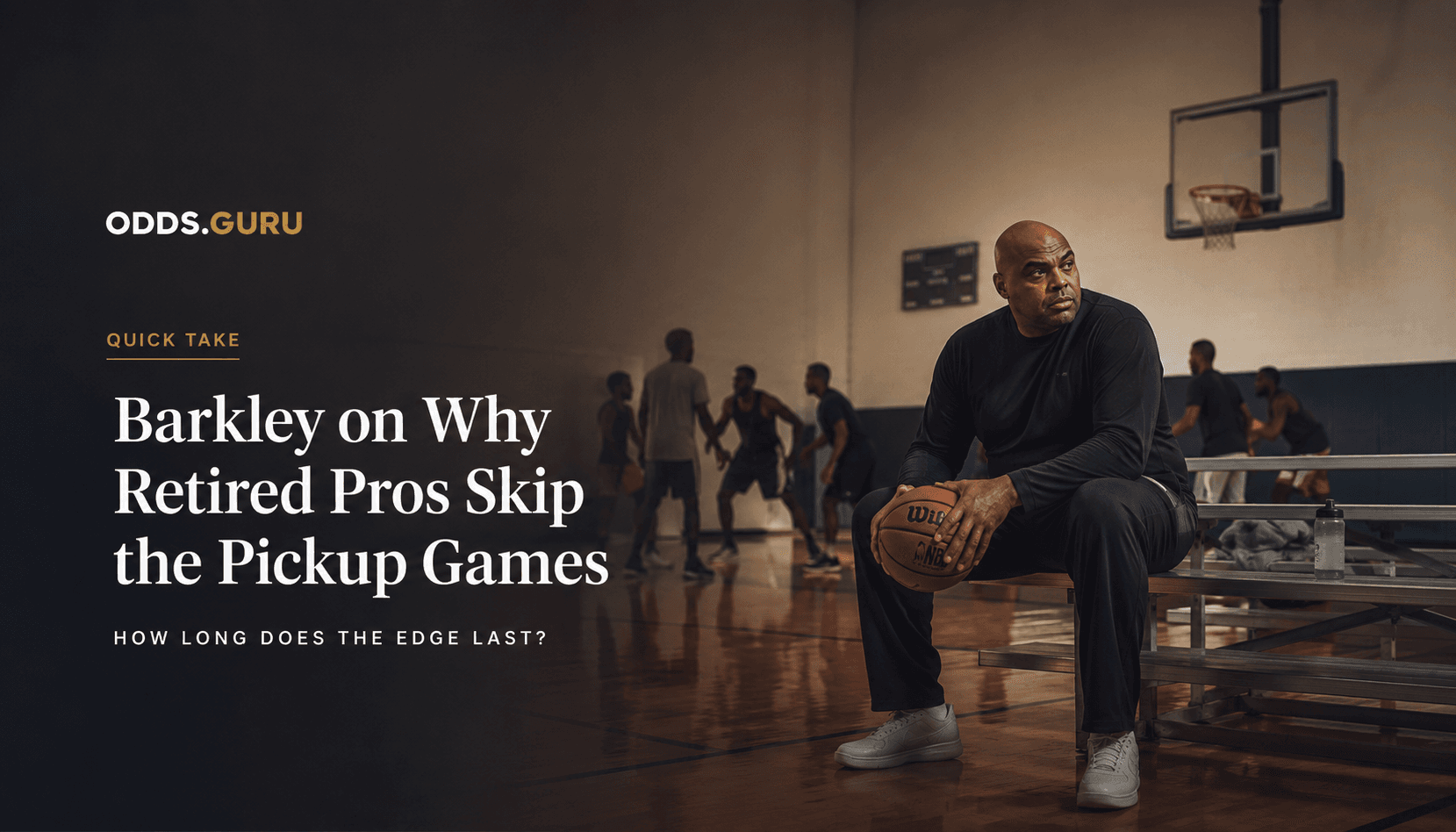
Charles Barkley has addressed why retired pros don't play pickup with the general public at local gyms, in a short clip that spread across basketball communities this week. The Hall of Famer, now 63 and twenty-six years removed from his final NBA game, was speaking to a question that follows every retired great around: if you were once among the best in the world, why not show up to the Tuesday-night run?
The clip itself is brief. The reasoning behind it, and the debate it reignited, are not.
A 63-year-old MVP, 26 years off the floor
The distance between Barkley and the local gym is worth measuring precisely. He retired in 2000 after 16 NBA seasons across the Philadelphia 76ers, Phoenix Suns and Houston Rockets, finishing as only the fourth player in league history to compile 20,000 points, 10,000 rebounds and 4,000 assists.
The full ledger: 23,757 points (22.1 per game), 12,546 rebounds (11.7), 4,215 assists, eleven All-Star selections, eleven All-NBA teams, the 1993 MVP award, and two Olympic gold medals with the 1992 and 1996 US teams. He was inducted into the Naismith Memorial Basketball Hall of Fame twice — in 2006 for his career and in 2010 as a member of the Dream Team.
Since then, Barkley has built a second career as an analyst on Inside the NBA, one that has earned him four Emmys and arguably a bigger cultural footprint than his playing days. Which is precisely why the pickup question keeps coming: he is visible, he is opinionated, and he has never pretended the competitor in him went quiet.
That last point is the tell. Viewers sharing the clip largely converged on a reading that for players wired like Barkley, basketball at the highest level was about proving something against the best available opposition — and once that stops being on the table, a run against accountants and college kids offers nothing the wiring recognises.
The lose-lose run: why retired pros don't play pickup
Set aside sentiment and the incentive structure explains most of it. For a retired pro walking into a public gym, there is no outcome that pays.
Dominate the run, and you have beaten hobbyists — a result that confirms nothing and reads as bullying. Lose a game, even one, and the story writes itself and travels for years. The amateur across from you carries zero downside and a lifetime anecdote as the upside. The pro carries the inverse. Community discussion around the clip reached for the same comparison repeatedly: elite performers in any discipline, from quiz champions to pool professionals, tend to avoid open amateur competition for exactly this reason.
There is a second mechanism, and it is less flattering to the rest of us. Pickup basketball with the general public involves the general public — including the subset that treats a Tuesday run as an outlet for everything else in their week. Several people responding to the clip described rec-league environments where disputes over playing time or fouls escalated far past anything the stakes justified. For a famous former pro, every one of those flashpoints comes with a camera phone attached.
And then there is the physical ledger. Retired pros are retired for a reason. The New York Times reported the case of Johnny Davis, a 1970s and 80s NBA guard who noticed in the summer of 1985, at just 29, that the quickness his game depended on was simply gone before his tenth season. Professional basketball extracts its payment up front; what remains afterwards is skill and guile layered over a body that no longer honours the old contracts.
None of which means retired players never touch a ball again. Plenty do — quietly, in closed runs with peers, or in settings where the game is the point rather than the spectacle. The clip's framing was narrower: the open gym, the general public, the run where anyone can walk in. That specific arena is the one former pros rationally avoid.
The 49-year-old at the gym, and the 60-year-old ceiling
The counterweight to Barkley's position is the enduring fan fascination with what a retired pro could do in a rec setting — and that debate has real texture.
A RealGM thread from November 2024 posed the question directly: what is the oldest age at which a retired professional can still dominate recreational play? The opening case study was a 49-year-old former overseas pro who, according to the poster, routinely handled good high school players and D2 and D3 college athletes — not by blowing past anyone, but through footwork, fakes and positioning. The poster's claim: a pro who stays in shape can dominate pickup until at least 60.
The pushback was immediate and specific. A respondent who played college basketball cited Jerald Brown — a McDonald's All-American who played at Texas A&M and professionally in Spain — as a live example. Brown, close to 50, remained very good in their shared runs but no longer dominated every game. The respondent's verdict: 60 is not close to possible, and a good current college player would likely get the better of a 60-year-old former NBA player. Too much physical deterioration, too fast.
The thread never settled it, which is rather the point. The honest answer sits somewhere between the two poles: craft ages far better than athleticism, but craft alone stops being decisive somewhere in the sixth decade. What both sides agreed on, implicitly, is the premise of Barkley's clip — that the interesting question is capability, while the pro's actual decision is about whether the exercise is worth anything at all.
'These guys can't play': the competitor who never fully clocked out
Barkley's own history makes his answer more credible, not less, because he is on record as someone who kept score long after retiring.
In 2002, two years out of the league, he told ESPN that the era's players — Allen Iverson excepted — could not match the generation before them, and went further: "I'm a lot better, right now, if I played in my prime. These guys can't play." Whether delivered with a wink or not, it was not the language of a man at peace with spectating.
A year earlier, he had flirted with something more concrete. When Michael Jordan was preparing his own 2001 comeback, he confirmed Barkley wanted in on the project. "I was 218 pounds, right at my playing weight," Jordan said at the time. "I know I can do this. I don't know about Charles. He wants me to seriously look at him. We'll see." Jordan made it back. Barkley did not, and Jordan later suggested the interest was never as serious as it appeared.
That arc — the itch, the flirtation, the acceptance — is the useful context for this week's clip. A player who genuinely considered an NBA return at 38, and who spent his broadcast career measuring eras against his own, was never going to find the answer at a public gym. The competition he respects retired when he did.
For everyone else, the practical takeaway is smaller and slightly deflating: if a Hall of Famer ever does wander into your local run, the smart money says he is there to watch.
 Reddit