

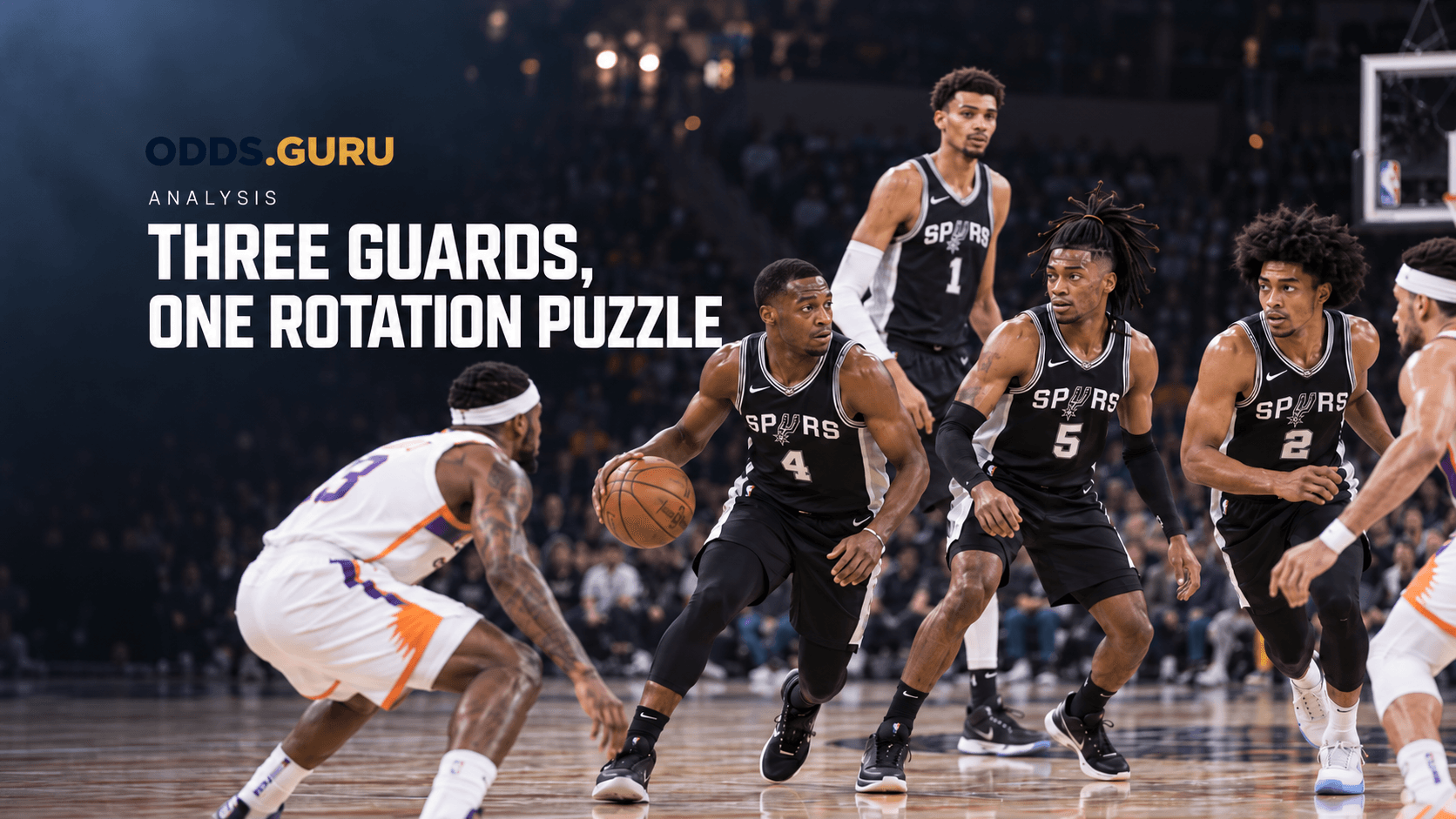
The Spurs guards De’Aaron Fox, Stephon Castle and Dylan Harper started alongside Devin Vassell and Victor Wembanyama against Phoenix in preseason, giving San Antonio a direct test of its crowded backcourt. The Spurs won 123-103, although their starting group was outscored 7-3 over the opening five minutes.
The experiment brought a rotation decision into view: whether San Antonio can accommodate three prominent creators together without compromising the players around them. A reserve role for one guard remains another route, and would not necessarily mean fewer important minutes.
Spurs guards’ shared minutes have produced early warning signs
Fox, Castle and Harper shared the floor for 25 regular-season minutes last season, with a net rating of minus-29.1. Their playoff sample was larger, at 44 minutes, but also negative: minus-24.9.
Net rating measures the scoring margin per 100 possessions while a group is on the floor. These figures therefore describe how those combinations performed, rather than the individual quality of the three guards.
Both samples are small. Neither establishes that the partnership cannot work, and the preseason opening against Phoenix adds only a brief stretch to the discussion. A few missed shots or difficult opposing lineups can have an outsized effect over such limited minutes.
The distinction between the Phoenix result and the starting group’s performance still matters. San Antonio won comfortably across the whole game; that does not establish that its opening combination was responsible. Equally, a four-point deficit after five minutes is not enough to abandon an experiment.
Three creators, fewer possessions to share
The basketball concern is the overlap between their roles. Fox, Castle and Harper all offer more when they can initiate an attack, challenge a defender and make the next decision with the ball.
Playing them together gives San Antonio several ways to begin a possession. If an opponent disrupts the first action, another guard can take over without requiring a substitution. That flexibility is a legitimate reason to continue testing the group.
The cost comes elsewhere. Once one guard starts an attack, the others must contribute through movement, screening or shooting. Their ability to create with possession does not automatically make them equally effective waiting away from it.
That leaves a distinction between having substantial guard talent and having a balanced five-player lineup. San Antonio can benefit from all three across a game without asking them to perform identical roles at the same time.
Wembanyama’s space is the central constraint
The Phoenix starting lineup placed Vassell and Wembanyama beside the three guards, leaving no place for a conventional forward. That arrangement concentrates creation in the backcourt, but also makes the guards’ work away from the ball particularly important.
Vassell supplies a shooting option. The unresolved issue is whether the rest of the perimeter group can consistently discourage defenders from moving towards Wembanyama.
When a defender can leave an outside player without paying a regular penalty, the space around the basket becomes harder to use. Wembanyama may face additional bodies on a catch, while a driving guard can encounter help before reaching the rim.
There is no shooting-percentage comparison here that establishes a fixed limit on the trio. The concern is about how opponents might defend this arrangement, and whether the guards can force them to change.
Movement can help, but it creates different demands
Improved shooting would be one route to a better fit. There are others: a guard can cut behind a defender watching Wembanyama, screen for a teammate or move quickly after passing.
Those actions could make shared minutes more productive without requiring every player to become a stationary perimeter shooter. They would also ask Fox, Castle and Harper to spend meaningful stretches doing work different from leading the attack.
Simply removing Vassell to accommodate a forward would create another trade-off. San Antonio would gain a different positional balance but lose a shooting option from the same group whose spacing is already under examination.
The defensive side also deserves attention. Castle is listed at 6-foot-6, Harper at 6-foot-5 and Fox at 6-foot-3. The trio is not uniform in size, and Castle’s experience defending Shai Gilgeous-Alexander offers a reason to see him as more than another competing ball-handler.
Against Oklahoma City in the Western Conference finals, however, San Antonio also encountered the cost of committing extra attention to one scorer. Gilgeous-Alexander’s passing created opportunities elsewhere, illustrating how quickly help defence can transfer pressure to another matchup.
As coach Mitch Johnson put it during that series: “You want to take this away, and then that hurts you, and then you want to take that away.”
That balancing act applies to the rotation too. Adding another creator helps one part of the team; the lineup must still cover the responsibilities of the player whose place he takes.
A reserve role can still carry major responsibility
San Antonio’s current depth-chart arrangement lists Fox and Castle as the starting guards, with Harper behind both. That offers an existing route to distributing responsibility without making the three-guard lineup the default.
Harper could enter for either starter and take an immediate role in directing the offence. Fox and Castle could then have separate stretches alongside him, allowing Johnson to assess each pairing as well as the full trio.
The distinction is between starting status and playing responsibility. A player who enters from the bench can still handle difficult possessions, receive substantial playing time and finish a close game.
Staggering would give San Antonio several practical options:
- Keep an established creator on the floor while another rests.
- Give Harper possessions in which he leads the attack.
- Reserve shared minutes for opponents and situations that suit the trio.
- Change the closing lineup according to shooting and defensive needs.
There would still be compromises. Fewer minutes together mean fewer opportunities to develop their partnership. A reserve assignment could also become restrictive if the player’s actual role shrinks with it.
That makes the quality of the minutes important. Bringing Harper off the bench would do little to resolve the underlying issue if he then spent most of his time alongside both other guards, with the same limited opportunities to initiate.
The forward options offer additional flexibility. San Antonio signed Tobias Harris in July, re-signed Harrison Barnes and extended Julian Champagnie. Harris is currently listed as out, limiting that particular option for now.
Those players give Johnson alternatives to the Phoenix alignment. Their presence does not settle which combination works best, but it means starting all three guards is a choice rather than a roster necessity.
Fox’s salary and the younger guards’ development complicate change
Fox is 28, Castle 21 and Harper 20. San Antonio is managing an established guard alongside two much younger players whose responsibilities could continue to grow.
The listed salaries underline the different stages of that investment. Fox is at $49.8 million, compared with about $10 million for Castle and $13 million for Harper. Vassell, another important part of the perimeter rotation, is listed at $27 million.
Those amounts do not determine who should start. They do explain why changing Fox’s role would be a substantial decision, rather than a routine adjustment involving interchangeable reserves.
There is also no confirmed basis for assuming Fox would reject a bench assignment, or that Castle or Harper would demand a move. A difficult allocation of minutes is not evidence of a dispute.
A trade could eventually change the balance by exchanging guard creation for a different skill or position. But no confirmed trade plan forms part of this development, and the poor shared-minute results alone do not establish that a departure is necessary.
Trading too early would carry its own cost: San Antonio could surrender a creator before testing whether clearer roles and different pairings solve the problem. Keeping the group indefinitely without sufficient responsibility for each player could also limit what the team gets from its talent.
The next rotation decisions can provide more useful evidence. Fox-Harper and Castle-Harper stretches would show which responsibilities transfer comfortably between players. Longer tests of the full trio would show whether better movement and shooting can improve the space around Wembanyama.
For Harper in particular, the useful distinction will be whether a reserve assignment includes genuine control of possessions. A bench role with responsibility would give San Antonio a different way to use its guard depth; a bench label followed by the same crowded combinations would leave the basketball problem intact.