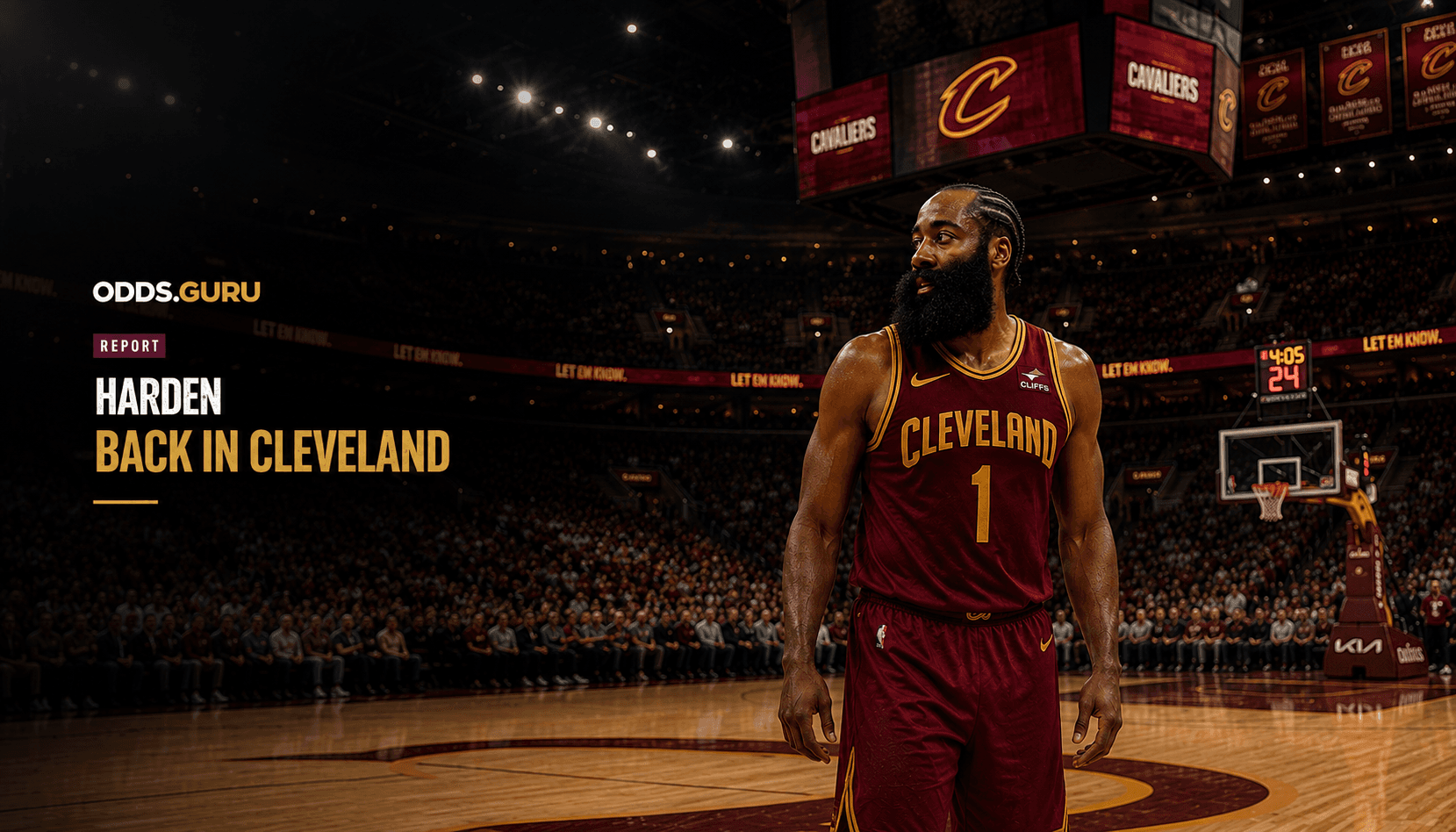
The James Harden contract that Cleveland spent most of the summer working around is finally agreed. Three years, $97 million, a player option in the final season and a trade kicker, agents Mike Silverman, Troy Payne and Brandon Grier of Equity Sports told Charania on Thursday.
Harden turns 37 next Wednesday. He is entering his 18th season. And he has just signed the last long-term contract of a career that will pass half a billion dollars in earnings before it ends.
The James Harden contract, line by line
Start with the number Harden walked away from. In June he declined a $42.3 million player option for 2026-27, betting that a multi-year deal at a lower annual figure would be worth more to him — and more useful to Cleveland — than one guaranteed season at the top of the scale.
That bet took nearly two months to settle. Here is what is confirmed and what is not:
| Term | Detail |
|---|---|
| Total value | $97 million |
| Length | Three years |
| Average annual value | $32.3 million |
| Final season | 2028-29 |
| Final-year control | Player option for Harden |
| Trade kicker | 15% |
| Guarantees | Fully guaranteed, per Michael Scotto of HoopsHype |
| Annual salary breakdown | Not yet publicly confirmed |
Contract terms as reported by ESPN and HoopsHype; annual figures become official on filing.
The trade kicker matters more than it looks. A 15% bonus on remaining salary is money in Harden's pocket if Cleveland moves him, but it also raises his outgoing number in any trade — which, for a team operating against a hard cap, narrows the list of deals that can legally be constructed. It is a protective clause and a friction point at the same time.
The player option is the other lever. Harden controls whether he plays the 2028-29 season on this contract, at what would be his age-39 year. That is unusual company: per Charania, when Harden signs he becomes the second player in league history to put pen to more than $90 million in guaranteed salary at 37 or older. LeBron James is the first.
Cleveland's $209 million ceiling
The Cavaliers are hard-capped at the first apron for the entire 2026-27 league year, a consequence of using a sign-and-trade to acquire Peyton Watson from Denver. The projected first apron sits at $209 million.
A hard cap is not a tax bill. It is a prohibition. For Cleveland that means:
- No salary added by trade that pushes team salary above the apron, at any point in the league year.
- No re-signing or extension that lifts the payroll past the line.
- Room must be kept in reserve for minimum signings, incentives, trade bonuses and injury replacements.
- No paying the difference. The apron cannot be bought through.
The gap is about $2.4 million. Two readings fit: the reported terms for Watson or Harden are slightly rounded up, or Cleveland has one more salary-shedding move to make before the Harden deal can be officially processed. Neither is exotic. Both are the kind of housekeeping that decides whether a reported agreement becomes a filed contract this week or next.
Watson's own deal — four years, $88 million, arriving via a five-team sign-and-trade — was the domino that unblocked all of this. Charania reported that Harden actively recruited him. Cleveland had turned to Watson and Jonathan Kuminga after missing on LeBron James, who signed with the Philadelphia 76ers rather than returning to Ohio for a third stint.
Harden's willingness to wait was the enabling condition. Without a starting salary locked in early, Cleveland's front office kept the flexibility to chase wing help first and settle the guard position afterwards.
From Garland to Harden, in 26 games
Cleveland acquired Harden from the LA Clippers at February's deadline for Darius Garland and a 2026 second-round pick, with Garland hampered through 2025-26 by recurring toe problems. The Cavaliers wanted a veteran initiator alongside Donovan Mitchell. They got a very effective one.
In 26 regular-season games with Cleveland, Harden averaged 20.5 points, 7.7 assists and 4.8 rebounds in 33.8 minutes, shooting .466/.435/.840. Across the full season, including his Clippers games, his line was 23.6 points and 8.0 assists. Career averages: 24.0, 7.3 and 5.6.
The playoffs were a different picture. Harden's scoring held roughly steady at 19.2 points, but his assists fell to 5.5, his field-goal percentage dropped to 41.0%, his three-point shooting to 29.9%, and his turnovers climbed to 4.7 per game. Cleveland reached the Eastern Conference Finals — its first since James left in 2018 — and was swept there by the eventual champion New York Knicks.
That split is the honest case for and against this deal. A 37-year-old lead ball-handler who shot 43.5% from three over half a season is a genuine offensive engine. The same player, asked to carry possessions against elite playoff defence, gave the ball away nearly five times a night.
Cleveland's answer was to keep the core and thin the edges. Mitchell signed a four-year maximum extension in July. Harden returns. Evan Mobley and Jarrett Allen stay. Watson replaces the departed Dean Wade, Max Strus and Dennis Schröder — one better player in place of three rotation bodies, which sharpens the first five and leaves the bench visibly lighter in a conference that added LeBron to Philadelphia.
$511 million, and the bill that arrives in 2028-29
Charania puts Harden's career earnings at $511 million once this contract is signed — the fourth player in league history past $500 million, after James, Kevin Durant and Stephen Curry. Other outlets count the milestone differently, tallying players who will cross the mark during their current deal, which produces a longer list. The method differs; the scale does not.
For Cleveland the relevant figure is not lifetime earnings but payroll share. At roughly $32 million a year against a projected $209 million apron, Harden occupies a manageable slice of the books for a player who was, for stretches of last spring, the team's primary shot creator. The discount he took relative to his $42.3 million option is real, and it bought the front office the room to add Watson.
The risk is entirely at the back end. Cleveland is not paying for 2026-27; it is paying for the option year Harden holds at 39, on a roster where Mitchell, Mobley and Allen are all under contract at significant numbers. If the third season becomes an anchor, it arrives at the same time as everything else.
Which is the trade the Cavaliers appear to have accepted knowingly. A team one round from the Finals, with its core signed and its hard cap already engaged, had the choice of paying market rate for the guard who got it there or replacing him with nothing comparable. The first option costs money in 2028-29. The second cost the window now.
 Reddit