By Pete Ivanov
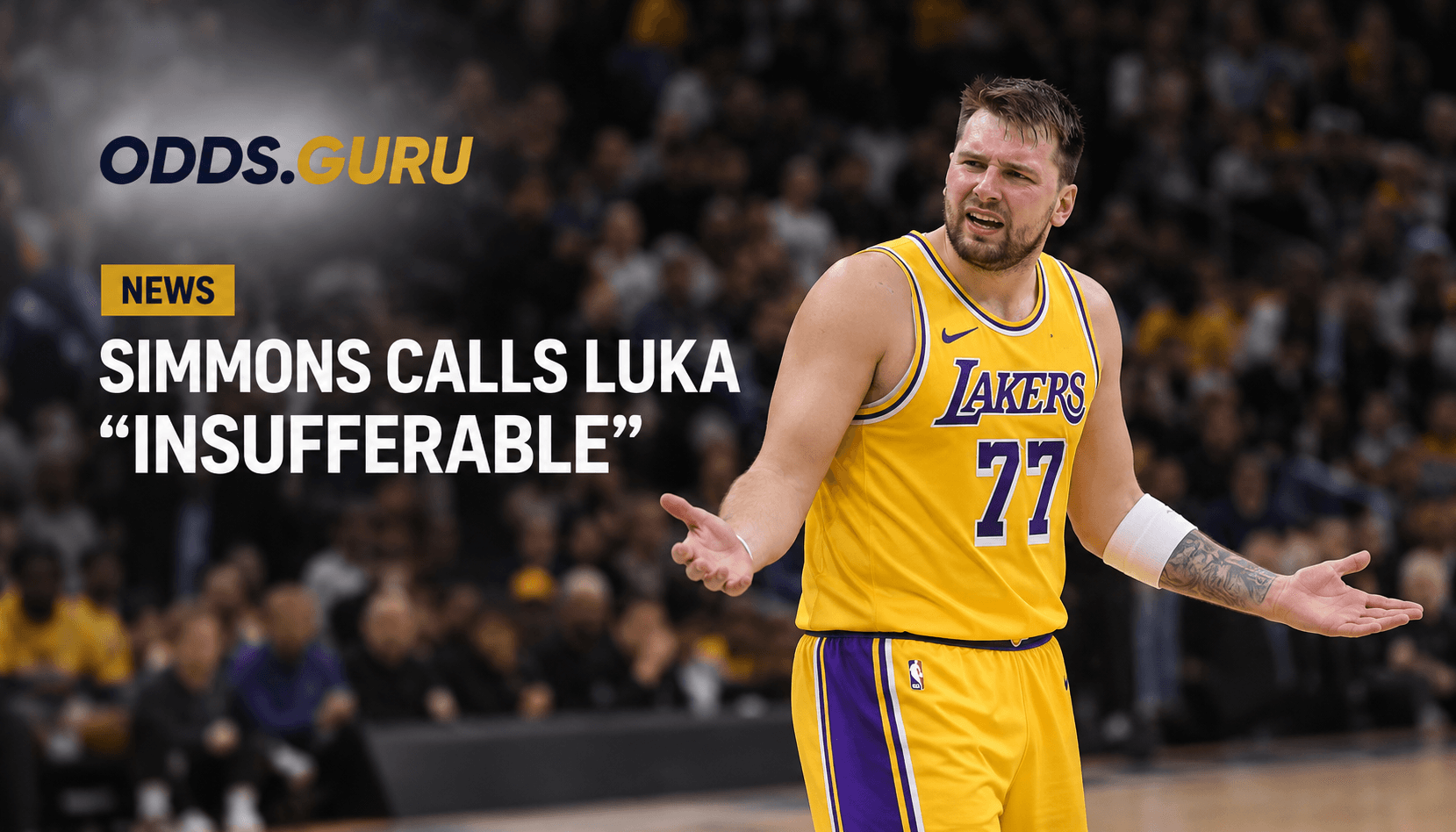
Luka Doncic is averaging 38.3 points per game, but Bill Simmons has taken aim at the Lakers guard’s demeanour and the experience of watching him produce those numbers. In remarks circulated on November 4, Simmons praised Doncic’s offensive ability before calling him “the most insufferable he’s ever been.”
The criticism arrives with Doncic producing substantial scoring nights and the NBA having rescinded a technical foul from his performance against Miami. It places two different assessments alongside each other: how well Doncic is playing, and how Simmons feels about watching him.
Luka Doncic’s 42-point night and a reversed technical
Doncic finished the Lakers’ 138–117 win over Miami with 42 points, 13 assists, seven rebounds and two steals. He made 14 of his 24 field-goal attempts, including six three-pointers, and committed just two turnovers in 36 minutes.
That performance also included a second-quarter technical foul after he appeared to clap towards an official. The NBA subsequently rescinded the call, leaving him with one technical foul for the season.
The reversal matters because referee exchanges are central to the criticism surrounding Doncic. The incident drew a sanction during the game, but that sanction did not survive the league’s review. It cannot be counted as another technical on his season record.
It also provides a concrete example of the tension in Simmons’s comments. Against Miami, Doncic combined efficient scoring with substantial playmaking, while an interaction with an official became a separate talking point.
Simmons’s description was emphatic: “I think Luka’s one of the best offensive players I’ve seen in my life,” he said, before adding that “this is the most insufferable he’s ever been.”
He also said: “I don’t know anyone who enjoys it,” and described Doncic as “unhappy constantly.” His complaint extended beyond the numbers themselves: “I don’t enjoy the process of how he gets those stats.”
Those are judgments about demeanour and entertainment, rather than a rejection of Doncic’s talent. Simmons explicitly acknowledged that talent. Nor does his assessment establish that Doncic is unhappy; it describes how the player’s behaviour looks to him.
The distinction is significant for a report about such a forceful criticism. Simmons can admire the production and dislike the performance around it. But the strength of the language does not turn his viewing preference into a finding about Doncic’s effectiveness or state of mind.
38.3 points, with more coming from three-point range
Doncic’s opening seven appearances provide considerable substance behind Simmons’s praise. He has scored 268 points, collected 56 rebounds and delivered 57 assists, averaging 8.0 rebounds and 8.1 assists alongside his scoring.
He is shooting 49.7% from the field and 42.7% from three-point range. Both figures are higher than his full-season marks from 2025–26, although seven games remain a much smaller sample than the 64 he played last season.
| Measure | 2025–26 season | First seven appearances, 2026–27 |
|---|---|---|
| Points per game | 33.5 | 38.3 |
| Assists per game | 8.3 | 8.1 |
| Field-goal percentage | 47.6% | 49.7% |
| Three-point percentage | 36.6% | 42.7% |
| Free-throw attempts per game | 10.1 | 10.1 |
| Turnovers per game | 4.0 | 5.0 |
The free-throw comparison is particularly relevant to a discussion about the “process” behind his statistics. His attempts remain at 10.1 per game, the same rounded average as last season. The scoring increase has therefore not come with an increase in his average number of trips to the line.
Instead, his three-point production has risen sharply. Doncic has made 41 of 96 attempts, averaging 5.9 made threes compared with 4.0 last season. His free-throw accuracy has also improved, from 78.0% to 88.7%.
That does not settle whether someone enjoys watching him. It does show that the scoring surge has a substantial shooting component, rather than simply reflecting more free-throw attempts.
Three recent scoring performances
His recent games illustrate both the scale of the production and the differences between individual nights:
- Against Utah, Doncic scored 52 points with 10 assists, shooting 17-for-30 from the field in a 132–123 win.
- Against Toronto, he scored 45 points with 15 rebounds and six assists, making eight of 12 three-point attempts in a 131–125 win.
- Against Miami, he followed with 42 points and 13 assists, while reducing his turnovers from seven against Toronto to two.
There are also less flattering numbers. Doncic is averaging 5.0 turnovers, up from 4.0 last season, and committed 11 in the victory over the Clippers. His offensive responsibility produces more than scoring highlights; possession losses belong in the assessment too.
The technical-foul history behind the criticism
Concern about Doncic’s exchanges with officials has a measurable history. He accumulated 16 technical fouls in 2025–26, the second-highest total among NBA players, after receiving 13 in 50 games during the previous season.
That gives the discussion a consequence beyond whether a commentator finds his behaviour irritating. Reaching 16 technical fouls brings a one-game suspension, making the season total an availability issue for the Lakers.
Doncic addressed that concern before the current run of games. “This season, I’m not trying to get techs,” he said on October 21.
His present total of one is consistent with avoiding an early accumulation. It is also too early to establish whether he will finish with a substantially lower number than last season. The rescinded Miami call leaves the record smaller than the initial in-game decision suggested.
Behaviour and disciplinary consequences
Technical-foul totals cannot capture every complaint or gesture. A player can repeatedly express frustration without receiving a technical, so the count alone cannot resolve Simmons’s criticism of the viewing experience.
But the count does matter when moving from irritation to basketball consequences. Describing Doncic as more difficult to watch than ever is a subjective assessment; suggesting that his disciplinary problems have worsened would require a different argument.
The Miami reversal further limits that argument. The league removed the penalty from that particular exchange. It did not issue a broader assessment of Doncic’s demeanour, and the decision should not be stretched into one.
For the Lakers, the practical concern is straightforward: a recurrence of last season’s accumulation could eventually cost them a game without their leading scorer. With only one technical currently standing, that remains a risk to monitor rather than an immediate suspension problem.
Simmons’s criticism stops short of a basketball verdict
The strongest part of Simmons’s criticism is also its limit: he is describing his own response to watching Doncic. His praise for the guard’s offensive ability makes clear that he is not arguing the scoring is ordinary or the talent overstated.
The broader claim that nobody enjoys it is harder to sustain as anything beyond rhetorical emphasis. Enjoyment cannot be read from a box score, and one commentator’s frustration does not establish a shared audience judgment.
Equally, Doncic’s scoring does not automatically answer every criticism of his conduct. A 42-point performance and an irritating exchange with an official can exist in the same game. Offensive excellence does not require viewers to appreciate every part of a player’s presentation.
The more consequential basketball assessment concerns what Doncic produces, what possessions he gives away and whether disciplinary sanctions affect his availability. Through seven appearances, the numbers show improved shooting and heavier scoring alongside an increased turnover average.
Miami supplied a particularly strong combination: 13 assists against two turnovers, with 42 points on 24 shots. Toronto had brought seven turnovers despite another enormous scoring performance. That variation gives the Lakers a concrete performance issue to follow as the season develops, separate from whether Simmons enjoys watching their star.
 Reddit