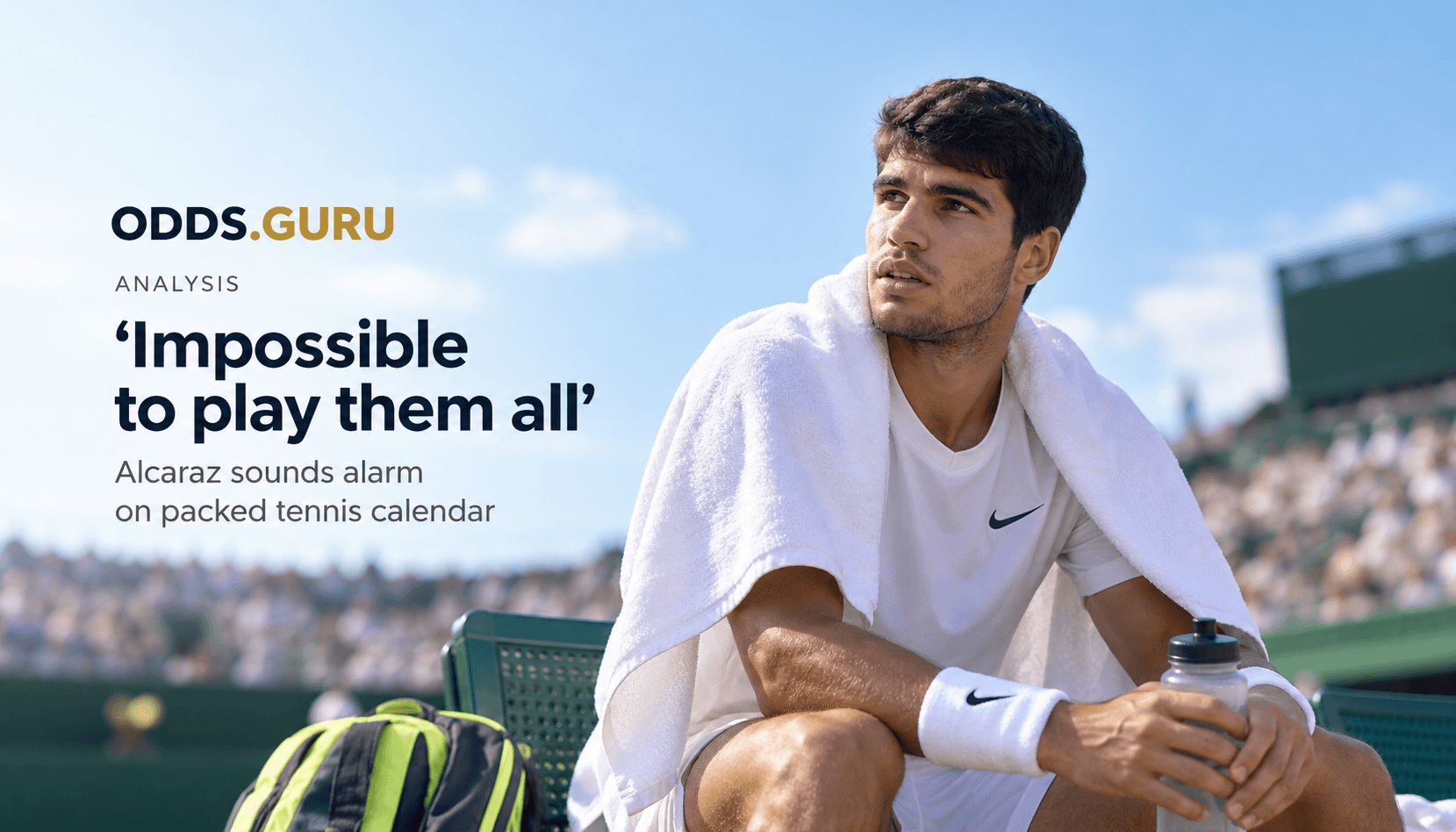
Carlos Alcaraz beat Jaime Faria 4-6, 6-0, 6-3, 6-2 in the US Open second round, a 2 hour 40 minute job against the world No. 72 on Arthur Ashe Stadium. Then he used the press conference to say that the Alcaraz tennis calendar of the next few seasons will contain deliberate gaps — not injury-forced ones, but scheduled absences of a month or two at a time.
Arthur Ashe, 2 hours 40 minutes, and a change of plan
The tennis was ordinary by his standards: a sluggish first set surrendered, then a bagel and two comfortable ones. That is what a four-month layoff looks like in the second round.
The answer that followed was more consequential than the scoreline.
"Obviously I don't want to have this break because [of] an injury," Alcaraz said. "But in the future I'm going to take some breaks, some long breaks. Maybe not four months, but one month, two months, missing some tournaments, because it's impossible to play them all."
He then pointed at the structure rather than his own body. "I think they adding more important tournaments... you know, in a way they are making us play. You can say no," he said. "So it's impossible, and we are seeing a lot of players getting injured, a lot of players getting tired. If they don't do anything about it, we are going to see even more in the future."
The framing matters. This is not a player saying he needs a holiday. It is the reigning US Open champion and a seven-time Grand Slam winner saying the mandatory-event architecture is the thing that has to give, and that if it does not, he will unilaterally take the rest anyway.
The Alcaraz tennis calendar, from Barcelona to Flushing Meadows
The 2026 version of that calendar effectively stopped on 15 April, when a right wrist problem forced his withdrawal from the Barcelona Open. Medical assessments pushed the recovery timeline out well past the initial expectation, and the absences stacked up:
- Madrid and Rome — both missed, removing him from the two biggest clay tune-ups.
- Roland Garros — no title defence, ending a bid for a third consecutive crown in Paris.
- Queen's — skipped, at an event he had won in two of the previous three years, leaving the entry list thin on marquee names.
- Wimbledon — skipped, at a tournament he had won in 2023 and 2024 and reached the final of last year.
The ranking cost was heavy. By the time Jannik Sinner had added the Italian Open, the gap between them had stretched to nearly 3,000 points, with Alcaraz stuck at world No. 2 and unable to defend anything. Sinner has since had his own problem — a knee injury that ruled him out of this US Open.
The thinking predates the wrist. In a Vanity Fair interview in May, Alcaraz talked about burnout, constant travel and the absence of any real separation between his professional and personal life, and said he did not want to end up "a slave to tennis." He tied his physical setbacks directly to stretches without adequate rest. Recovery, in that telling, is a structural requirement, not a tactical luxury.
PTPA data: arm injuries up 112%, re-injuries up 55%
The Professional Tennis Players Association has been building the numerical case. Working with medical director Dr. Robby Sikka, the PTPA analysed more than 30,000 professional matches across all levels over the past eight years. The first-quarter 2026 comparison against the same period in 2025 is stark.
| Injury measure (Q1 2026 vs Q1 2025) | Change |
|---|---|
| Upper body injuries | +42% |
| Arm injuries | +112% |
| Match-ending injuries | +53% |
| Re-injuries | +55% |
"The data is clear: the season is too long, recovery time is decreasing, and injuries are occurring earlier and becoming more severe," the organisation said.
Its primary culprit is the same one Alcaraz named: the expansion of Masters 1000 events from seven days to twelve. Seven of the nine now run close to a fortnight. That format was once confined to the Sunshine swing; Madrid, Rome and Shanghai were added, then Canada and Cincinnati in 2025. The PTPA has asked the ATP to revert to the one-week model.
The mechanism is less about matches played than about time occupied. A player can reach the second week of a 12-day Masters having played six matches, but he has still spent twelve days in tournament mode — travel, practice courts, media, no home base — and back-to-back editions turn that into four continuous weeks on tour. The recovery window that used to sit between events has been engineered out.
Alcaraz is also, structurally, the worst-placed player to absorb it. Deep runs are his baseline, so he accumulates matches at a rate a first-round loser never touches. He was absent from the Canadian Open entry list this year alongside a long list of other leading names, and Jack Draper and Arthur Fils are among those who have missed large chunks of 2026.
Mouratoglou's dissent: slower courts, different balls
Not everyone accepts the calendar as the cause. Patrick Mouratoglou, reacting to the PTPA figures on Instagram, called the numbers "crazy" but rejected the diagnosis.
"You know the reason, the calendar? I don't think so. I have a completely different explanation," he said. His argument: since the early 2000s the governing bodies have slowed and homogenised surfaces, which has pushed almost everyone into full-power baseline tennis at very high intensity. "Look at the injuries that are listed. It's only upper body injuries. We're not talking about the movement."
He also flagged equipment inconsistency — a different ball from one tournament to the next, some lighter than others — as a second contributor.
It is a serious objection, and the injury profile does lean his way; a purely workload-driven crisis would be expected to show up more in legs and backs. But the two explanations are not rivals so much as multipliers. Harder-hitting tennis raises the load per match; a compressed schedule removes the recovery that would let the body absorb it. The PTPA's re-injury figure, up 55%, is the one that reads most like insufficient healing time rather than technique.
What is missing from either account is a governing body with an incentive to shrink anything. The commercial logic of the 12-day Masters runs the other way, and the mandatory-event rules mean the cost of saying no falls on the player, in ranking points and in fees.
Alcaraz has now said publicly what his answer to that arithmetic will be. Tournament directors selling tickets on his name will be reading the entry lists more nervously from here.
 Reddit