

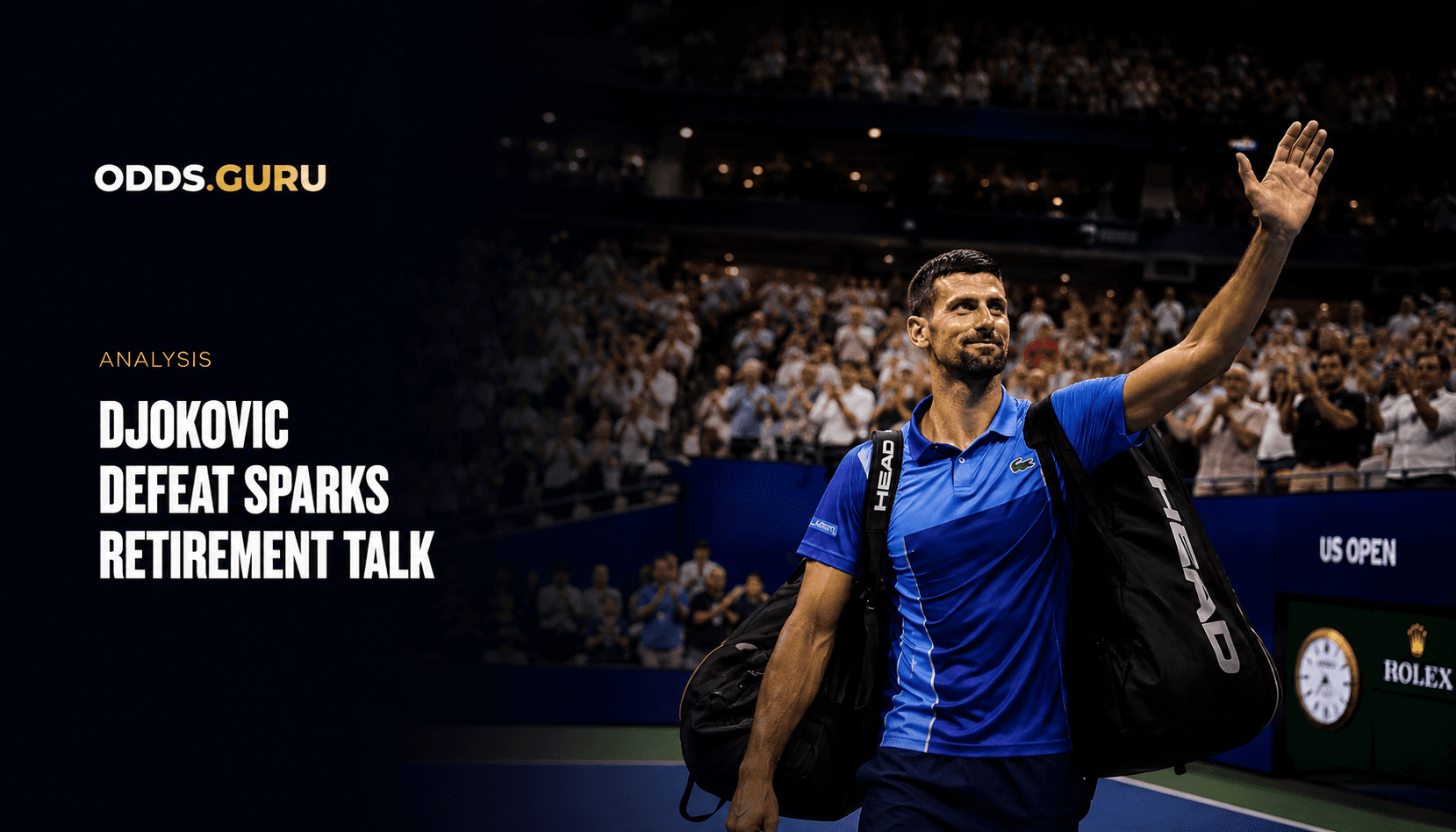
Djokovic lost 7-6(5), 5-7, 4-6, 6-2, 6-1 to Argentina's Mariano Navone, a player ranked outside the world's top 40, in a match that ran past 4½ hours and pushed the last contest of the tournament's opening day beyond midnight. The tennis was the smaller story. What travelled furthest was the exit: the wave, the heart sign to a full stadium, the autographs signed by a man who could barely move in the closing games — and the Djokovic retirement speculation that followed within minutes of him leaving the court.
Four hours, 36 minutes, and a heart sign at the exit
The physical detail is what made the ovation land the way it did. Djokovic vomited repeatedly during the match, used an inhaler at a changeover in the fourth set, took pills supplied by his team, received a doctor's visit and took a medical timeout before the deciding set for treatment on his lower back and hip.
He cramped in his left foot. He went down hard chasing a wide forehand. Midway through the fifth set, standing behind the baseline waiting to receive, he began to cry, and the tears ran for a minute or two before he composed himself and played the match out.
Jelena Djokovic and the couple's children, Stefan and Tara, watched from the box.
He was asked afterwards whether he had thought about stopping. "I have, I have," he said. "But then I won a set, and then the third one, and then I was like, 'OK, you know, maybe there is a chance,' and yeah, I didn't want to give up in fourth or fifth, so I wanted to finish the match."
That is the context for the goodbye. A player who had just described the afternoon in blunt terms — "I pretty much despised every moment that I spent on the court" — still stopped to thank the crowd and sign for people on his way out. The gesture was small. Coming from someone who had spent the previous half-hour trying not to fall over, it read as something larger.
The tone of the crowd changed before the result did
Ashe has not always sounded like that for Djokovic. For the better part of a decade the building leaned towards whoever stood on the other side of the net, and he made a running theme of using that hostility as fuel.
Sunday was the opposite. The noise was warm from early on, and it grew as the match turned against him.
That shift is doing a lot of the emotional work in the reaction we are seeing. Among fans, the dominant note is not disappointment at a first-round loss to a player ranked 40-odd places below him — it is relief that the appreciation arrived while he can still hear it. A recurring thread in the response is the comparison with other great careers that ended in a colder atmosphere, with the crowd never quite reconciling with the player before the end.
There is a second, quieter thread: discomfort. Watching a 24-time major champion be sick on court, take an inhaler, and lose 6-2, 6-1 over the last two sets is not a comfortable spectacle even for people who spent fifteen years hoping he would lose. Several self-described former critics have said as much.
And a third: caution. Plenty of fans are pushing back on reading a farewell into a wave, pointing out that a player who has been "retired" by the public for years has a habit of turning up again the following season.
Navone, for his part, treated it as the biggest day of his career. "Novak is the GOAT in this sport. Beating him at the US Open, Arthur Ashe, is one of the first moment I have in tennis," he said. "It's a dream come true."
Djokovic retirement speculation, against his own timeline
The awkward part for anyone reading the ovation as a goodbye is that Djokovic has already answered the question, recently and directly.
In Novak Djokovic: The Wolf in Winter, the 92-minute documentary released worldwide on 20 August, he put it plainly: "I truly feel still young. I don't know when I'm going to finish my career. It might be another year, it might be another 15 years, I don't know."
He went further. "I have no date in my mind, to be honest, the expiry date of my career," he said, before adding: "I know a lot of people are speculating that, a lot of people are retiring me already for many years. Why would you want to retire me when I'm still playing and I'm still competing at the highest level? I'm still top five, top 10 in the world."
The ranking supports him. At 39, Djokovic is world No. 5 and the oldest player inside the top 100 — the only man older than him in the top 200 is 41-year-old Stan Wawrinka, who retires at the end of this season.
What has changed since he filmed those lines is the tone of his own assessment. Asked in New York whether the physical issue could be fixed, he said: "I don't know, man. I'm trying. I'm trying. Let's see." He also said he was trying to work out "how far I can go this way."
That is not a retirement announcement. It is a much narrower and more serious statement: the problem is unresolved, and he does not yet know its ceiling.
A 2026 season that reads like two different players
The results make the case for both sides of the argument, which is why the reaction has split the way it has.
| 2026 major | Result | Context |
|---|---|---|
| Australian Open | Runner-up | Beat Sinner in a five-set semi-final; oldest AO finalist since Rosewall |
| French Open | Third round | Lost to Joao Fonseca in five sets |
| Wimbledon | Semi-final | Lost in straight sets to Sinner |
| US Open | First round | Lost to Navone in five sets, 4hr 36min |
Season record: 14-7, no titles, a 12-4 mark at the majors. His last Grand Slam title came in 2023; his last title of any kind was a 250-level event in Athens in November 2025.
He has also kept adding to the ledger. This year he passed 400 career Grand Slam match wins, moved beyond Federer's Wimbledon match-win record, and became the first man in the Open Era to win more than 80 opening-round matches at the majors.
The physical thread runs through all of it. Djokovic withdrew from his scheduled season opener in Adelaide because he was "not physically ready to compete." He lost his first match in Cincinnati this month to Thiago Agustin Tirante, having thrown up and needed treatment there too. Then New York, where he described the same pattern: "vomiting, throwing up, a serious issue there. Then my whole body starts to collapse, basically cramping and pain."
He has scheduled his year around the majors — six events since January, three of them Grand Slams — precisely to protect his body for the biggest weeks. On Sunday that protection lasted four games.
The ovation, the heart sign and the autographs are the images the sport will keep from the night. The sentence that matters more is the one about not knowing whether any of this is fixable.
 Reddit