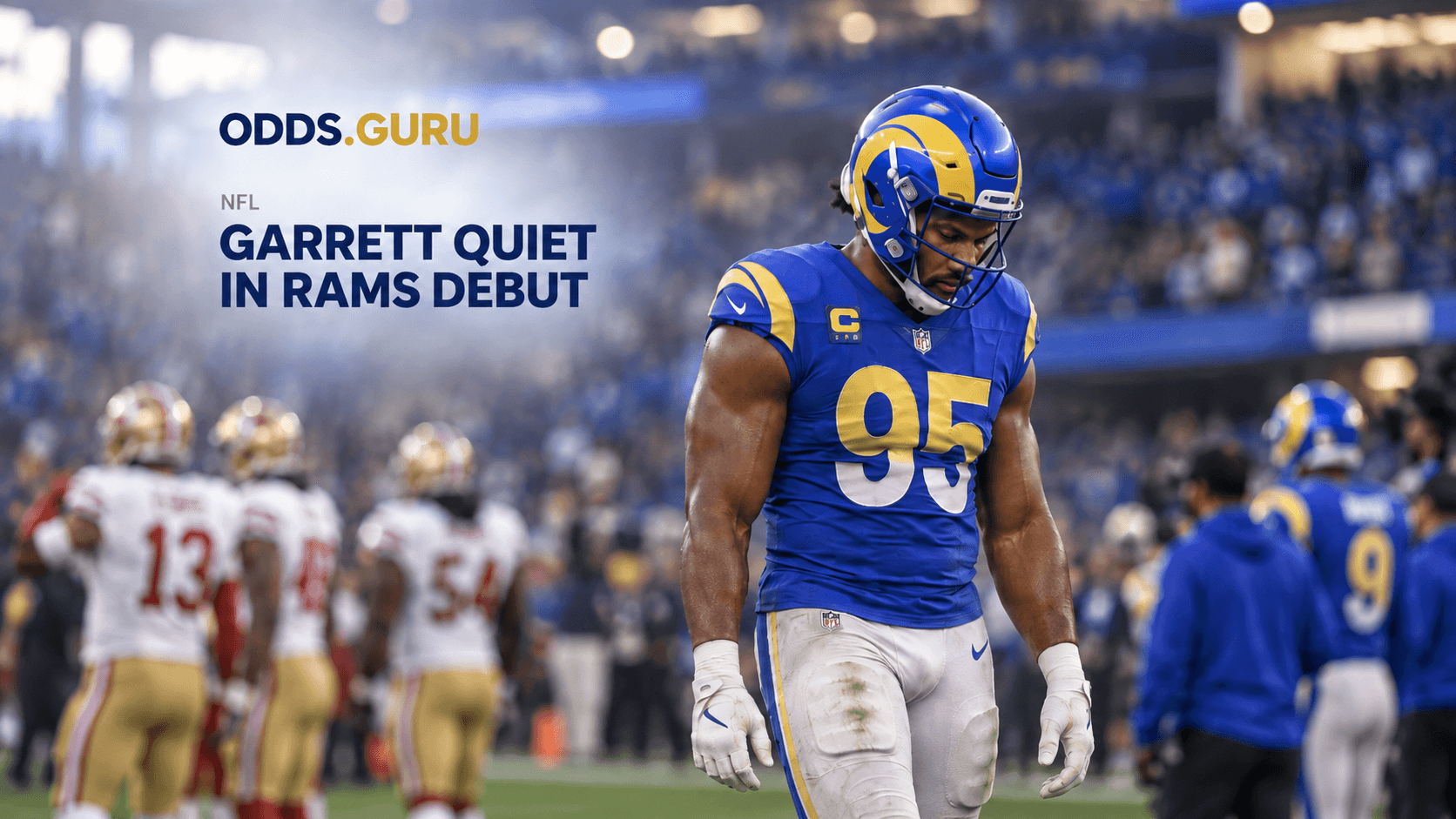
Myles Garrett Rams debut, reduced to one hurry
Pro Football Focus charted Garrett with exactly one pressure across the whole game. Not a sack. Not a hit. A hurry.
Everything else was empty. The full line from the season opener in Australia:
- 0 tackles
- 0 sacks
- 0 quarterback hits
- 0 batted passes
- 0 forced fumbles
This was the fourth game of Garrett's career in which he was blanked for tackles, quarterback hits and sacks. The previous three were all defeats, and all by at least 17 points. The most recent came in Week 11 of the 2024 season, when Cleveland lost 35-14 to New Orleans. Thursday's 20-point margin fits the pattern neatly — when Garrett vanishes from a box score, his team is usually losing in ways that run far wider than one edge position.
The contrast is what makes it a story. Nine months ago he set the NFL single-season sack record with 23 in Jim Schwartz's Cleveland defence and collected his second Defensive Player of the Year award in three years. He arrived in Los Angeles as the most decorated defender to change teams in the offseason. Then he produced a stat line that looks like a typo.
San Francisco's answer: quick game, and a chip on every snap
Some of this was done to him rather than by him.
The 49ers ran away from Garrett's side consistently, which is the cheapest way to remove a dominant edge from a game. In the passing game they leaned on quick throws from Brock Purdy, and the ball coming out fast is the single most effective counter to a rusher whose value is measured in time-to-pressure. San Francisco also chipped him repeatedly, using a tight end or running back to bump him before releasing into a route.
None of that is unusual. Garrett has been the focus of protection plans since roughly 2018, and he still posted 23 sacks last year while being game-planned the same way.
The difference is that a well-schemed rusher normally still shows up in the pressure numbers even when the sack column stays at zero. One charted hurry across four quarters says he was not consistently beating single blockers either. That is the detail worth holding onto: the design explains the absence of counting stats, but it does not fully explain the absence of disruption.
There is also a rotation element. Garrett was in and out of the game all night rather than playing the long, uninterrupted stretches that let a rusher build a pattern against a tackle — and that took him off the field at moments when the Rams badly needed a change in the tempo of the game.
The knee that never made the injury report
Garrett carried no injury designation into Week 1. That is the part that ages worst.
He barely practised in training camp and sat out both of the Rams' joint practices with what the club described as a knee problem. Garrett himself has been looser with the label, calling it "lower-leg stuff" and acknowledging it is still causing him pain.
During a fourth-quarter sideline report, Netflix's Tom Pelissero described what the broadcast was seeing: Garrett subbing in and out, and looking visibly spent every time he came off. Conditioning, not just soreness. A player who misses a camp does not simply pick up where he left off, however good he was in January.
Garrett's own postgame assessment was blunt. He said it was "the worst version" of himself he had put on the field, and that he has "got to be better."
Two readings are available, and both are defensible.
The generous one: a 30-year-old with a lingering lower-leg issue, no meaningful camp reps, a new defensive system and an opponent built to avoid him. Under those conditions, one hurry is disappointing but not diagnostic.
The uncomfortable one: the Rams declined to list him as limited, played him through it, and got 60 minutes of evidence that he is not currently able to rush the passer at the level they paid for. Whether the club changes its designation before the next fixture is now a live question rather than a procedural one.
Jared Verse, three picks, and the bill that comes due
The trade is the reason a single bad Thursday registers at all.
| Rams received | Browns received |
|---|---|
| Myles Garrett | Jared Verse |
| 2027 first-round pick | |
| 2028 second-round pick | |
| 2029 third-round pick |
Los Angeles did not just buy a pass rusher. They sold a young edge defender they had drafted and developed, plus three years of future draft capital, for a player entering his thirties. That structure only works if Garrett is close to his 2025 self in 2026 and 2027 — the Rams have removed the cushion that would let them absorb a slow year.
The historical baseline is worth stating plainly. Garrett has 125.5 career sacks, with 83 of them since 2021, an average of 16.6 per season across that span. Before last year, his career high was 16, reached in both 2021 and 2022. The 23-sack season was an outlier even by his standards, and no player since sacks became an official statistic in 1982 has recorded 20 or more in consecutive seasons.
The franchise marker he was signed to chase belongs to Aaron Donald, who had 20.5 in 2018. Robert Quinn's 19.0 from 2013 sits second. Both were always going to be difficult targets; they are considerably harder starting from zero.
That is the accounting reality of Thursday. One quiet game does not break a season for a defender of Garrett's calibre — he has had three others like it and won two Defensive Player of the Year awards around them. But it removes the margin for a slow start, and it puts the Rams in the position of explaining a health situation they chose not to document.
Eleven days separate the opener from the next assignment. The useful evidence will not be the sack total in that game. It will be whether Garrett appears on the injury report in the week leading up to it, how many snaps the coaching staff lets him take, and whether he can stay on the field for consecutive series without the broadcast cameras finding him bent over on the sideline.