

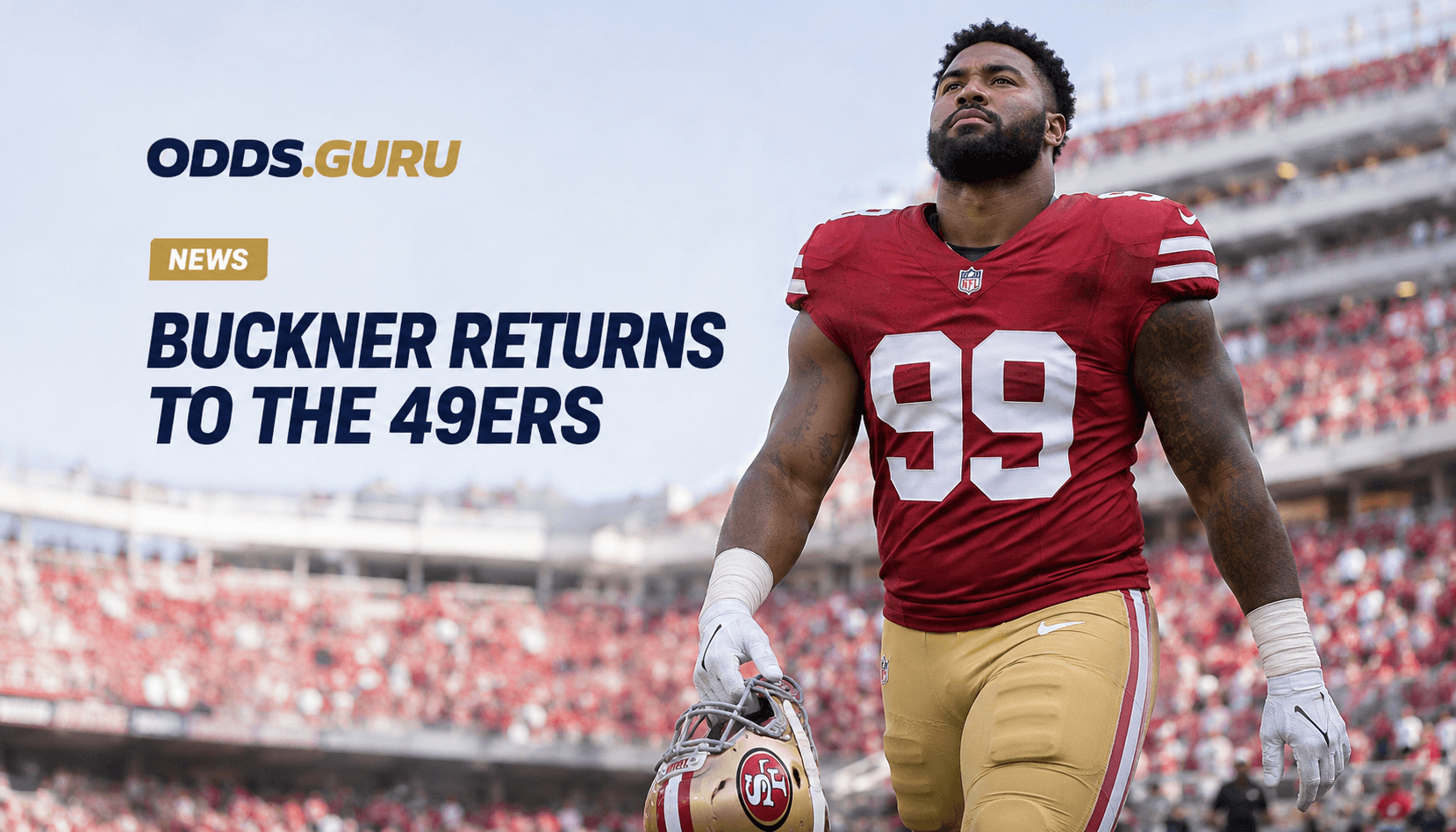
DeForest Buckner asked the Indianapolis Colts to send him back to San Francisco, then dropped to his knees when the call confirmed it was happening. Speaking to reporters on Monday, Nov. 2, the defensive tackle described his reaction to the Oct. 27 trade that returned him to the 49ers for a fourth-round draft pick.
“I just fell to my knees and I started praying,” Buckner said. “It’s just crazy the way everything happened. God, he’ll open doors you thought were closed.”
The reunion follows six years of separation from the franchise that drafted him. It also follows a direct request from a player whose loyalty to Indianapolis had become increasingly difficult to reconcile with another losing season.
DeForest Buckner asked Indianapolis for a specific destination
The Colts were 2-5 after an Oct. 25 loss to Minnesota, Buckner’s final game with Indianapolis. Two days later, they traded him to the team he had told owner Carlie Irsay-Gordon and interim general manager Ed Dodds he wanted to join.
That sequence gives his emotional response a practical context. Buckner had reached the point of asking to leave, and San Francisco was his preferred destination. Indianapolis accommodated both parts of that request.
The Colts “wanted to make sure that I went to a place where I wanted to be,” Buckner said.
“They held their end of the bargain,” he added.
His frustration had become public after the Minnesota defeat. Asked about the Colts’ start, Buckner responded: “I don’t know. How about you guess. I’m frustrated. Same thing. We lost.”
For a player generally measured away from the field, it was a blunt expression of accumulated disappointment. Indianapolis never won a playoff game during his tenure and has a 40-52 record since 2021. The poor start to 2026 extended a pattern he had already spent years trying to change.
Still, his account of the departure included gratitude towards the people who arranged it. He had wanted a different competitive situation, but he also recognised the Colts’ willingness to help him reach it.
The fourth-round return is the confirmed compensation for the trade. It does not, by itself, explain Indianapolis’ full assessment of the deal. Buckner’s comments establish that his wishes mattered to the process; they do not establish that those wishes were the only consideration.
For San Francisco, the transaction brings back a former defensive captain with substantial experience inside the organisation. For Buckner, it resolves a request that carried both professional ambition and a personal attachment.
A first-round exit, a fourth-round return
San Francisco originally selected Buckner seventh overall in 2016. His first four seasons covered a sharp change in the team’s fortunes: a 2-14 rookie year, followed eventually by an NFC championship and a Super Bowl appearance in his final season before the trade.
He saw himself as part of the reason for that progress. After leaving in 2020, Buckner said he had poured his “heart and soul” into the franchise.
“You just don’t expect to be traded,” he said then.
The original separation was particularly painful because Buckner had compromised on his contract-extension demands in an effort to stay. San Francisco instead signed defensive tackle Arik Armstead and safety Jimmie Ward to extensions, while sending Buckner to Indianapolis.
The two transactions sit at very different points in his career:
- 2016: San Francisco drafted Buckner seventh overall out of Oregon.
- 2020: Indianapolis acquired him for the 13th overall draft pick and signed him to a four-year, $84 million contract.
- 2026: Indianapolis sent him back to San Francisco for a fourth-round pick, following his request to return.
Treating those prices as a direct measure of the two teams’ judgement would overlook that six-year gap. The Colts paid for Buckner at an earlier stage of his career and backed the acquisition with a major contract. That commitment helps explain why he felt loyal to Indianapolis even while maintaining relationships in San Francisco.
His individual career continued to advance with the Colts. He earned first-team All-Pro honours in 2020 and made the Pro Bowl in 2021 and 2023, following a Pro Bowl selection in 2018 and second-team All-Pro recognition in 2019 with the 49ers.
The disappointment in Indianapolis was therefore more specific than a career that had stalled. Buckner continued to earn individual recognition. The team success he wanted did not follow.
San Francisco gets back a contributor to its last title push with Buckner
Buckner’s first spell with the 49ers provides a clear record of what he contributed before the separation. He started all 63 regular-season games in which he appeared across those four seasons and recorded 28.5 sacks.
His strongest sack total came in 2018, when he finished with 12 sacks and earned his first Pro Bowl selection. In 2019, he added 7.5 sacks, four fumble recoveries and two forced fumbles as San Francisco reached the Super Bowl.
Those numbers explain why the original trade was more consequential than the departure of a popular teammate. Buckner had been a productive interior defender during the team’s rise, with responsibility and recognition to match.
He also received the 2019 Bill Walsh Award, given to the 49er who best represented the standard of professional excellence associated with the former coach. His standing inside the organisation extended beyond his statistical contribution.
Buckner’s postseason contribution went beyond reaching the game
Across San Francisco’s three postseason games following the 2019 regular season, Buckner recorded 12 tackles and 2.5 sacks, along with a forced fumble and a fumble recovery.
In the Super Bowl loss to Kansas City, he contributed six tackles, 1.5 sacks and three quarterback hits. His desire to win a championship comes with experience of playing in the game and leaving without the title.
Those performances remain part of his history, rather than a forecast for his second stint. San Francisco is acquiring the current version of Buckner, six years removed from that postseason run. His earlier production establishes what he helped build; it cannot determine what he will contribute now.
The familiarity is nevertheless considerable. Buckner kept in contact with George Kittle, Kyle Juszczyk, Nick Bosa, Deebo Samuel, Fred Warner and Dre Greenlaw during his time away.
Through messages and Pro Bowl meetings, he heard a recurring invitation: “Come back home, bro.”
His response reflected his commitment elsewhere. “I had my own things I had to do out in Indy,” Buckner said.
A 6-1 team and an unfinished championship ambition
Buckner joined a 6-1 San Francisco team, a markedly different position from the one he left in Indianapolis. That contrast is central to the move: the reunion offers an immediate chance to contribute to a successful season, as well as the comfort of familiar teammates.
Across his 11-season career, Buckner’s teams have a 76-95 record and have made two playoff appearances. For a player with All-Pro honours and three Pro Bowl selections, the opportunities to pursue a championship have been relatively scarce.
At 32, that matters. Buckner spoke about the contribution a Super Bowl title makes to a player’s “legacy,” making clear that his return is tied to something still unachieved.
San Francisco’s record offers a promising starting point, not an assured destination. Buckner’s own experience illustrates the distinction: his first stint included a dramatic improvement from his rookie season and a trip to the Super Bowl, but no championship.
The immediate challenge is to join the current team’s progress. Familiarity can help a reunion feel natural; the remaining season still requires performance from a veteran arriving partway through it.
Buckner said a Monday conversation with Fred Warner focused on the way strong teams continue improving as the season advances. That was the competitive message accompanying the welcome from former teammates.
“This is the part of the season where some teams start falling off,” Buckner said. “And the really select group continue to rise and get better each and every week. That’s what I’m trying to do.”