

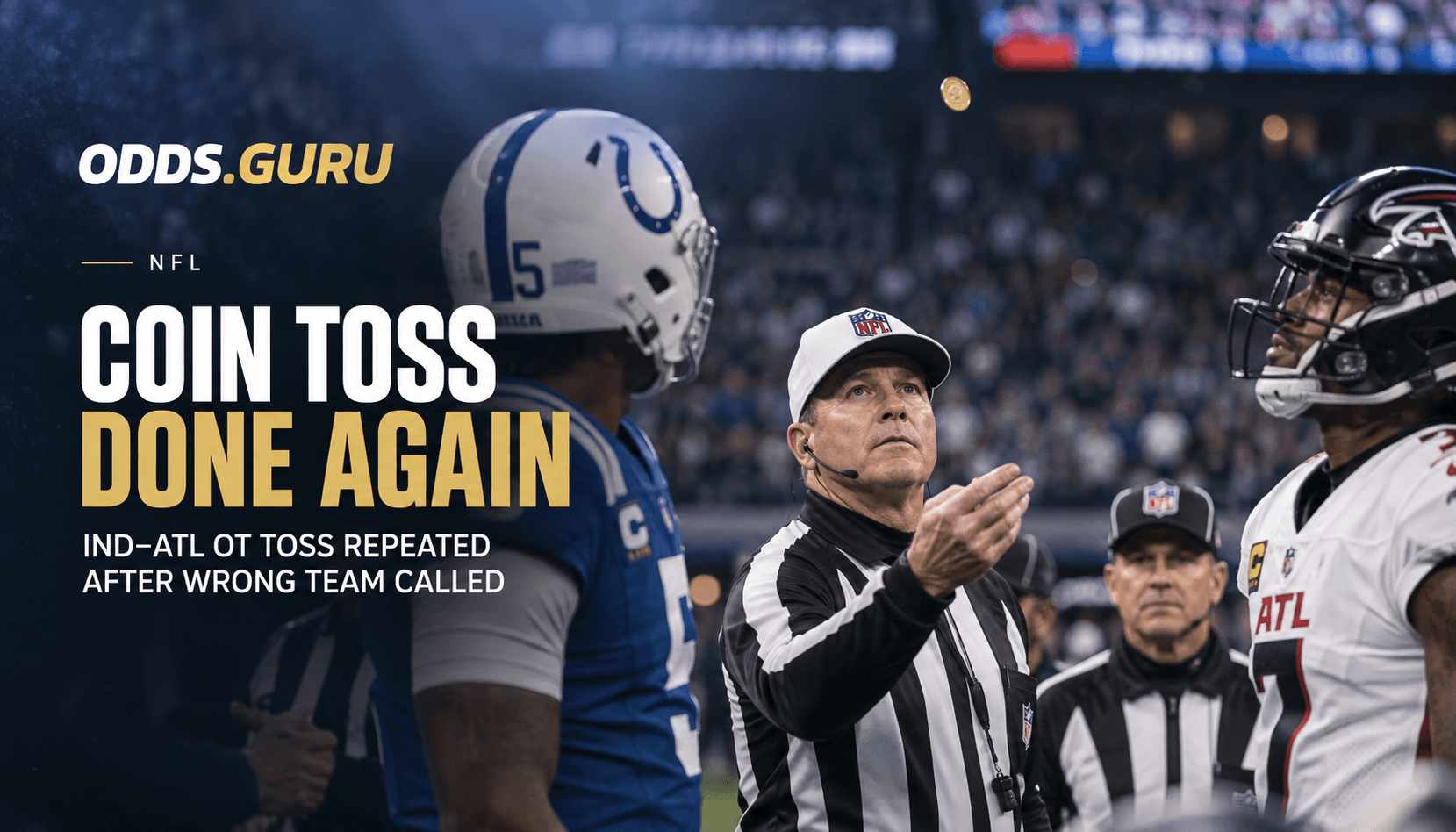
NFL coin toss error changed the first overtime possession
On November 9, 2025, an NFL coin toss in Germany initially gave Indianapolis the choice to receive in overtime against Atlanta. Officials had allowed the Colts to call heads or tails, even though Indianapolis was the designated home team and the call belonged to the Falcons.
The Colts called correctly and chose to receive. During a television commercial break, officials repeated the toss to correct the mistake. When the broadcast returned, Atlanta was preparing to receive the overtime kickoff instead.
That was a procedural failure before either team could begin its possession. The problem was not whether the referee caught the coin, let it land or produced an awkward-looking throw. The wrong captain had been given the call.
Atlanta did not score on its opening overtime possession. Jonathan Taylor subsequently scored the touchdown that won the game for Indianapolis. The correction changed which team received first, although the Colts still won.
The episode illustrates the distinction behind complaints about referees being unable to perform an ordinary coin flip. There is the physical action of tossing a coin, and there is the football procedure attached to its result. Either can go wrong.
A perfectly rotating coin would not have fixed the Indianapolis–Atlanta error. Once the wrong team had called, the ceremony had failed to follow the required sequence.
The criticism has a straightforward basis: identifying the designated visiting team should happen before the toss. An international venue does not remove the home and visiting designations. In Germany, those designations still mattered even though neither club was playing in its own stadium.
But the correction also mattered. Leaving the first result in place would have preserved an opening-possession choice awarded through the wrong procedure. Repeating the toss restored the visiting team’s opportunity to make the call.
A coin that does not turn must be tossed again
The NFL’s rule directly addresses the most conspicuous physical failure: if the coin does not turn over in the air, the referee must toss it again. The same requirement applies if the toss is compromised in any way.
The captain’s original heads-or-tails call stays in place. A failed toss does not give the caller a chance to reconsider.
That answers one part of the question about an apparently abnormal flip. A coin thrown into the air without turning is not a result the referee should simply accept. The remedy is another toss, rather than an argument about whether the side facing upwards should count.
The call comes before the coin leaves the hand
For the pregame NFL procedure, the visiting captain calls heads or tails before the toss. If there is no home team, the referee designates the captain who makes the call.
The referee conducts the toss at the centre of the field, in the presence of the captains, no more than three minutes before kickoff. Each team may have up to six captains present, including active, inactive or honorary captains.
Those details establish a shared sequence:
- Identify the captain entitled to call.
- Obtain the heads-or-tails choice before tossing.
- Repeat the toss if the coin fails to turn or the attempt is compromised.
- Keep the original call when repeating it.
- Establish the winner before recording the team’s choice.
A familiar casual routine involves catching a coin and turning it onto the back of a hand. That habit does not establish what a football official must do. The relevant requirement is the competition’s procedure, rather than whichever version spectators use at home.
Nor does an unusual-looking throw, by itself, establish manipulation. The NFL rule provides a specific test for the clearest failure: the coin has to turn in the air. A toss that does not meet that requirement must be repeated.
“Defer” and “kick” carry different consequences
The coin toss does more than allocate the opening kickoff. It establishes who chooses first, and that choice can concern either the kickoff or the goal a team will defend.
Unless the winner defers its choice to the second half, it selects one of two privileges: the opportunity to receive or kick off, or the choice of goal. The opponent gets the other privilege.
That distinction creates room for a mistake even after a valid toss. Winning heads or tails does not automatically mean receiving the ball, and choosing to kick is not the same as saving the first choice for later.
Deferring preserves the winner’s first choice for the second half. Choosing to kick uses the first-half choice immediately.
In the ordinary sequence, the team that lost the pregame toss gets first choice for the second half. The exception is when the toss winner deferred, in which case that team has the first choice instead.
Consequently, a team that wins the toss and chooses to kick has not necessarily secured the right to receive after halftime. The opposing team can have the second-half choice and select receiving again. The distinction is between choosing an action now and postponing the choice itself.
Prescott’s 2019 misunderstanding
That difference became a practical problem for Dak Prescott and Dallas against the Los Angeles Rams in 2019.
Prescott told referee Walt Anderson that Dallas would defer after winning the toss. Anderson misheard him, producing an initial decision that would have given the Rams the ball to begin both halves. The mistake was eventually corrected.
The incident involved communication rather than the coin’s movement. Replacing the coin, changing its size or using a more familiar throwing motion would not have resolved a misheard declaration.
The NFL procedure also makes a captain’s first choice final. Immediately before the second half, both teams’ captains must inform the referee of their respective choices.
Those requirements make the brief conversation after the toss consequential. The official needs to record the choice the captain actually makes, and both teams need to understand the resulting allocation. A clean physical flip completes only one part of that exchange.
College mechanics belong to a separate rulebook
The same complaint often groups the NFL and college football together, but NCAA football uses its own rules and officiating mechanics. An NFL instruction should not automatically be presented as a college requirement.
College mechanics cover more than the movement of the coin. They include officials’ positions, captain protocol, signals and duties after the toss. The ceremony coordinates the crew and the teams before play begins.
The precise current NCAA instruction governing catching the coin versus allowing it to land remains unconfirmed here. There is therefore no basis for declaring that every college referee must use either method, or that a particular landing style is itself a mistake.
High school officiating guidance demonstrates why the distinction matters. One procedure permits the referee either to catch the coin or deliberately let it hit the ground. If caught, the coin is not turned over; if accidentally dropped, the toss is repeated.
That guidance also identifies a practical surface issue: a coin can settle unevenly on grass, making a catch worth considering. It is a high school template, however, not a universal instruction for NFL and NCAA crews.
The visible differences can therefore reflect different mechanics rather than an official’s inability to perform a simple task. Catching, turning a caught coin and deliberately allowing a landing are separate actions; they should not be treated as interchangeable.
The confirmed NFL mistakes show where scrutiny is most useful. In Germany, officials gave the call to the wrong team. In the Dallas–Rams incident, the captain’s choice was misheard. Neither problem depended on whether the toss looked elegant.
For a coin that fails to rotate, the NFL remedy is already explicit: toss again, with the original call unchanged. For the rest of the ceremony, the essential work happens around the flip: identifying the correct caller and accurately recording the choice that follows.
 Reddit