A 74-day war, 907 dead, and one football match
The number Scaloni was working against is not a scoreline. In 1982, Britain and Argentina fought a 74-day war over the islands Argentina calls Las Malvinas — a conflict that killed 649 Argentine soldiers, 255 British combatants and three civilians. Sovereignty over the British overseas territory remains disputed to this day.
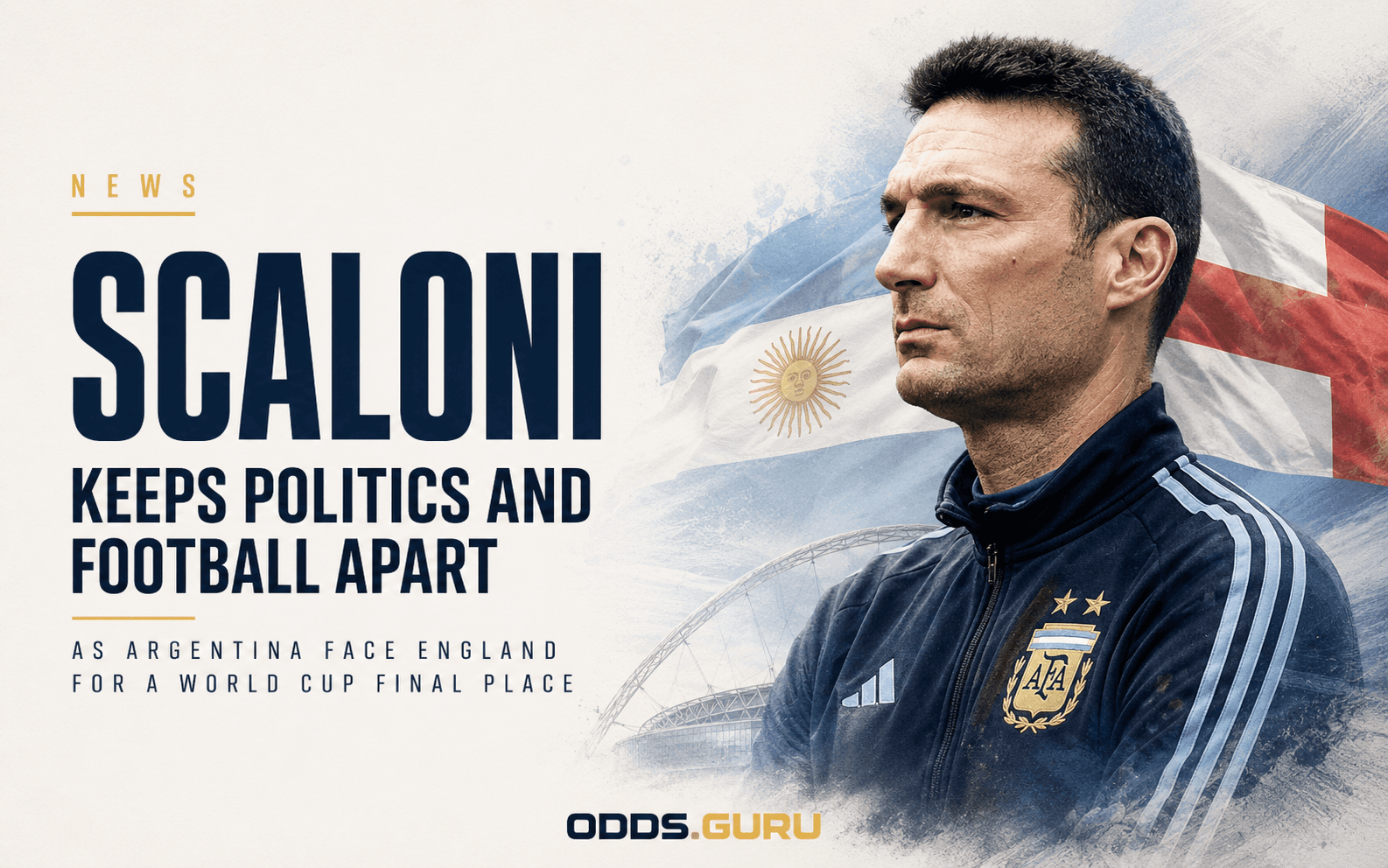
That history is why an England–Argentina knockout tie is never just a knockout tie, and Scaloni knew it walking into his pre-match press conference at the Atlanta Stadium.
> "The reality is that this is a football match. I can't mix things up, especially out of respect for what happened so many years ago," Scaloni said. "It was a very sad period in our history, and there isn't much we can do about it, that's the reality."
He went further, tying the moment to conflicts still running elsewhere. "Things are happening elsewhere in the world, and we criticise the existence of war. We certainly remember those people, of course. But it is a football match; we shouldn't confuse the two."
The restraint is deliberate. Argentina's on-pitch rivalry with England has been sharpened by everything off it — Diego Maradona's Hand of God and his second, brilliant goal in the 1986 quarter-final, the decades of chants, and the sovereignty question that never quite closes. Authorities have already confirmed increased security measures in Atlanta because of the historical tensions between the two nations. Scaloni's answer to all of it was to shrink the frame back down to 90 minutes.
The line on politics and football, and the vice-president who crossed it
Here is the tension Scaloni cannot control. While he was drawing a border between politics and football, a senior member of his own country's government was erasing it.
In a post on X, vice-president Victoria Villarruel cited the chant Argentina's players sang after their dramatic 3-2 win over Egypt in the last 16 — a song referencing the Malvinas alongside Maradona and Messi.
> "This is not just another match. I'm not going to be politically correct — against the English, it's always something more," Villarruel wrote. "It's the Malvinas, it's Diego, it's Leo's last one, and it's about putting the invaders in their place. Long live Argentina! Because until our very last breath, we will reclaim what is ours!"
Two messages, one country, pointed in opposite directions. The manager wants a football match; the vice-president wants a reckoning.
That split is the real story here, and it is bigger than one press conference. Sport and nationalism have always leaked into each other, and a semi-final of this weight is exactly where the seams show. Scaloni's discipline is admirable, but he is one voice competing with an official state account, a viral squad chant, and a rivalry that predates every player on the field.
The players themselves have not been shy. After the Egypt win, they were filmed singing the Malvinas chant — the same one Villarruel amplified. Scaloni can decline to engage. He cannot un-sing it.
Three knockout scares, and a semi-final nobody scripted
For all the noise around the fixture, Argentina have reached the last four the hard way. The defending champions have been tested in every knockout round:
| Round | Opponent | Result | Note |
|---|---|---|---|
| Last 32 | Cape Verde | 3-2 | after extra time |
| Last 16 | Egypt | 3-2 | recovered from two goals down |
| Quarter-final | Switzerland | 3-1 | extra time, vs 10 men |
Two of the three went to extra time. The Egypt comeback arrived from two goals down with 11 minutes left. This is not a team cruising; it is a team surviving.
Scaloni is refusing to apologise for the method. "A month-and-a-half ago I would have taken getting to the semi-final if you had offered me that, so I don't mind how we got here," he said. "I can't reproach my players. Whether we are tired or not I don't care. This is a World Cup semi-final."
The one constant has been Lionel Messi. At 39, the eight-time Ballon d'Or winner has scored a joint-tournament-high eight goals, level with France's Kylian Mbappe, and is set to face England for the first time in his career. Around him, Argentina have leaned on his output more than any collective fluency — a dependency that has carried them this far and could just as easily run dry against a stronger side.
England arrive chasing their own weight of history: a first World Cup final since 1966. Scaloni confirmed he has been briefing his squad specifically on how to handle Harry Kane and Jude Bellingham, who have each scored six goals at the tournament. "They are two great players, among the best in the world," he said. "Any coach would like to have them."
The back-to-back bid, measured in Scaloni's record
The reason Scaloni's every word carries is what he has already delivered. In a little over 100 matches, his Argentina have won 75, drawn 18 and lost just nine, banking four major trophies — the 2021 Copa América, the 2022 Finalissima, the 2022 World Cup and the 2024 Copa América — and reaching five consecutive semi-finals at major tournaments.
Now the 48-year-old is 180 minutes from a place no coach has held since Brazil's Aymoré Moreira in 1962: back-to-back World Cup winners. He has spent most of his career underestimated — Maradona once scoffed that Scaloni "cannot even manage traffic on the road" — and answered with silverware rather than volume.
His refusal to dramatise the England tie fits that pattern exactly. He has waved away the favouritism talk that trailed Argentina through their VAR-tinged wins over Egypt and Switzerland, noting the accusation is "nothing new" and dates to 1986. He is applying the same instinct to the Falklands framing: acknowledge the history, honour the dead, then get back to the football.
Whether it lands is another matter. A manager can set the tone inside his dressing room. He cannot set it for a nation, a government, or a rivalry that has outlasted every one of them. Kick-off in Atlanta is at 20:00 BST — and the border Scaloni drew between politics and football will be tested the moment the whistle goes.
 Reddit