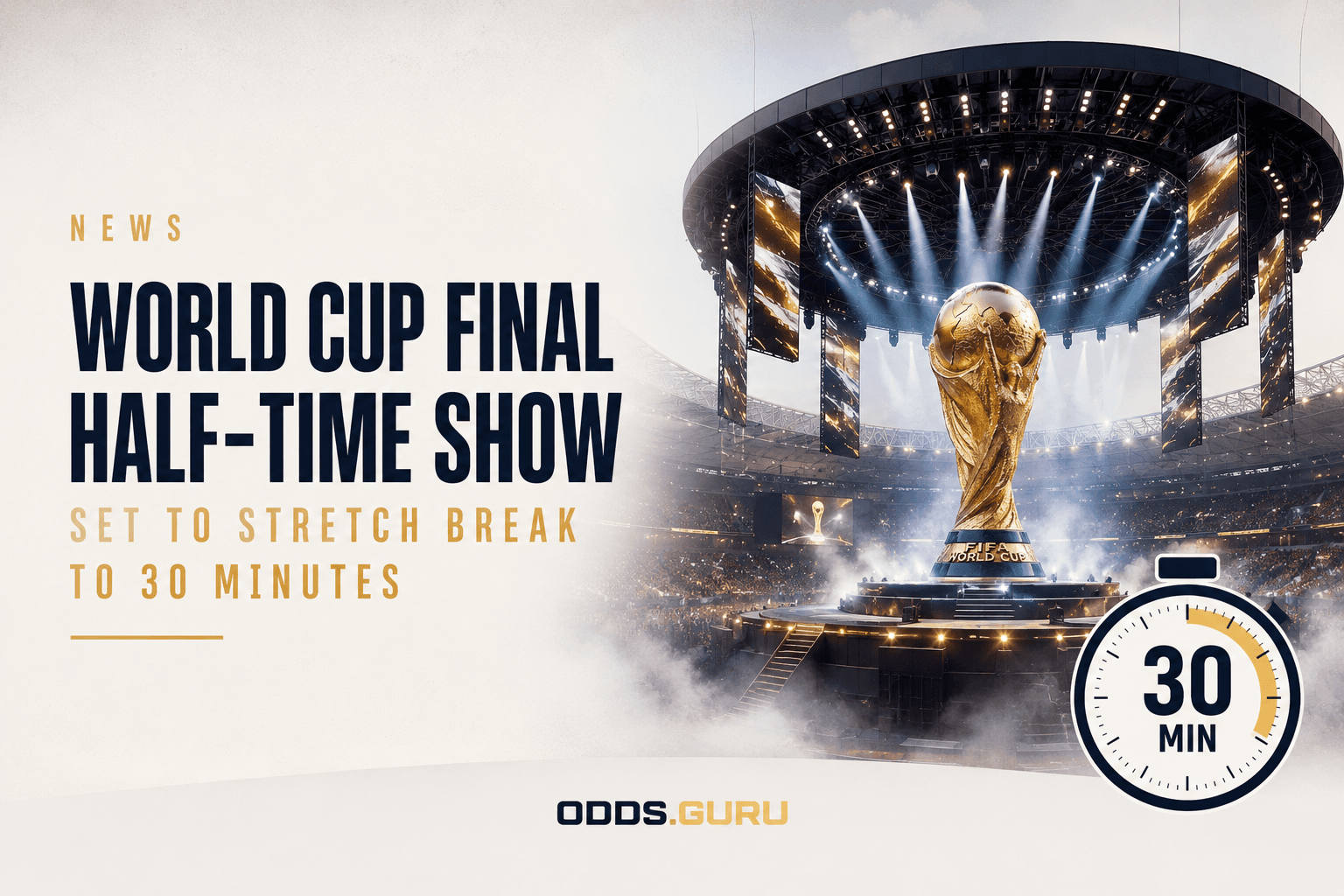
An 11-minute set inside a 30-minute break
The performance itself is expected to last 11 minutes. The World Cup final half-time show around it — stage construction, the set, teardown — is what pushes the interval towards 30 minutes, according to reporting from The Times, which says broadcasters covering Sunday's final in the New York/New Jersey area are working on that assumption.
That is not a rounding error on the rules. Law 7 of the Laws of the Game caps the half-time interval at 15 minutes. A 30-minute break isn't a stretch of the law; it's the law doubled.
FIFA, notably, has declined on several occasions to confirm the total expected length. The 11-minute show is locked in — ITV and the BBC, both carrying the final live in the UK, plan to broadcast it in full — but the overall run of show remains officially unpublished days before kick-off.
For the broadcasters, the arithmetic has actually landed in their favour. Both networks initially worried the show would eat into punditry time; they now expect at least the usual 15 minutes of first-half analysis plus the 11-minute performance, with the stage build and strike absorbing the rest. A half-hour interval is awkward for the laws and the players. For television, it's a gift.
The template is obvious. The Super Bowl has run an extended, headliner-led halftime for decades, and FIFA — staging its showpiece in an NFL stadium, in the NFL's home market — is borrowing the format wholesale. FIFA has announced Madonna, Shakira and BTS as co-headliners, with the show curated by Coldplay's Chris Martin and produced by Global Citizen.
The World Cup final half-time show FIFA won't put a clock on
The governing body's silence on timings is the most telling detail in the story. FIFA announced the show months ago and has promoted it heavily. What it has not done is publish a number for the length of the break — the one figure that would confirm, in black and white, that the organiser of the tournament is breaching the laws it is bound to apply.
There is precedent, and it points one way. At last year's Club World Cup final, also in the United States, the half-time break stretched to roughly 25 minutes to accommodate a halftime performance. No sanction followed, because there is no body positioned to sanction FIFA for it. The interval crept past the legal maximum, the game resumed, and the precedent quietly set.
Here is how Sunday's expected break sits against the rulebook and recent history:
| Interval | Length | Status |
|---|---|---|
| Laws of the Game (Law 7) maximum | 15 minutes | In force |
| CONMEBOL proposal to IFAB (2021) | 25 minutes | Rejected |
| Club World Cup final (2025) | ~25 minutes | Played anyway |
| World Cup final (2026), broadcasters' expectation | ~30 minutes | Unconfirmed by FIFA |
The pattern is a familiar one in football governance: test the boundary at a secondary competition, absorb the criticism, then normalise it at the main event. The Club World Cup was the trial. Sunday is the rollout.
IFAB said no to 25 minutes. FIFA booked 30.
The half-time cap is not an obscure technicality that nobody ever thought about. It was litigated — recently, and explicitly.
In 2021, the South American confederation CONMEBOL formally proposed extending the maximum interval to 25 minutes, precisely to allow half-time entertainment at showpiece matches. IFAB, the body that owns the Laws of the Game and on which FIFA itself holds half the voting power, rejected it. The stated reason: the "negative impact on player welfare and safety resulting from a longer period of inactivity." And the confederation that asked went ahead regardless — CONMEBOL staged a roughly 25-minute Shakira concert at the 2024 Copa América final the following year, rejection or not.
Read that sequence back. The law-making process considered exactly this trade-off — spectacle versus player safety — and ruled for the players. FIFA is now expected to implement not the rejected 25 minutes, but 30, at the single most important fixture in the sport.
The welfare argument is not hand-waving. Sports-science orthodoxy holds that muscles cool and stiffen during extended inactivity, which is why clubs run structured re-warm-up routines even inside a standard 15-minute interval. Doubling the downtime doubles the management problem, in a match that may already be heading for 120 minutes and penalties, played in July heat, at the end of an 11-month season for most of the players involved.
Both finalists' staff will adapt — extended warm-up blocks, staggered returns to the pitch, the tricks NFL teams have refined over years of long halftimes. But NFL squads are built around constant stoppages. Footballers are not, and the team chasing the game faces the grimmer version: half an hour in a dressing room, trailing in a World Cup final, waiting out a pop concert.
Cold muscles and live prices: the second-half knock-on
For betting markets, half-time is already the biggest single repricing window of any match — first-half markets settle, second-half lines open, and traders re-mark the full-time prices with 45 minutes of evidence in hand. Sunday triples the length of that window.
In practice, we'd expect two effects. First, a slower, more considered second-half open: with 30 minutes to work with, bookmakers have no excuse for stale lines at the restart, and the usual scramble to reprice in a 15-minute interval simply won't exist. Sharp bettors lose a little of the edge that comes from beating a rushed re-mark.
Second, genuine uncertainty around the restart itself. If the physiological concerns IFAB cited are real, the opening minutes of the second half carry elevated risk of sloppiness — slow starts, soft goals, and injury stoppages — relative to a normal final. Nobody has meaningful data on elite footballers resuming after a 30-minute break, because the laws have prevented the sample from existing. That is a rare thing in modern football: a structural variable the models haven't seen. We'd treat early second-half in-play prices with more scepticism than usual, in both directions.
The larger point stands apart from any single market. The Laws of the Game bind every competition on earth, from Sunday league to the Champions League — except, apparently, the one match FIFA most wants to sell. Whether the interval runs 28 minutes or 32 on the night, the number that matters is already on the record: 15. It's in the laws FIFA helps write, and on Sunday, by every available indication, it will be ignored by the body that wrote it.
 Reddit