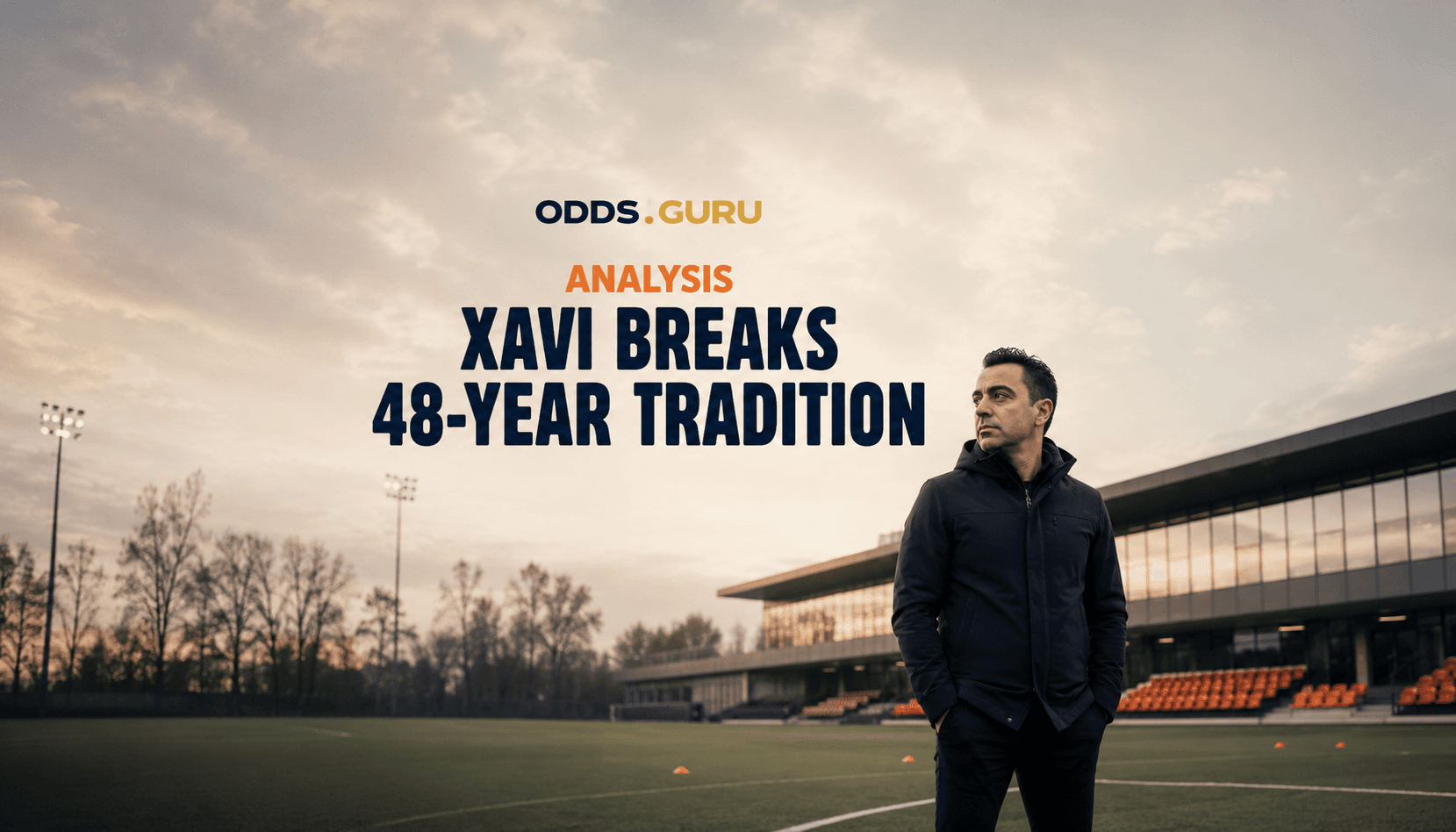
Xavi Hernández will manage a national team for the first time in his career. The Royal Dutch Football Association published the Xavi Netherlands head coach announcement on 12 August, hours after the documents were signed, confirming a deal that runs to 30 June 2030 and covers the entire next qualifying cycle.
He replaces Ronald Koeman, who stood down this summer after the Netherlands went out of the 2026 World Cup in the round of 32 against Morocco. That ended Koeman's second spell in the job; his first ran from 2018 to 2020.
"It is a great honour to become head coach of the Netherlands national team," Xavi said in the federation's statement. "You could say I am, in a way, a son of Dutch football."
A contract to 2030, signed by a coach who averages 1.67 years per job
The length is the first thing worth reading. Four years is close to the maximum a federation can commit to a coach in one go, and it is roughly two and a half times longer than Xavi has ever stayed anywhere as a manager.
Transfermarkt lists his average term in charge at 1.67 years across two appointments. Al-Sadd ran from July 2019 to November 2021. Barcelona ran from November 2021 to June 2024. Neither ended at a natural stopping point.
The KNVB has bought the opposite: a fixed horizon that ends at the 2030 World Cup, with the next European qualifying campaign sitting inside it. That gives Xavi a full cycle to install a method rather than a season to survive one.
He arrives after two years out of the dugout. Since leaving Barcelona in the summer of 2024 he had been linked with several club roles, and he spent the 2026 World Cup writing as a columnist for The Athletic — the same outlet whose interview with him trailed a stated ambition to coach in the Premier League. That ambition has been parked, at least until 2030.
Spanish outlet AS reported that Patrick Kluivert, Xavi's former Barcelona teammate, will sit alongside him as assistant. That is the obvious hedge against the one thing Xavi cannot bring: an insider's read of the Dutch dressing room, the Eredivisie pipeline and the KNVB's internal politics.
Xavi Netherlands head coach: Slot said no, Martínez and Reiziger lost out
The appointment was not the federation's opening move. Arne Slot was among the favourites and confirmed there had been contact, but told Dutch outlet Voetbal International that talks "never reached" the stage of salary and contract length. He stayed in club football.
Two other names were on the table. Roberto Martínez, with a long record in international management, and Michael Reiziger, currently in charge of the Netherlands Under-21 side and the continuity candidate.
The KNVB went for neither. Choosing Xavi over Reiziger means the federation decided the senior job was not the natural next rung for its own age-group coach. Choosing Xavi over Martínez means it preferred an unproven international coach with a defined playing method to a proven one without a signature style.
That is a philosophy hire, and the federation has not pretended otherwise.
239 matches, eight trophies, and nothing at international level
The managerial CV is short and unusually front-loaded with silverware.
| Club | Period | Matches | Points per match | Trophies |
|---|---|---|---|---|
| Al-Sadd | Jul 2019 – Nov 2021 | 96 | 2.20 | 6 |
| Barcelona | Nov 2021 – Jun 2024 | 143 | 2.07 | 2 |
Match totals and points-per-match figures per Transfermarkt; trophy counts per The Athletic. Barcelona's two are the 2023 La Liga title and the 2023 Spanish Super Cup.
Two hundred and thirty-nine games in total, at two clubs, in two leagues. Eight trophies. Zero matches in charge of a national team.
The gap matters more in international football than in club football, because the job is different work. A club manager has daily contact and a transfer market. A national coach has a handful of camps a year, no signings, and selection as almost his only lever. Coaches with strong training-ground methods have historically found that transition harder than man-managers do.
What Xavi does bring is a playing career the Dutch squad will not need convincing by: 767 official matches for Barcelona, 133 caps for Spain, a World Cup in 2010, and European Championships in 2008 and 2012. Spain's 2010 final came at the Netherlands' expense — a detail nobody in Dutch football requires reminding of, and one that has already produced a fair amount of dry commentary since the news broke.
The Barcelona–Dutch loop closes again
Xavi is the first foreign coach of the Netherlands men's team since Austria's Ernst Happel, who led the Oranje in 1977-78. That is a gap of roughly 48 years, and it is the single most striking fact of the appointment.
Except the "foreign" label does most of its work on the passport rather than the football. Xavi came through La Masia, an academy built on ideas imported from Amsterdam, and he named the chain himself: Johan Cruyff and Rinus Michels as founding influences, Louis van Gaal — who gave him his Barcelona debut — and Frank Rijkaard as formative ones.
"The Netherlands has a rich football culture and a clear vision that strongly appeals to me," he said. "Attacking football, based on possession, with creativity, passion and conviction."
He also added the caveat that tends to get lost in appointment-day quotes: "The main objective is always to win." That line will be tested first, and quickly.
24 September, Klopp's Germany, and a short runway
Xavi's first match in charge is a Nations League fixture against Germany, now managed by Jürgen Klopp, on 24 September. It is an awkward opener by any standard — a first competitive night in international management, against a neighbouring rival, with a high-profile counterpart on the other bench.
The structural challenge is time. Between now and the start of the next qualifying campaign, Xavi will get a small number of camps to translate a possession model onto players drawn from Europe's leading clubs, most of whom are drilled in something else week to week. Federations that hire on philosophy usually discover that the philosophy takes a full cycle to show up in results.
The KNVB has priced that in with the contract length. The 2030 endpoint is the assessment date, and the qualifying cycle in between is the first real read on whether the method transfers.
For now the facts are settled: a signed four-year deal, a 46-year-old first-time international coach, an assistant with deep Oranje credentials, and a debut against Germany in six weeks.
 Reddit