

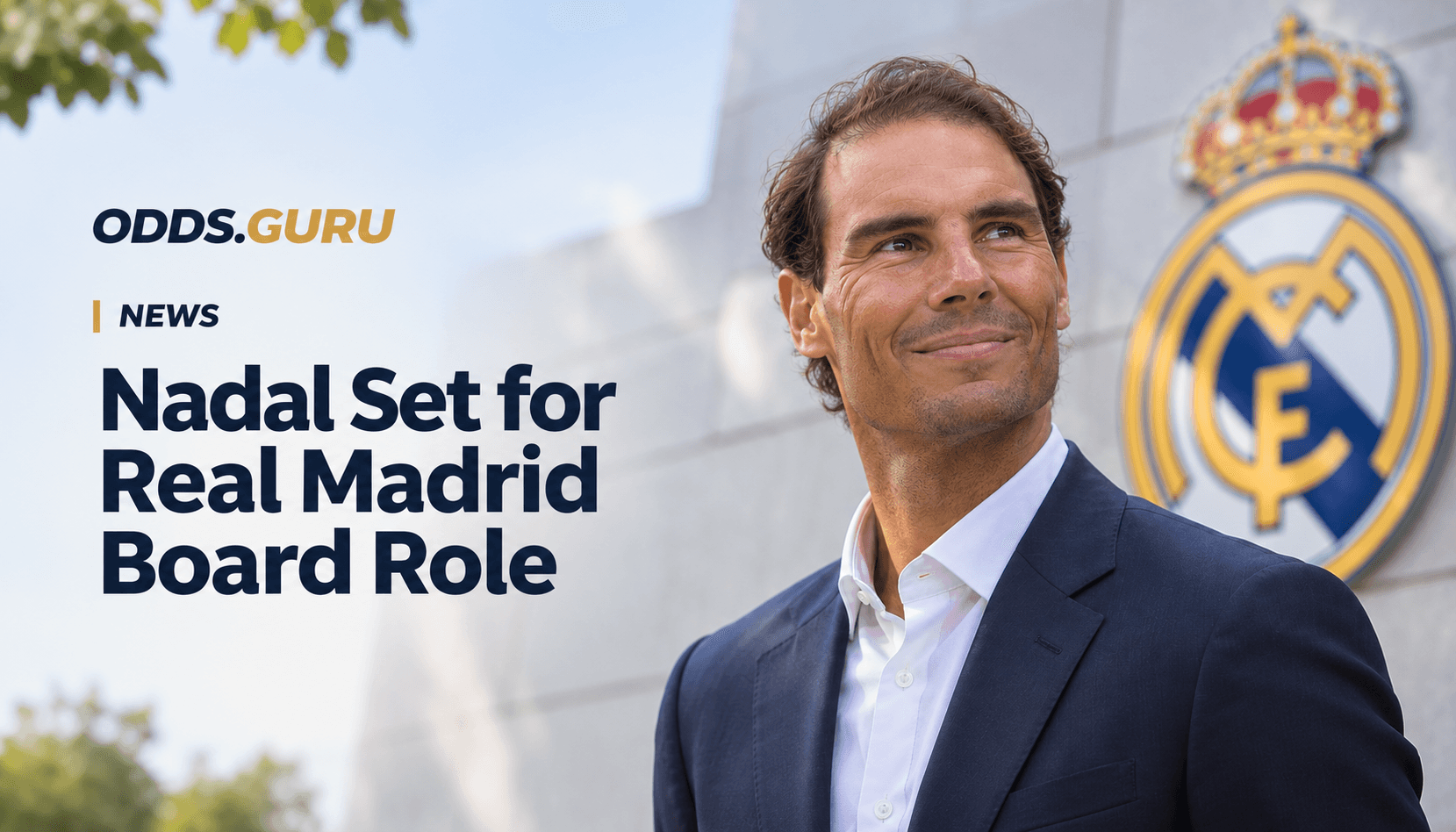
Rafael Nadal has accepted an invitation to join Real Madrid’s board of directors, after the board agreed on November 4 to submit his appointment to the club’s General Assembly of Delegate Members for ratification. The assembly is scheduled for November 21, when the proposed addition to Florentino Pérez’s leadership team is expected to be considered.
Nadal would become the board’s 20th member. The move gives the retired tennis champion a formal route into the leadership of the club he has supported since childhood, although the announcement does not establish an executive job or designate him as a future president.
November 21 is the next step for Rafael Nadal
The board’s resolution identifies Nadal as member number 67,778 and names the General Assembly of Delegate Members as the body responsible for ratifying his appointment. That remaining step matters: Nadal has accepted the proposal, but the process still requires the members’ formal endorsement.
The November 4 decision therefore moves him beyond an expression of interest in helping the club. There is now a board resolution, an acceptance and a scheduled assembly at which his appointment can advance. There is no need to infer his willingness from past interviews or his appearances at Madrid matches.
Nadal thanked Pérez and the board for the invitation and said he had accepted with enthusiasm, a desire to learn and a willingness to contribute as much as possible. His response emphasised joining and learning, without setting out a programme for the club or claiming responsibility for a particular department.
The immediate sequence is clear:
- November 4: the board agreed to submit Nadal’s appointment for ratification.
- Nadal accepted the invitation and publicly thanked Pérez and the directors.
- November 21: the scheduled general assembly provides the next formal step.
The announcement leaves the practical detail open. It does not identify a department he would oversee, a specific project he would lead or an operational brief. Those details will determine what the appointment means in the club’s daily work once the ratification process is complete.
For now, the concrete development is the board’s decision to bring him in and his agreement to take that step.
A 22-major career behind Madrid’s invitation
Nadal retired from professional tennis in 2024, leaving a record that gives Madrid little need to introduce its prospective director to a sporting audience. His career included 92 singles titles, 22 Grand Slam titles, two Olympic gold medals and five Davis Cup triumphs with Spain. He also reached world number one.
Those achievements explain the scale of the appointment’s profile. They do not, by themselves, define the work Nadal will perform at Madrid.
The club’s announcement placed considerable emphasis on his conduct as well as his results. It highlighted his competitiveness, willingness to improve, respect for opponents and teammates, and commitment to helping others. Madrid presented those qualities as consistent with its own identity.
That is a statement about the person the board wants to add. The invitation brings someone whose reputation was built through a long individual sporting career into a collective leadership setting, where decisions and responsibilities differ from those of a professional athlete.
Sporting experience, different responsibilities
Nadal’s experience of elite competition gives him a perspective on preparation, pressure and sustained performance. The usefulness of that perspective at board level will depend on the responsibilities he receives and the issues on which the club seeks his contribution.
Winning major titles does not establish experience of running a football club. Nadal’s own response acknowledged that distinction through his emphasis on learning. He has accepted a place within an existing leadership structure, rather than announcing that he intends to direct Madrid’s football operations.
His connection to the club also predates the proposed appointment by decades. A childhood supporter, Nadal accompanied his acceptance with an image of himself as a toddler wearing a Madrid kit. The image reinforced the personal history behind a move that could otherwise be read simply as the recruitment of a famous sporting figure.
That longstanding attachment gives the appointment continuity. It also creates expectations: supporters familiar with Nadal’s career will now be watching for evidence of what he contributes in a role where results are less immediately visible than a match score or a trophy.
A board seat without a published executive brief
Nadal is expected initially to contribute in an advisory capacity rather than take an executive role. His precise remit, however, has yet to be confirmed, and the appointment announcement does not assign him control over the club’s operations.
That distinction limits the immediate conclusions that can be drawn. A place on the board is a formal leadership position, but it does not establish that Nadal will direct recruitment, manage the first team or take charge of commercial decisions. None of those responsibilities has been announced.
An advisory contribution could allow Madrid to draw on his sporting experience while Nadal learns the demands of football administration. It would also fit the measured language of his acceptance, which focused on contributing where he can.
The unresolved issue is how that contribution will be organised. Without a defined brief, it is too early to judge whether his work will centre on particular projects or broader discussions within the board.
Recognition is immediate; responsibility needs detail
Madrid gains the association of a globally recognised Spanish athlete with a deep personal connection to the club. That public significance exists from the moment of the announcement, regardless of how extensive Nadal’s eventual duties become.
The administrative significance will take longer to assess. It depends on the responsibility attached to the position and the work Nadal undertakes after joining. His sporting reputation explains the attention; the eventual remit will explain the appointment’s practical importance.
There is room for both a prominent representative role and a useful advisory contribution. The announcement does not yet provide enough detail to establish the balance between them.
Pérez’s succession remains a separate decision
Nadal’s previous interest in the Real Madrid presidency ensures that the board invitation will also be viewed through the question of who eventually follows Florentino Pérez.
In 2017, Nadal said he would like the opportunity to become president. Asked again in September 2023, he expressed interest while questioning whether he had the experience and qualifications required. His interest is longstanding, but so is his recognition that supporting the club and leading it are different responsibilities.
Joining the board could give him closer knowledge of how Madrid is run. It could also allow the club’s existing leadership to see how he works within that environment. Those are reasonable potential consequences of the appointment, rather than evidence of an agreed succession plan.
Pérez remains president. Nothing in the November 4 announcement names Nadal as his successor, sets a timetable for a leadership change or confirms a future presidential candidacy.
The board role can therefore be significant without being treated as a presidential nomination. Nadal has accepted an opportunity to contribute now; any later ambition would require its own decision and confirmation.
For the November 21 assembly, the matter submitted by the board is narrower and specific: ratification of Rafael Nadal Parera’s appointment as a director. The club has not announced a presidential transition as part of that proposal.