127 heroes, 112 of them older than Dota 2 itself
Anti-Mage, Axe, Crystal Maiden, Dazzle, Drow Ranger, Earthshaker, Lich, Lina, Lion, Mirana — all carry a release date of 1 November 2010, the first wave of the Dota 2 beta. Every one of them existed years earlier under a different name in the Warcraft III mod: Magina, Mogul Khan, Rylai Crestfall, Shadow Priest, Traxex, Raigor Stonehoof, Kel'Thuzad, Slayer, Demon Witch, Priestess of the Moon.
That inheritance is most of the game. Of the current roster, 112 heroes — roughly 88% — were ported directly from Defense of the Ancients. The rest arrived after patch 7.00 landed on 23 August 2016, when Valve began genuinely expanding the pool rather than transplanting it.
Sources still disagree on the headline number, which is worth being precise about. Guides written against patch 7.39d list 126 heroes; the count as of 7.40c is 127, with Largo the most recent addition. Both figures are current in circulation, and the gap is one hero, not a methodology dispute.
The pace has slowed sharply. Early post-7.00 releases came quickly; Valve now ships roughly one new hero every 8–12 months, with the development weight moved to balance passes and systems changes. The attribute system itself was reworked to four categories — Strength, Agility, Intelligence and Universal — with Universal added as a late, deliberately flexible bucket whose strength swings hard by patch.
For a player installing the game this week, none of that history is visible. What is visible is a grid of 127 portraits, all unlocked, none gated behind grinding or payment. The choice is total, which is precisely why it tends to collapse into the same handful of answers.
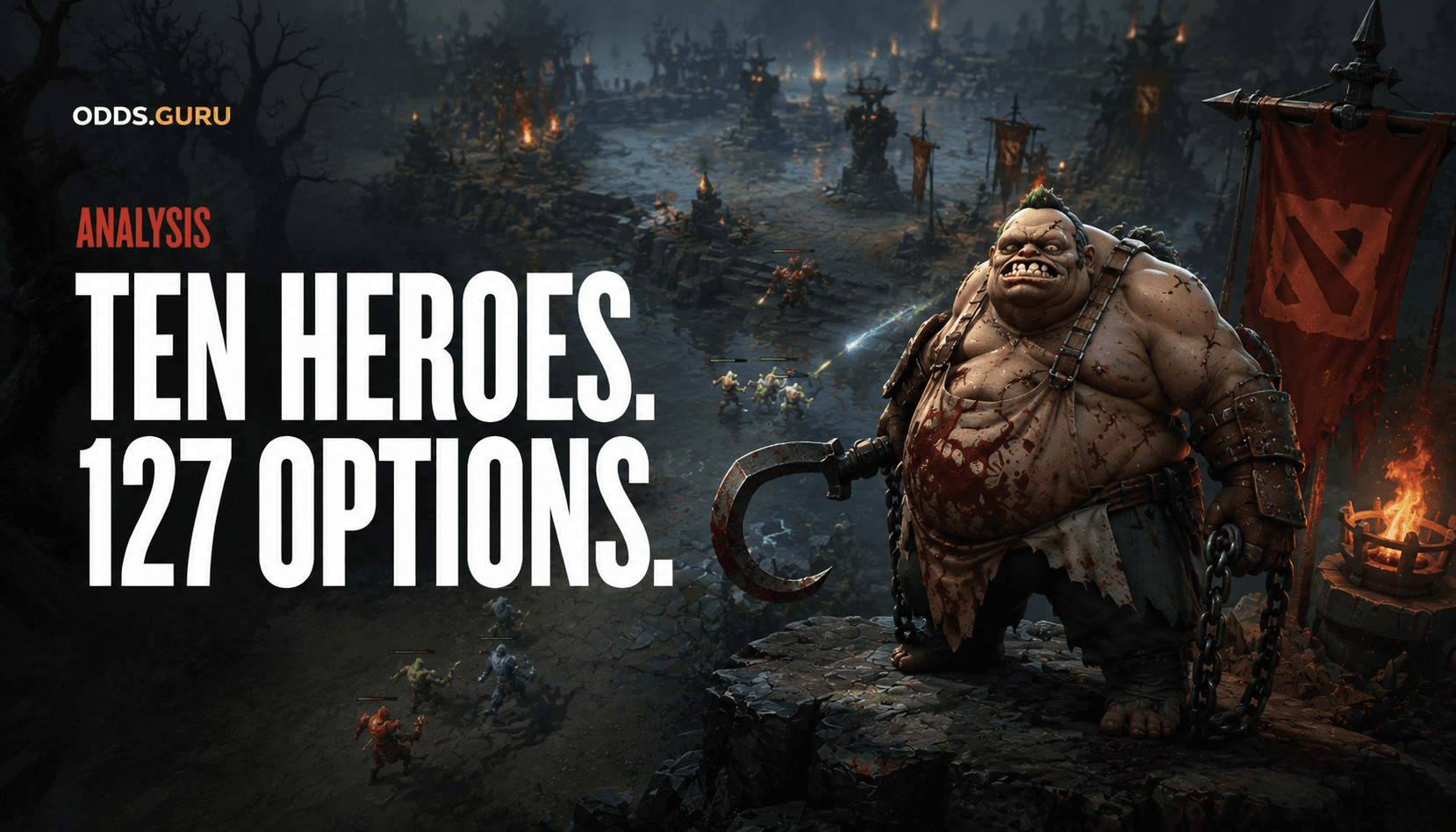
Pudge at 28.07%: the first hero in Dota that almost every lobby meets
Dotabuff's hero tracker, filtered to the last seven days across all ranks and regions, puts Pudge at 1,842,912 matches and a 28.07% pick rate, with a 51.27% win rate. Lion follows at 24.79%, then Snapfire at 20.61%, Sniper at 19.65% and Zeus at 19.63%.
Patch-level data tells the same story with slightly different edges. Dotacoach.gg's 7.40c tracker has Pudge at 26.6% and a 51.6% win rate; Statista's mid-2025 figures, drawn from Dotabuff across 83 million matches, had him at 26.54%. Three datasets, three methodologies, one number that refuses to move.
| # | Hero | Pick rate | Win rate | Role |
|---|---|---|---|---|
| 1 | Pudge | 26.6% | 51.6% | Support / Offlane |
| 2 | Lion | 26.3% | 49.4% | Support |
| 3 | Sniper | 19.9% | 47.5% | Mid / Carry |
| 4 | Axe | 19.5% | 51.0% | Offlane |
| 5 | Invoker | 19.5% | 51.3% | Mid |
| 6 | Witch Doctor | 19.5% | 52.3% | Support |
| 7 | Rubick | 18.1% | 48.2% | Support |
| 8 | Windranger | 18.1% | 48.3% | Mid / Carry / Offlane |
| 9 | Shadow Fiend | 18.0% | 50.4% | Mid / Carry |
| 10 | Ogre Magi | 17.2% | 50.9% | Support |
Ranked pick and win rates for patch 7.40c, all ranks and all regions, February 2026, per Dotacoach.gg.
The Pudge win rate is the genuinely odd data point. Heroes picked this often normally sag below 50% because a large share of those picks are situationally wrong. Holding 51.6% at a quarter of all games suggests the kit carries enough baseline value — Dismember remains a hard disable, Flesh Heap compounds tankiness — to survive being played badly.
His popularity is not a strength argument, though. It is a feedback argument. Landing a hook is one of the game's most legible successes, and in a match type where a single minute-20 pick-off can end a game, that legibility is worth more than efficiency.
The beginner shortlist and the professional meta barely overlap
Beginner guides converge to a remarkably tight set: Wraith King, Sniper, Ogre Magi, Bristleback, Abaddon, Shadow Shaman, Lion, Juggernaut and Viper. The logic is consistent — forgiving kits, low mechanical overhead, and abilities that stay useful across all three phases of a game.
Broken down by role, the recommendations sort like this:
- Position 1 (hard carry): Juggernaut for all-round teamfighting, Sven for cooldown-driven tempo, Medusa for late-game scaling, Sniper for positioning and sieging, Nature's Prophet for itemisation practice.
- Position 2 (mid): Zeus for spellcasting and lane pressure, Dragon Knight for surviving melee matchups, Queen of Pain for roaming, Leshrac as a straightforward magic-damage core.
- Position 3 (offlane): Bristleback and Abaddon, both hard to kill and hard to punish.
- Positions 4 and 5 (support): Ogre Magi, Shadow Shaman and Lion — durable or disable-heavy, with clear win conditions.
Two different games, effectively. One is drafted; the other is chosen.
Six supports in the top ten, and the laning changes behind it
The current distribution is not purely cultural inertia. Patch 7.40c nerfed shared tangoes and removed flagbearer creep health regeneration for heroes, which made the laning stage materially more punishing.
Supports who can trade hits and keep a core alive gained value accordingly. Six of the ten most-picked heroes in 7.40c are supports, which is unusually top-heavy. On the core side no single carry dominates — Clinkz led early in the 7.40 cycle before nerfs pulled him back — so the carry pool is comparatively spread out.
That matters for the entry-point question. A patch that punishes bad laning pushes newer players toward heroes that forgive it, and the forgiving heroes are largely the same ones the guides already recommend. The patch and the tutorial pipeline are pointing the same direction.
The counter-case is real, and Valve's own release strategy is the evidence. Slowing to one hero every 8–12 months, with modern additions built around deeper mechanics rather than roster volume, is a bet that depth beats breadth. A 127th hero does not widen the beginner funnel; a rebalanced laning stage might.
Our read: the funnel is stable because it is doing a job. With 127 heroes, four attributes and five roles, the practical advice has not changed in a decade — pick a few comfort heroes and learn them properly. The first hero in Dota is less a preference than a landing pad, and the reason people still remember theirs is that almost everyone landed in the same small clearing.