Echo Sabre and a 30-minute Battle Fury
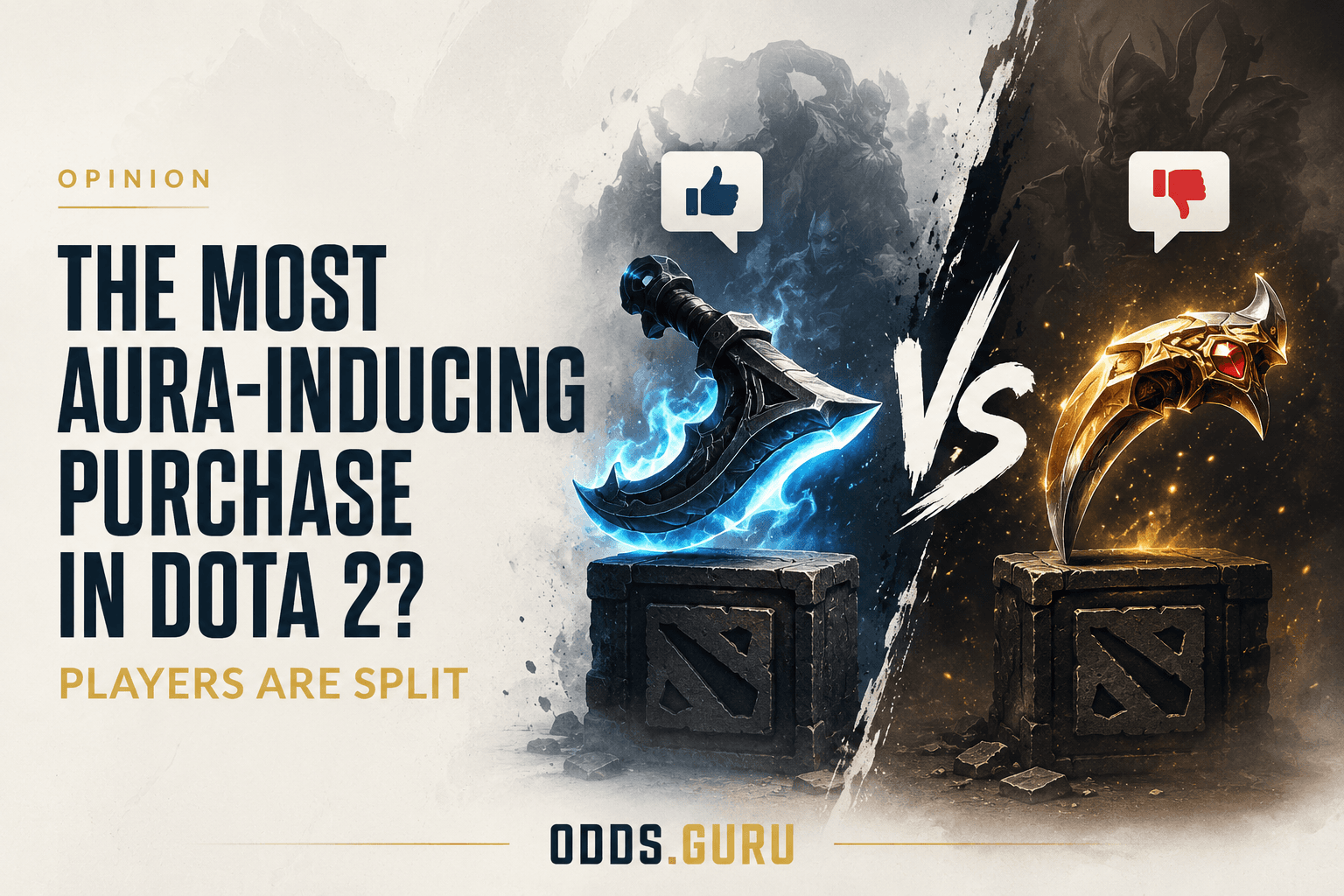
Two answers ran away with the thread. Death Prophet's Echo Sabre pulled 323 upvotes, and Anti-Mage buying Battle Fury at 30:00 took 209. Both land because both describe a player quietly abandoning the plan.
Death Prophet is a caster — a hero whose value is her spells and her push, not her right-click. Echo Sabre is a raw attack item. Buying it is a small confession: I've stopped playing the hero and started playing the fantasy of the hero.
The Anti-Mage pick is sharper still. Battle Fury is a farming accelerator, the item you rush early to speed up your own economy so the late game arrives on your terms. For reference, Aghanim's Scepter — a genuine game-warping upgrade — lands at an average of roughly 24:27 across ranked play. An Anti-Mage still assembling a farming item at 30:00 has inverted the whole point: the acceleration item now arrives after the window it was meant to open.
The top reply nails the tone — he just needs to farm, give him time, sacrifice both tier-4 towers so he can clear the ancient camps, it'll be worth it, trust me. That is the aura. Not the item. The serene confidence of a teammate steering the ship into the rocks.
Radiance is the only literal answer
Here the joke folds back on the game's own vocabulary. In Dota, an aura is a defined mechanic: a passive area-of-effect buff or debuff that radiates from the holder to nearby units, with a standard half-second linger after you leave the radius.
So when someone answers Necrophos Radiance (41 upvotes) or Chen Radiance, first item (31), they're being technically correct. Radiance projects an actual burn aura — the item literally induces an aura. The pun is the point.
But those are the outliers. Chen is a support who conscripts jungle creeps; a 5,050-gold Radiance as his opening buy means his lane partner spent ten minutes alone. The literal reading and the slang reading collide in the same purchase — a real aura mechanic bought by a player emitting the metaphorical kind.
One commenter closed the loop cleanly: these items induce an aura of despair to your own teammates. That is the working definition the whole thread is circling.
Ranking the most aura-inducing purchase, by upvote
The thread is, functionally, a leaderboard of tilt. The purchases that scored highest all share a structure — a hero buying an item that betrays its role, its timing, or its economy.
| Purchase | Upvotes | Why it reads as a threat |
|---|---|---|
| Death Prophet, Echo Sabre | 323 | Caster buying a right-click item |
| Anti-Mage, Battle Fury at 30:00 | 209 | Farming item, bought after the farming window |
| Phantom Lancer → Diffusal → Bloodseeker Force Staff | 106 | Core item build-around, handed to the wrong hero |
| Six Boots on Broodmother | 74 | Redundant item, times four |
| Any carry buying wards | 74 | Core hero spending on support duties |
| Terrorblade, Shadow Blade → Dagon | 41 | Illusion carry going full burst-mage |
| Soul Ring on Huskar | 38 | A self-damage item on a self-damage hero |
| Divine Rapier, first item, on a support Sniper | 25 | The highest-risk item, earliest, on the wrong slot |
A pattern emerges from the numbers. The biggest scores aren't the worst items — they're the items that signal a player has stopped reading the game. Six boots on Broodmother earns a deadpan correction in the replies (you should buy eight, but it's pairs, so four is enough), which is the joke eating itself. The comedy isn't the waste; it's the certainty behind the waste.
Note what's absent: nobody's aura comes from a good buy. The aura-inducing purchase is defined entirely by mismatch — right item, wrong hero; right hero, wrong minute; right minute, wrong slot.
The Divine Rapier and the silence that followed
The thread's best entry isn't the highest-voted. It's an anecdote, sitting at 23 upvotes, and it's where the joke stops being a joke.
A player recalls a five-stack — friends queuing together, talking and laughing in voice chat. Their Phantom Assassin bought a Divine Rapier as a first item. Rapier is the most dangerous purchase in Dota: enormous damage, and it drops on death for the enemy to grab. First-item, on a squishy carry, it's less a build than a dare.
His account of the moment: he has never seen four people lock in so fast. The chatter stopped. In a way, he wrote, that's real aura.
That's the whole thread in one story. Strip the memes and the format, and the community is describing a specific, shared sensation — the drop in the room when a teammate does something that tells you, wordlessly, that the next 20 minutes are already written. The Rapier, the 30-minute Battle Fury, the support Sniper rushing a Divine — each is a status signal read instantly by everyone else on the map.
The one that flips the aura outward
Most of these purchases point inward, radiating dread at your own team. A handful invert it. Someone nominated upgrading the courier to fly, stacking a Soul Booster and a Dagon 5 onto it — a courier zapping enemy heroes dead. Nothing farmed aura harder, they wrote. It's absurd, it's illegal-feeling, and it's the rare version where the menace lands on the opponents instead.
That inversion is the tell. The joke works because Dota players carry a precise, unspoken model of what every item means at every minute. Aura — the slang — is just the name they've given to being legible to everyone at the table.
The thread never settles on a single winner, and it doesn't need to. Its real finding is that a competitive playerbase can compress an entire theory of tempo, role, and economy into one word borrowed from the game's own manual — and get the joke, and the analysis, in the same breath.
 Reddit