A $9.6m tax line on a $430m payroll
The number that makes Bowden's point is not Skubal's. It is everything sitting above him.
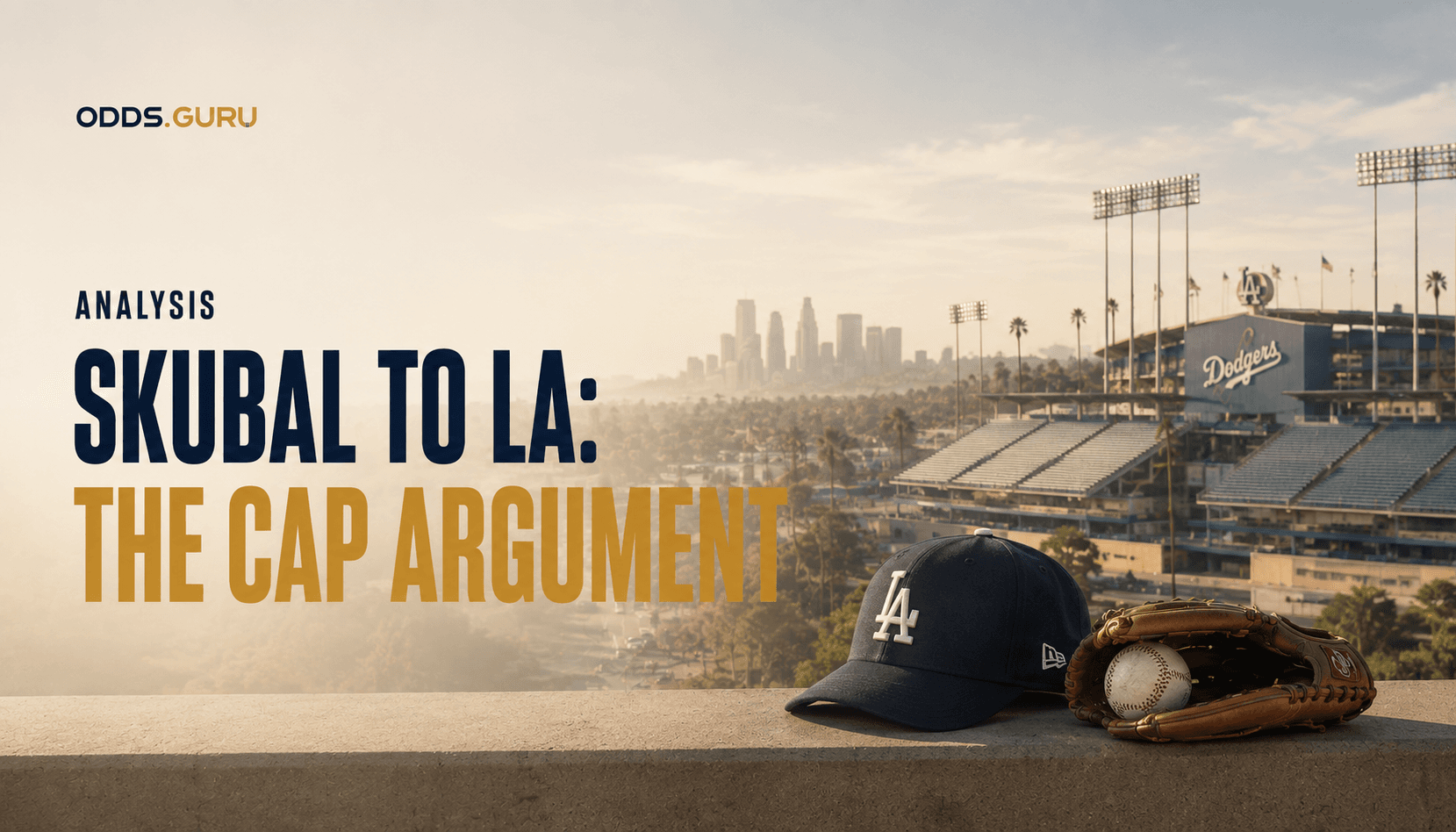
Skubal arrives in Los Angeles on an arbitration-year figure of $9,582,888 against the competitive balance tax, per Spotrac — the 11th-largest tax hit on the Dodgers' active roster, and a contract that runs out after 2027. In isolation, it is an ordinary mid-rotation salary.
The context is not ordinary. Spotrac projects the Dodgers' total 2026 luxury-tax payroll at $430,281,508, first in the sport, roughly $186.3m beyond the top threshold. As a 50 percent, three-plus-time payor, their estimated tax bill alone comes to $180,309,659.
That penalty is about 64 percent of what the club will actually pay its players in cash this season — a projected $283,356,070, which ranks fifth. Read those two rankings together and you have the whole dispute in miniature: first in committed value, fifth in current outlay.
The gap exists because tax accounting uses average annual value while cash payroll counts the cheques written this year. The distribution is uneven enough to be worth looking at directly.
| Player | 2026 luxury-tax hit | 2026 cash salary |
|---|---|---|
| Kyle Tucker | $57,195,000 | $55,000,000 |
| Shohei Ohtani | $46,081,476 | $2,000,000 |
| Mookie Betts | $30,416,667 | $20,000,000 |
| Yoshinobu Yamamoto | $27,083,333 | $12,000,000 |
| Freddie Freeman | $27,000,000 | $15,000,000 |
| Tarik Skubal | $9,582,888 | $9,582,888 |
Figures from Spotrac's 2026 Los Angeles Dodgers luxury tax and financial summary pages.
Adding a reigning front-line starter at under $10m, while carrying nearly $59m in tax charges for two injured starting pitchers in Blake Snell and Tyler Glasnow, is the sort of transaction only one payroll structure in baseball can absorb without flinching. Bowden's reaction was a single sentence, but he was pointing at that structure rather than at Skubal.
The MLB salary cap push is about franchise values, not parity
Here the argument gets less romantic than the parity framing suggests.
CBS Sports has reported that ownership's renewed cap drive has less to do with competitive balance than with an internal belief that being the only major North American league without a salary cap is suppressing franchise values. Parity is the public case. Valuations are the private one.
Orioles owner David Rubenstein has been unusually direct about the destination: "I wish it would be the case that we would have a salary cap in baseball the way other sports do, and maybe eventually we will, but we don't have that now." He added that he suspects the sport will end up closer to the NFL and NBA models.
The league's opening CBA proposal reflects that. It pairs a raised minimum salary with new restrictions on free-agency contracts — but only in a package that includes a cap. Owners are not offering the cap as a concession; they are offering everything else as the price of it.
And the mechanism they already have is not doing the job. The competitive balance tax works as a governor for clubs that treat the thresholds as a ceiling. The Dodgers have demonstrated, at $180m in projected penalties, that they do not. A tax you are willing to pay is a cost of business, not a constraint. That is the honest core of Bowden's point, and it is not easily dismissed.
The floor, the cap, and who pockets the difference
The pushback arrived quickly, and it split along two lines that deserve separating.
The first is a straightforward challenge to motive: owners want a hard ceiling because it lowers the total wage bill, and competitive balance is the marketing. That reading has support from the league's own conduct — a proposal that ties a minimum-salary increase to a cap is, functionally, a trade of a small floor for a large lid.
The second line is more interesting, and it comes mostly from supporters of clubs at the bottom of the payroll table. Their complaint is not only that Los Angeles spends too much. It is that several low-revenue clubs choose not to spend at all while collecting revenue-sharing money. A cap does nothing about that. A floor does.
Notably, the MLBPA's 21 July counter-proposal on the draft pushed to keep competitive balance picks flowing to small-market and lower-revenue clubs, alongside preserving the 20-round format, raising bonus-pool money and rejecting hard slot bonuses. The union's position is not that the bottom of the sport should be abandoned — it is that the answer should not be a ceiling on the top.
There is also warranted scepticism about the comparison set. Pointing at the NFL, NBA and NHL as leagues that "have it figured out" skips over how often capped leagues rewrite their own rules to patch consequences of the last set of rules. A cap is not a settled solution; it is a different set of problems, arriving with an apron, exceptions and a new class of loophole.
Detroit's end of it
Lost in the labour argument is a question the Tigers will be asked all winter: whether the return justified moving a pitcher of Skubal's standing to the club best positioned to absorb him. Sending a controllable ace to the sport's largest payroll invites that scrutiny by default, regardless of the prospect package. Detroit's front office will be judged on it long after the CBA is signed.
December 1, and the 99-day precedent
The calendar is the part nobody controls.
The current CBA covers the 2022 through 2026 seasons and expires on 1 December 2026. The last negotiation produced a 99-day owner lockout that delayed the start of the 2022 season. Before the long peace, every CBA negotiation from 1972 through 1994-95 produced a stoppage, culminating in the cancellation of the 1994 World Series.
The working target is a deal before the middle of March 2027. Past that point, the risk of a delayed or shortened 2027 season rises sharply. As of late July, the two sides were still exchanging structural proposals on the draft, which is a long way from agreement on the central question.
Bowden is right about the argument, not necessarily the remedy
We think Bowden has correctly identified what the Skubal trade is going to be used for. A $430m tax payroll adding a front-line starter at a $9.6m tax hit is precisely the image ownership will put in front of the public between now and December. It requires no explanation, which makes it powerful.
Whether it justifies the remedy is a separate matter. The Dodgers' payroll demonstrates that the competitive balance tax has stopped constraining the club it was most obviously designed to constrain. It does not demonstrate that a hard ceiling is the fix, rather than a floor, sharper revenue-sharing conditions, or penalties that escalate faster than a large-market club's willingness to pay them.
Owners have the better slogan. The union has the better question: if the problem is a $300m spread between the top and bottom of the sport, why does every proposed solution start by capping the top?
 Reddit