Thirty-five seconds, two halves, one scoreboard cue
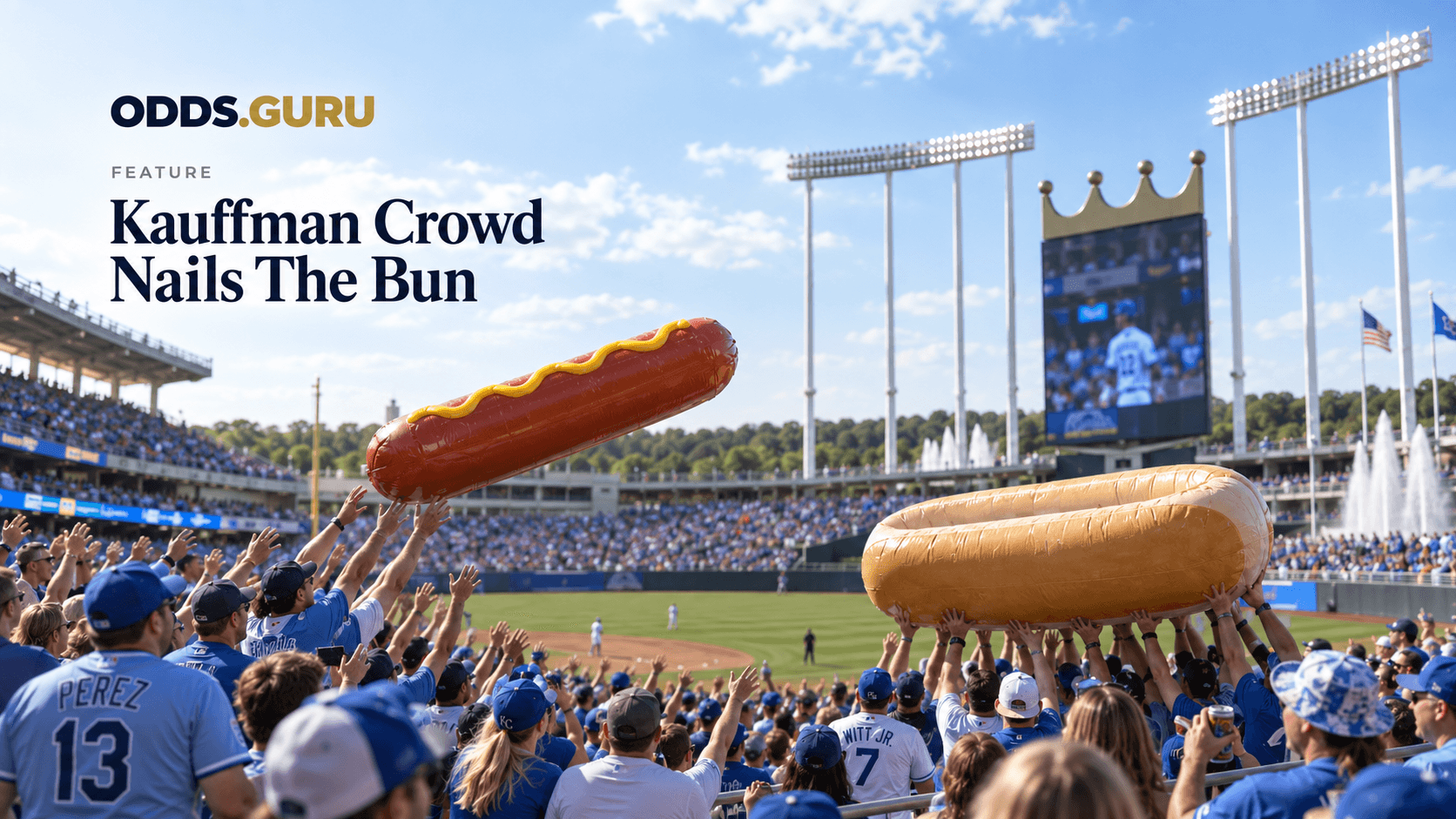
The mechanics are deliberately simple. The stadium is divided in two. One side is handed an oversized inflatable frankfurter branded by QuikTrip, the other an equally oversized inflatable bun. The two objects have to meet.
The scoreboard plays "Who Let the Dogs Out?", a 35-second countdown starts, and the assembled crowd has to move both inflatables across sections by hand until they line up. When it works, the jumbotron flashes "HOME BUN!"
Saturday's attempt got there with roughly three seconds left, according to a fan account of the sequence circulating alongside the video. The reward is not symbolic: completing the task inside the clock earns everyone in the building a free hot dog from the sponsor.
That is the entire concept. No skill component, no selected contestants, no prize wheel. It is a crowd-coordination problem with a hard deadline and a small, universal payoff — which is precisely why it produces the noise it does.
The moment carried on social media with a caption from Sportsnet — "THEY GOT THE HOT DOG IN THE BUN" — and spread from there through reposts and aggregator accounts, one of which cleared 11,800 likes on a single Instagram version.
The Royals inflatable hot dog landed with three seconds left, the Royals did not
The scoreboard around the stunt told a bleaker story for the home side.
Toronto opened the game against Seth Lugo and struck first. Alejandro Kirk reached on an infield single, a Josh Rojas throwing error let Vladimir Guerrero Jr. score from first, and Nathan Lukes drove in Kirk with an RBI single for a 2-0 lead.
Kansas City answered inside the same inning. RBI singles from Jac Caglianone and Salvador Perez levelled it at 2.
From there the game moved in short bursts:
- Kazuma Okamoto doubled home a run in the top of the third to restore Toronto's lead at 3-2.
- John Rave answered with a game-tying home run, and the score held at 3-3 into the seventh.
- With Craig Kimbrel pitching, Okamoto singled in the go-ahead run for a 4-3 Toronto lead.
- Neither side scored again.
Read in that context, the reaction inside Kauffman is less strange than it first appears. A crowd that has run out of meaningful things to shout about in September will happily redirect that energy at something it can actually win.
QuikTrip bought a stadium's attention for the price of one hot dog run
The sponsorship logic here is worth separating from the comedy.
QuikTrip, a convenience store and fuel chain, is paying for two things: the in-venue activation itself, and the free-hot-dog liability that triggers when the crowd succeeds. The second cost scales with attendance and with the success rate. The first is fixed.
What the brand received in exchange was a clip that ran through a national broadcaster's social account, aggregator pages, and general-audience feeds — with the sponsor's name printed on the inflatable in every frame. Several commenters made the point unprompted: the giveaway is the cheap part, the distribution is the return.
Compare that to conventional in-venue signage, which is seen by the people already in the building and almost nobody else. A promotion designed to be filmed vertically and shared is a different product from a rotating board behind home plate, even though both sit in the same line of a sponsorship deck.
There is a catch that clubs should price honestly. The activation only travels when it works. A failed attempt — inflatables stuck in an aisle, clock expiring, no free hot dog — produces a very different clip, and the sponsor's logo is just as visible in that one. Saturday's three-second finish was the good version of a coin flip that the crowd does not always win.
The Hot Dog Derby has company
Kauffman Stadium already owns one food-themed tradition. The Hot Dog Derby, a between-innings mascot race, has been part of the ballpark experience for years and is well established enough to have its own page on the club's website.
The QT Home Bun Race is a structurally different thing. The Derby is a spectacle the crowd watches; the Home Bun Race is a task the crowd performs. That distinction is the whole reason one of them generated a viral clip and the other, for all its longevity, generally does not.
Participation promotions are not new to baseball — the sport's dead time between half-innings has been filled with t-shirt cannons, kiss cams and dance contests for decades. What is different is the shared stake. Every person in the section has a reason to push the inflatable in the right direction, and the failure state costs everybody the same thing.
Kansas City is not the only venue running the format, but it has emerged as the one people are pointing at. If the Royals repeat it and it keeps landing, it stops being a stunt and starts being a fixture — the sort of thing visiting fans check the promotional schedule for.
The response, and its limits
Online reaction has been mostly affectionate and mostly about the crowd rather than the sponsor. A recurring theme across posts: Kansas City continues to fill seats and generate atmosphere well past the point where the standings justify it, which is a real observation about the fanbase even when it arrives wrapped in a joke about inflatable food.
A smaller strand of comment ran the obvious contrast — enormous payrolls elsewhere in the league versus a ballpark in Missouri deriving genuine collective joy from a piece of branded vinyl. It is a soft argument, but it is not an empty one. The moments that travel furthest out of a stadium are rarely the expensive ones.
What Saturday actually proves is narrow. Roughly 30-odd thousand people can move two large objects toward each other in half a minute when the incentive is a free hot dog. That is not a statement about the Royals' season, the Blue Jays' Wild Card position, or anything on the field.
It is, however, the clip from that game that anyone outside Kansas City and Toronto has seen — and for a team 9.0 games out of a playoff place in September, being the ballpark people want to watch is not the worst asset to own.
 Reddit