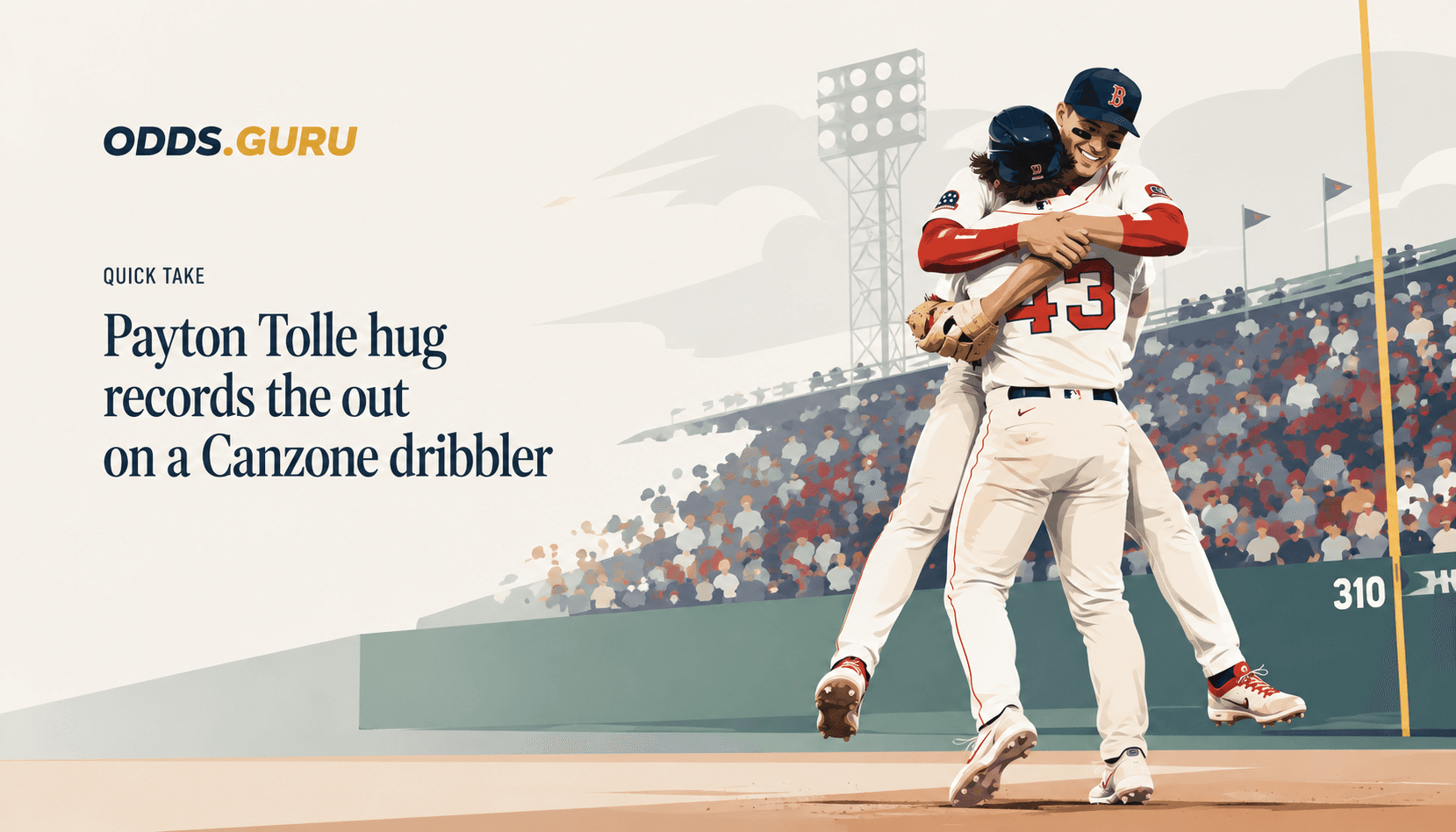
Boston led 3-2 when Canzone came up as Seattle's designated hitter. He got a 90 mph cutter, made weak contact, and rolled it straight back at the mound. What followed was not a throw and not a swipe tag. Tolle, a second-year major league pitcher, opened his arms and hugged the runner, and Canzone accepted it. The clip was posted by Rob Friedman on August 31 and travelled from there.
Third inning, 3-2, and a cutter at 90 mph
The mechanics of the play are ordinary right up until the last half-second, and that is the part worth slowing down.
A dribbler back to the pitcher on a cut fastball is the pitch working exactly as designed — jammed contact, no exit velocity, no chance. From that position a pitcher has two standard options: field it and throw to first, or, if the runner is close and the throw is awkward, step into the baseline and apply the tag directly.
Tolle took the second route:
- Weak contact on a 90 mph cutter, the ball dying back toward the mound.
- Tolle fielded it cleanly and moved into the runner's path, cutting off the lane to first.
- With the runner effectively dead, he skipped the quick tag and opened his arms.
- Canzone ran into the hug rather than around it, and the out went into the book.
The Payton Tolle hug worked because Canzone accepted it
A tag in baseball requires a fielder to touch the runner while holding the ball securely. Nothing in that definition specifies how much of the fielder does the touching. A hug is simply a tag with more surface area.
The risk is possession. Tags come apart when contact jars the ball loose, and a pitcher inviting a full-speed runner into his chest is not the low-variance version of the play. Tolle held on, and the umpire had a straightforward call to make.
The second risk is social rather than technical. Improvisation on a routine out sits close to the line that separates a joke two players share from a joke one player makes at the other's expense. Canzone's response settled it — he took part instead of brushing past, and the moment stayed mutual.
That distinction is the whole story. Had the runner shouldered through and kept walking, the same three seconds of video would have been filed under friction rather than warmth. Baseball's tolerance for this kind of thing has widened considerably over the past decade, but the tolerance is conditional, and the condition is consent.
There was no ejection, no warning issued and no dispute over the call in what has been reported. The play simply ended the at-bat.
Canzone's .253/.327/.475 season, and one soft grounder
Canzone arrived at that at-bat in a flat stretch. Through 121 games he was hitting .253/.327/.475 with 20 home runs and 59 RBI — real power production for a corner bat. Over the seven days before the Boston series, the numbers thinned out.
| Split | AVG/OBP/SLG | HR | RBI |
|---|---|---|---|
| 2026 season (121 games) | .253/.327/.475 | 20 | 59 |
| Last seven days (16 PA) | .200/.250/.400 | 1 | 3 |
Season and rolling seven-day splits for Dominic Canzone entering the Boston series, via pitcherstat.
The one bright spot in that recent window came at Toronto on August 28, a 2-for-4 game with a home run and an RBI. Then the flight to Boston and a three-game road set running August 31 to September 2.
None of that changes how the play should be read, but it does frame the at-bat honestly: a hitter in a cold week, jammed by a cutter, retired before he had a step to give. The out was a pitcher's out. There was no defensive gem underneath the comedy — no diving stop, no strong throw, nothing that would have made the highlight reel on merit.
Which is a large part of why the clip moved. A spectacular play gets replayed for the skill. This one got replayed because the skill was irrelevant and something else filled the gap.
A highlight with nothing attached to it
We should be plain about the scope here. This is a single defensive-play clip from a series opener, and it does not connect to anything larger.
No injury came out of the contact. No rule was tested in any meaningful way, because a tag is a tag whatever shape the fielder makes. Neither club's position in the standings turned on a third-inning out in a 3-2 game, and there is no on-record comment from either player in the reporting that has surfaced so far.
What the clip does document is a specific piece of on-field temperament. Tolle chose the theatrical version of a play he had already won, in a one-run game, against an opponent with every reason to be irritated. That is a small read on a young pitcher's disposition, and small reads accumulate.
The distribution path is worth recording too. Friedman's post on August 31 was the on-ramp; national aggregation followed inside a day, and the play was being written up by the following morning. Three seconds of video, no consequence attached, and it still outran most of the box scores from the same night.
Boston and Seattle finish the three-game set on September 2.
 Reddit