

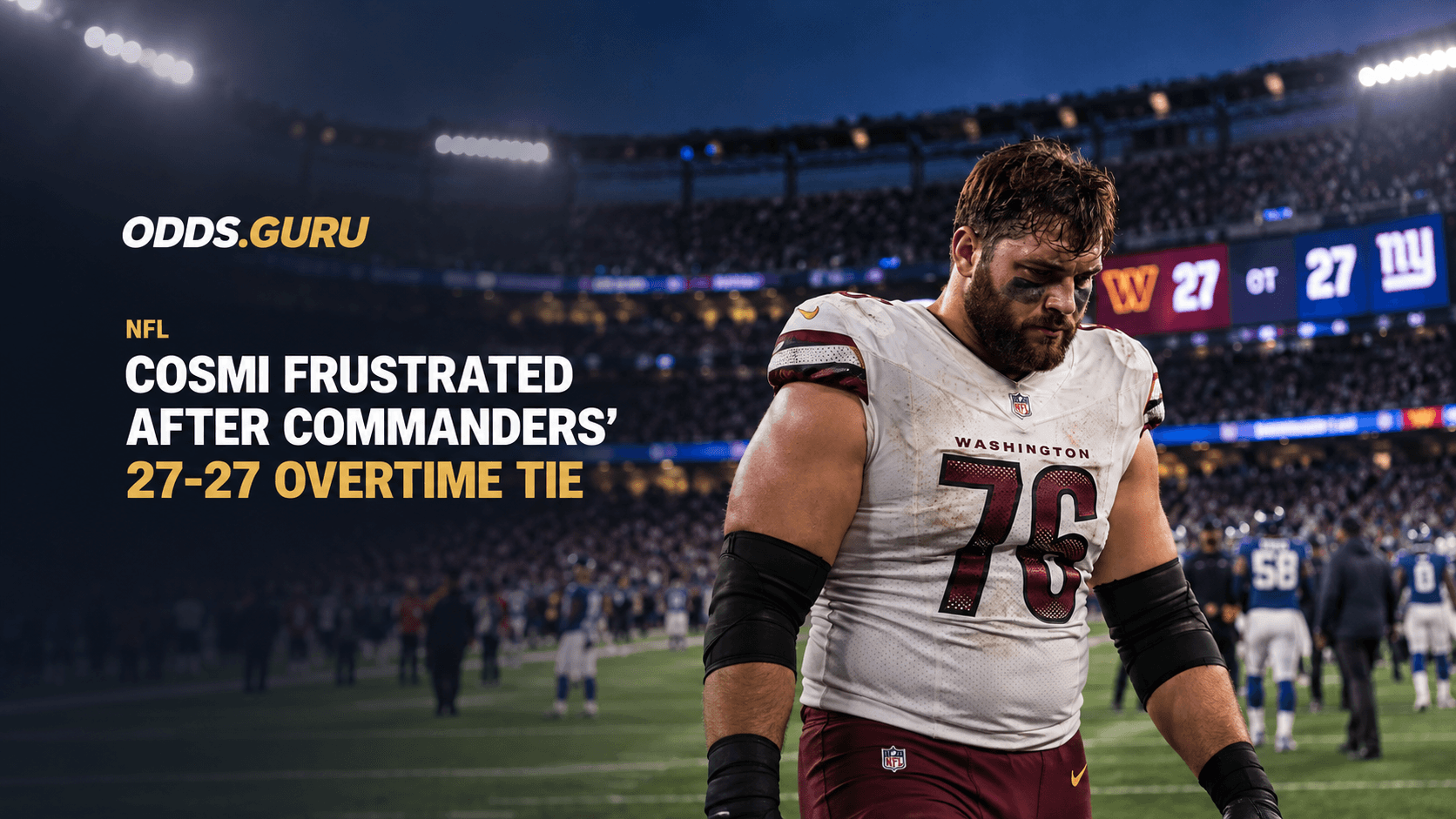
Sam Cosmi left the field asking, “What are we doing?” after the Washington Commanders drew 27-27 with the New York Giants on Sunday, October 11. Washington had a chance to win in overtime but allowed time to expire before Jayden Daniels could spike the ball and stop the clock.
Head coach Dan Quinn accepted responsibility afterward. For Washington, the ending compounded an earlier failure to protect a two-touchdown lead and left the team with one victory through five games.
Cosmi’s frustration followed his return from a concussion that had kept him out for two games. The right guard’s words captured the disappointment of the finish, although the target of his anger was unclear.
Sam Cosmi’s return ends with an unanswered complaint
Washington led 27-13 with 11:05 remaining in the fourth quarter. By the time Cosmi walked off the field, that advantage had disappeared, neither side had scored in overtime, and the Commanders had missed their final opportunity to turn possession into a winning attempt.
The result left Washington at 1-3-1, while New York moved to 3-1-1. A victory would have brought the Commanders to 2-3; instead, their second win remained out of reach despite a home game in which they led throughout much of regulation.
Cosmi’s postgame reaction was brief rather than a detailed account of the final sequence. His question expressed frustration, but it did not identify a particular decision, teammate or coach. There was no accompanying explanation establishing whether he was angry about the overtime possession alone or the wider collapse.
That distinction matters for the dressing room. A player visibly upset after a missed chance to win is not, by itself, evidence of a dispute with the quarterback or a rejection of the coaching staff. Cosmi’s reaction should not be expanded into either claim.
Quinn’s acceptance of responsibility supplied a clearer statement about accountability. The head coach owned the finish, while the on-field sequence ended with Daniels unable to stop the clock in time.
The consequence was concrete: Washington never reached the kick that could have decided the game. Whether that attempt would have succeeded is a separate uncertainty; the failure was losing the opportunity to take it.
Daniels produces 302 yards, but Washington cannot finish
Jayden Daniels returned to the lineup and supplied Washington’s strongest attacking moments. He completed 17 of 25 passes for 199 yards without an interception and added 103 rushing yards and two touchdowns on nine carries.
His 302 combined passing and rushing yards explain why the final mistake was so costly. Washington had received substantial production from its quarterback, including two long touchdown runs, without converting that performance into a victory.
The Commanders’ scoring was built around three substantial runs:
- Jacory Croskey-Merritt opened the scoring with a 33-yard touchdown run, finishing the game with 82 yards on 11 carries.
- Daniels scored from 38 yards in the third quarter to extend Washington’s lead to 19-6.
- Daniels added a 26-yard touchdown run in the fourth quarter, then found Terry McLaurin for the two-point conversion that made it 27-13.
Those figures show an offence capable of gaining far more than the minimum needed to sustain possessions. Croskey-Merritt’s opening touchdown completed a four-play, 69-yard drive. Daniels’ first touchdown capped a five-play, 77-yard possession, and his second finished an eight-play, 81-yard drive.
Five sacks complicate the offensive picture
Washington’s passing game was less comfortable than Daniels’ completion rate alone suggests. New York sacked him five times for 23 yards, reducing the Commanders’ net passing total to 176 yards.
Terry McLaurin caught all four of his targets for 62 yards, while Chig Okonkwo contributed 60 yards on four catches. Washington had receiving production alongside its rushing success, but no passing touchdown.
The sack total also places limits on any simple reading of the offensive line’s afternoon. Washington created room for three scoring runs and more than 200 rushing yards, yet Daniels was repeatedly brought down behind the line of scrimmage. The team totals do not assign individual responsibility to Cosmi or any other blocker.
Daniels’ contribution and the final failure belong in the same account. His running helped build the lead; his presence at quarterback also placed him at the centre of the sequence that ended without a spike. Neither fact removes the other.
Winston’s 326 yards bring New York back from 14 down
The Giants did more than wait for Washington to make a late mistake. Jameis Winston completed 33 of 54 passes for 326 yards and three touchdowns without an interception, repeatedly finding Isaiah Likely and Malik Nabers as New York recovered.
Washington led 12-3 at halftime and 19-6 after Daniels’ first touchdown run. New York’s response began with a 13-play, 63-yard possession that took 7:03 and ended in Winston’s three-yard touchdown pass to Likely with 44 seconds remaining in the third quarter.
Daniels then restored a two-touchdown advantage. The Giants answered again, this time with consecutive touchdown drives in the fourth quarter.
| Fourth-quarter score | Time remaining | Scoring play |
|---|---|---|
| Washington 27-13 | 11:05 | Daniels’ 26-yard run and a two-point pass to McLaurin |
| Washington 27-20 | 7:20 | Winston’s 17-yard touchdown pass to Likely, followed by the extra point |
| Tied 27-27 | 1:43 | Winston’s 17-yard touchdown pass to Nabers, followed by the extra point |
Likely finished with 11 catches for 94 yards and two touchdowns. Nabers caught 11 passes for 121 yards and a touchdown, including the score that brought New York level.
Together, they accounted for 22 of Winston’s 33 completions, 215 of his 326 passing yards and all three touchdown receptions. Washington’s defence could not prevent that concentrated production from turning into sustained scoring drives.
The Giants’ final two touchdown possessions covered 75 yards in nine plays and 72 yards in 10 plays. Both required New York to move down the field rather than capitalise on a short scoring opportunity.
That leaves Washington with a problem extending beyond the final overtime possession. The offence’s clock management determined how the game ended, but the defence had already allowed a 14-point advantage to disappear in the fourth quarter.
An untaken kick follows an uneven special-teams game
Washington’s failure to stop the overtime clock denied Drew Stevens a potential deciding attempt. He had made both of his field goals, from 28 and 40 yards, although he missed the extra point after the Commanders’ opening touchdown.
New York’s kicking performance was far less consistent. Dominic Zvada made two of five field-goal attempts, with successful kicks from 51 and 56 yards, and converted all three extra points.
Those numbers underline the distinction between securing an attempt and securing a win. Stevens had been accurate on field goals, but his earlier makes could not guarantee another. Washington’s mistake was allowing the clock to eliminate that possibility altogether.
The Giants also had missed opportunities to consider. Alongside three unsuccessful field-goal attempts, they lost two fumbles, one by Winston and one by Cam Skattebo. Washington lost no fumbles, and neither quarterback threw an interception.
Despite those advantages, the Commanders could not finish ahead. New York recovered from its mistakes through sustained passing production; Washington’s strong rushing performance was offset by sacks, a late defensive collapse and the wasted overtime possession.
Quinn has accepted responsibility for the ending. The unresolved detail is the precise breakdown between the sideline’s instructions and the offence’s execution before time expired. Cosmi’s short complaint did not explain that sequence or assign blame; it left Washington’s frustration plainly visible after a game it had been positioned to win.
 Reddit