200-plus letters, one candidate, zero suspense
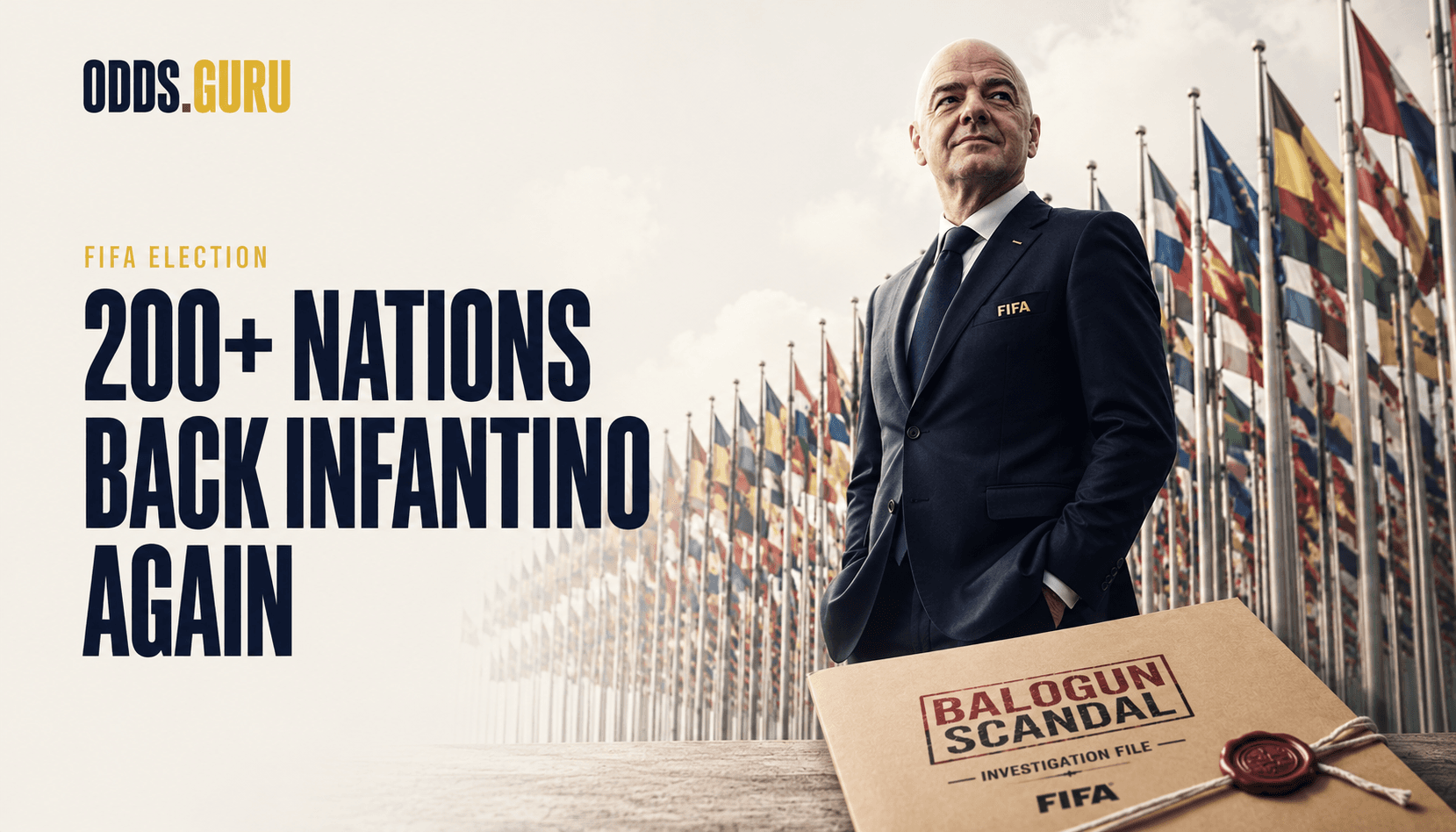
The number that decides this is 200. That's how many of FIFA's 211 member associations have already sent letters of support for Gianni Infantino, according to the Guardian's reporting, with only a handful still to declare.
Each of those 211 federations holds one vote. When more than 95% of the electorate has committed in writing months before the ballot, the March congress stops being a contest and becomes a ratification.
Infantino is, at present, the only declared candidate. He ran unopposed in 2019 and 2023, and nothing in the current tally suggests 2027 will break that pattern.
The holdouts are almost entirely European, and Germany is the most prominent name yet to file. Even there, the resistance is thin: Portuguese reporting puts European backing at 50 of the confederation's 55 members. The continent that is loudest in its objections has, in the main, already signed.
The confederation math was locked in long before the letters arrived. Africa and Asia — together 100 of the 211 members — announced their support before Infantino had even confirmed he was running. CONMEBOL had backed him earlier still. Three of the six confederations were his before the campaign began.
The Balogun reprieve, and the red line UEFA drew
What makes this landslide notable is its timing. It has firmed up in the weeks after the incident that was supposed to test Infantino's grip.
Folarin Balogun, the USA striker, was sent off against Bosnia and Herzegovina. His suspension was then lifted — after Donald Trump admitted lobbying FIFA to review the red card. FIFA's disciplinary committee leaned on article 27, the same provision used in November 2025 to trim Cristiano Ronaldo's three-match qualifying ban and clear him for Portugal's World Cup opener.
The committee's line was that reviewing the consequences of a red card is "nothing new in the modern game." That framing skipped the part that made this one different: it was reportedly the first time since 1962 that a player sent off at a World Cup finals avoided suspension. The legal grounds for the decision were never made public, which leaves little to hold the disciplinary body to.
UEFA did not hedge. It called the reprieve "unprecedented, incomprehensible and unjustifiable," and said FIFA had "crossed a red line."
Then came the line that stung most. Sepp Blatter — Infantino's predecessor, ousted in a corruption scandal and still banned from football — posted: "Red cards are not overturned by political phone calls." When the man FIFA exiled is the one lecturing it on integrity, the optics have gone sideways.
The inconsistency is where the anger concentrates. In the same fortnight, FIFA opened a disciplinary investigation into two Argentina players for holding up a "Las Malvinas son Argentinas" banner after beating England — enforcing its ban on political statements to the letter. Belgium's federation, meanwhile, said it was "astonished" and challenged Balogun's eligibility; FIFA rejected the appeal, ruling the association had no standing to bring it.
The rulebook, in other words, was applied strictly to a banner and set aside for a phone call. That contrast, more than the reprieve itself, is what Europe keeps returning to.
The arithmetic of an Infantino fourth FIFA term
Follow the money and the loyalty starts to make sense. An Infantino fourth FIFA term is being underwritten by the same distributions that have kept the electorate content for a decade.
At the Vancouver congress where he announced his candidacy, Infantino promised the 211 members a combined $2.7 billion (£1.98bn) in distributions over the next four years. The current cycle already guarantees each association a baseline of $8 million. He has also thrown something to the bigger federations, raising the payout to each of the 48 World Cup teams by more than $2 million.
His pitch to the room is blunt and effective — "FIFA's money is your money" — paired with the reminder that, by his account, three-quarters of the members could not run organised football without FIFA's support. That claim is disputed. The votes are not.
Here is the shape of the machine that keeps re-electing him:
| Lever | Figure |
|---|---|
| Members backing him | 200+ of 211 |
| European federations on board | ~50 of 55 |
| Distributions pledged (4 years) | $2.7bn / £1.98bn |
| Baseline per member (2023–26) | $8m |
| Extra per World Cup team | $2m+ |
| Terms served if re-elected | up to 15 years |
That final row is its own controversy. FIFA's statutes cap presidents at "no more than three terms." Infantino's workaround, "clarified" to him on the eve of the 2022 World Cup final, is that his first stint from 2016 to 2019 doesn't count — it wasn't a full four-year term. The reading clears him to serve up to 15 years.
Germany's silence, and Europe's missing challenger
The interesting variable now is procedural, not political. Candidates must be nominated by 18 November, and until then letters can be withdrawn or transferred to a rival. That is the only window in which the arithmetic could shift.
Talk of a Europe-backed challenger has, per the reporting, gained real traction behind closed doors over the past ten days. But the prospect of multiple federations agreeing on a single name feels remote. UEFA has made its opposition plain — on Balogun, and on the barring of Somali referee Omar Artan from the World Cup — yet it is unclear whether its leadership would formally endorse anyone.
The bar being discussed is deliberately modest. Sources close to European football suggest a candidate who could gather 30 or 40 votes wouldn't win, but would at least force a public debate about FIFA's governance and direction. Even that looks like a stretch right now.
There is one detail worth holding onto: some associations say they were pressured from inside FIFA to declare early. FIFA's own ethics code is meant to forbid exactly that kind of lobbying. So a share of these 200-plus endorsements may reflect institutional pressure as much as genuine conviction — a distinction that matters if the mood ever turns and letters start getting withdrawn before November.
For now, none of it moves the needle. The members convene in New York this Saturday with Infantino chairing, and the recent scandals are unlikely to reach the agenda. The topic more likely to dominate is the World Cup's financial performance — and what gets passed back to the federations.
That, in the end, is the story. Spain won the trophy at MetLife, Trump handed it over, and the tournament threw the longest half-time show in World Cup history at 27 minutes and 22 seconds. But the other winner walked away untouched. The scandal that should have been a reckoning produced an overwhelming show of support instead — which, for anyone hoping FIFA might hold itself to account, is the most telling result of all.
 Reddit