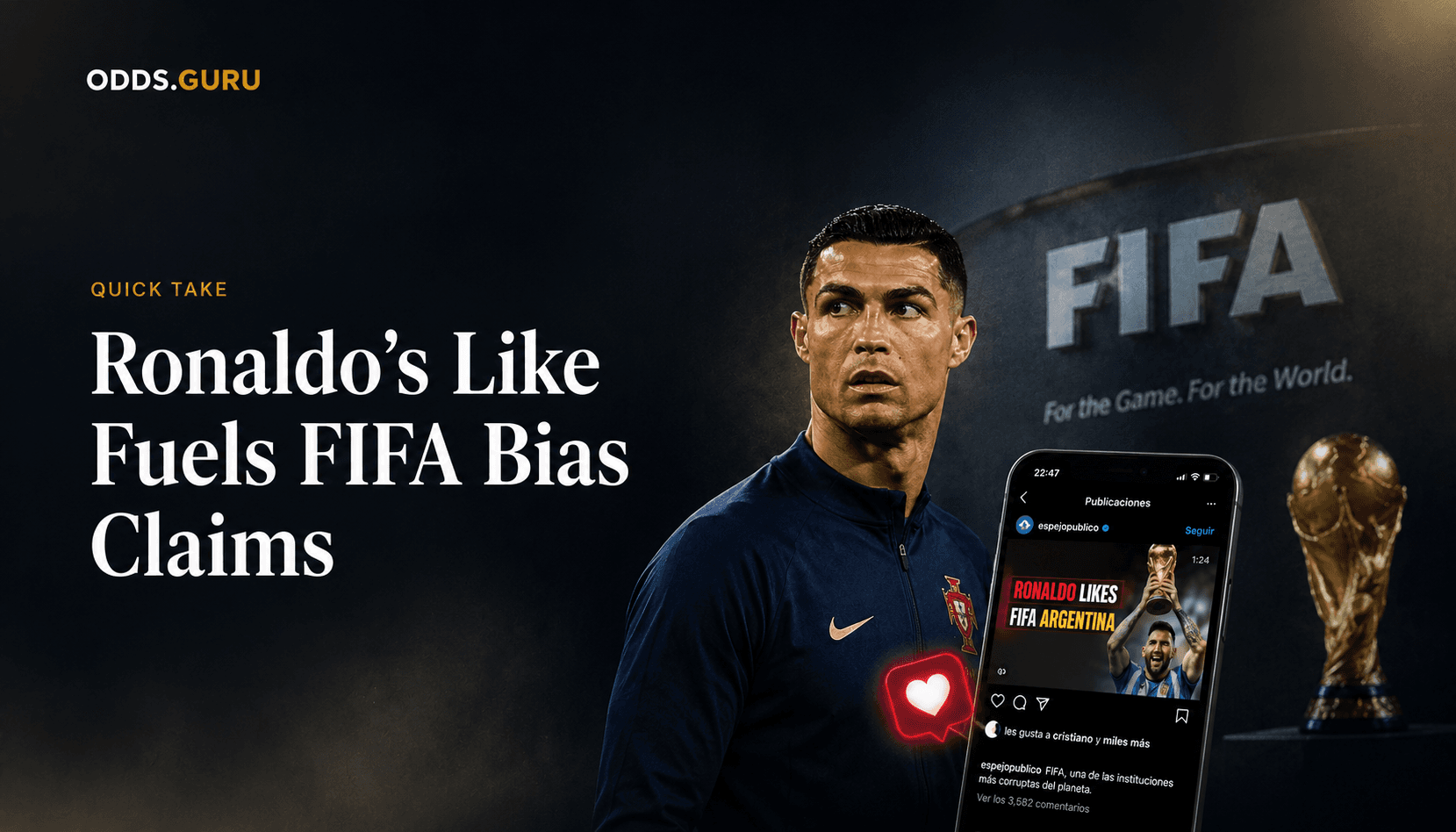
A social interaction that takes half a second to register is now doing a lot of narrative work. That is the short version of the Ronaldo likes FIFA Argentina video story.
The 'Ronaldo likes FIFA Argentina video' clip, line by line
The clip that started this was not subtle. On the Spanish programme Espejo Público, journalist Pilar Rodriguez Losantos argued that Argentina "should have been eliminated at least five matches ago" and were "only still in the tournament thanks to help from FIFA, which is one of the most corrupt institutions on planet earth."
She went further, naming the governing body's president directly: "I'm not afraid of Argentina at all; I'm more afraid of Gianni Infantino. I think we're not going to play against Argentina, but against the whole of FIFA, who want to hand the World Cup to Lionel Messi."
A second panellist, Ruben Amon, called FIFA a "mafia" and an "abject... shameful organisation," tying his complaint to ticket pricing that he said had turned football into "an experience reserved for the elite."
That is the content Ronaldo's account liked. Eagle-eyed fans flagged the interaction on Monday, 20 July, and it spread from there. No caption, no statement, no interview — just a like, screenshotted and passed around.
A few things are worth holding onto before the theory runs away with itself.
- A "like" is not a signed op-ed. Accounts of this size are managed, feeds move fast, and an interaction can be logged without much thought behind it. We would treat it as a signal, not a confession.
- The clip is opinion, not evidence. Losantos's "five matches ago" line is rhetoric, not a refereeing audit.
- The messenger has a stake. This aired on Spanish television, days before Spain — the side that knocked Portugal out — met Argentina in the final. A Portuguese icon amplifying Spanish media's case against Argentina is not a neutral data point.
Argentina's knockout run, and the calls that drew the accusations
The favouritism theory did not appear from nowhere; it was built on a run of disputed decisions, and those are the concrete parts of this story.
The loudest came in the last 16, where Argentina edged Egypt 3-2. Egypt had Mostafa Ziko's second-half goal ruled out for a foul in the build-up, and manager Hossam Hassan did not hide his reading of it afterwards.
"It's all about money. They want Messi to stay in the tournament," Hassan said. "In football, many things happen off the pitch because of interests. What happened was unfair. Egypt deserved to qualify. We were the better team."
From there, the grievances stacked up. A VAR review reduced Switzerland to ten men in the quarter-final, and a "number of decisions" were read as going Argentina's way in a 2-1 semi-final win over England, a match in which Messi supplied two assists.
| Round | Result | The disputed moment |
|---|---|---|
| Last 16 | Argentina 3–2 Egypt | Ziko's goal chalked off for a build-up foul; Hassan alleges bias toward Messi |
| Quarter-final | Argentina beat Switzerland | VAR intervention reduces Switzerland to 10 men |
| Semi-final | Argentina 2–1 England | Several calls read as favouring Argentina; Messi two assists |
| Final | Spain 1–0 Argentina | Argentina lose; post-match altercations; FIFA opens a case |
Here is the honest problem with the pattern, and we would flag it in either direction. Every deep World Cup run collects contested calls, because every knockout tie is one refereeing judgement away from a different result. A串 of decisions that feel one-sided is not the same as proof that a governing body engineered them. The clip treats correlation as intent. It might be right; it has not shown its work.
The final flipped the story — and that cuts both ways
Then Sunday happened, and the plot turned in a way the pre-match clip did not anticipate. Spain beat Argentina 1-0 in New Jersey. Argentina, supposedly ushered toward a coronation for Messi, could not score.
That result is doing double duty in the argument right now.
For the skeptics, it is the cleanest rebuttal available: if FIFA truly wanted to "hand the World Cup to Lionel Messi," it did a spectacularly poor job of it in the one match that decided the trophy. A rigged tournament that ends with the favoured team losing is not much of a rig.
For the believers, the loss changes nothing about the path. The accusation was always that Argentina were helped to reach the final, not to win it — and a 1-0 defeat does not retroactively re-award Ziko's goal or put Switzerland's eleventh man back on the pitch.
Both readings are live, and neither is settled by the scoreline alone.
What complicates the favouritism framing further is where FIFA's attention actually landed after the whistle. Members of the Argentina squad were involved in altercations with Spain players, and — as reported by the BBC — FIFA has since opened an investigation into Argentina's conduct. That case could end in player suspensions or fines for the Argentine Football Association. A body accused of protecting Argentina is now, days later, the one weighing disciplinary sanctions against them. That tension is real, and it sits awkwardly on top of the corruption claim.
Where Ronaldo actually sits in this
The reason a single like travels this far is the person attached to it, and his own summer gives the gesture its edge.
Ronaldo's World Cup ended in the round of 16, with Portugal beaten by eventual champions Spain in Dallas. At 41, he was the second-oldest player at the tournament, behind only Scotland goalkeeper Craig Gordon, and he confirmed afterwards that it was his last World Cup appearance.
"I am sad to leave like this but I have given everything, always given my best," he said. "I go with a clear conscience... It was my last World Cup, but as far as the rest of it is concerned: there will be time to think, to be with my family, [I will] not make decisions in the heat of the moment."
Hold that final line next to the Instagram like, and you get the whole ambiguity in one frame. A man who publicly counselled against decisions made in the heat of the moment appeared to make exactly that kind of interaction on his way out of the tournament — nudging a corruption claim aimed at the sport's governing body.
The Messi comparison writes itself, and it is part of why this resonates. By 2030 the Argentine will be 42, turning 43 during the tournament, his international future openly uncertain. Two of the era's defining rivals are exiting the World Cup stage at almost the same moment; one via a 1-0 final defeat, the other via a like on a video questioning how his rival got there.
So the speculation is not really about whether FIFA fixed anything — the evidence for that remains a talk-show assertion and a handful of contested VAR calls. It is about durability. Fringe theories usually fade once the trophy is lifted. This one now carries the biggest amplifier in the sport, however lightly it was applied, at the exact moment fans are looking for a story to explain a chaotic tournament. Whether a half-second tap gives an unproven bias narrative real staying power, or gets quietly written off as an algorithm-managed account catching a stray, is the part no one can settle yet.
 Reddit