Skip to content
Markets
Markets updating…
OddsGuru

A 64-Team World Cup Would Leave Only a Handful of Host Nations

A capacity-based map of qualifying stadiums lands as CONMEBOL pushes to double the field again — and the hosting arithmetic is unforgiving.

M

By

News & Analysis · odds.guru

Published 6 min read
A 64-Team World Cup Would Leave Only a Handful of Host Nations
Quick Take
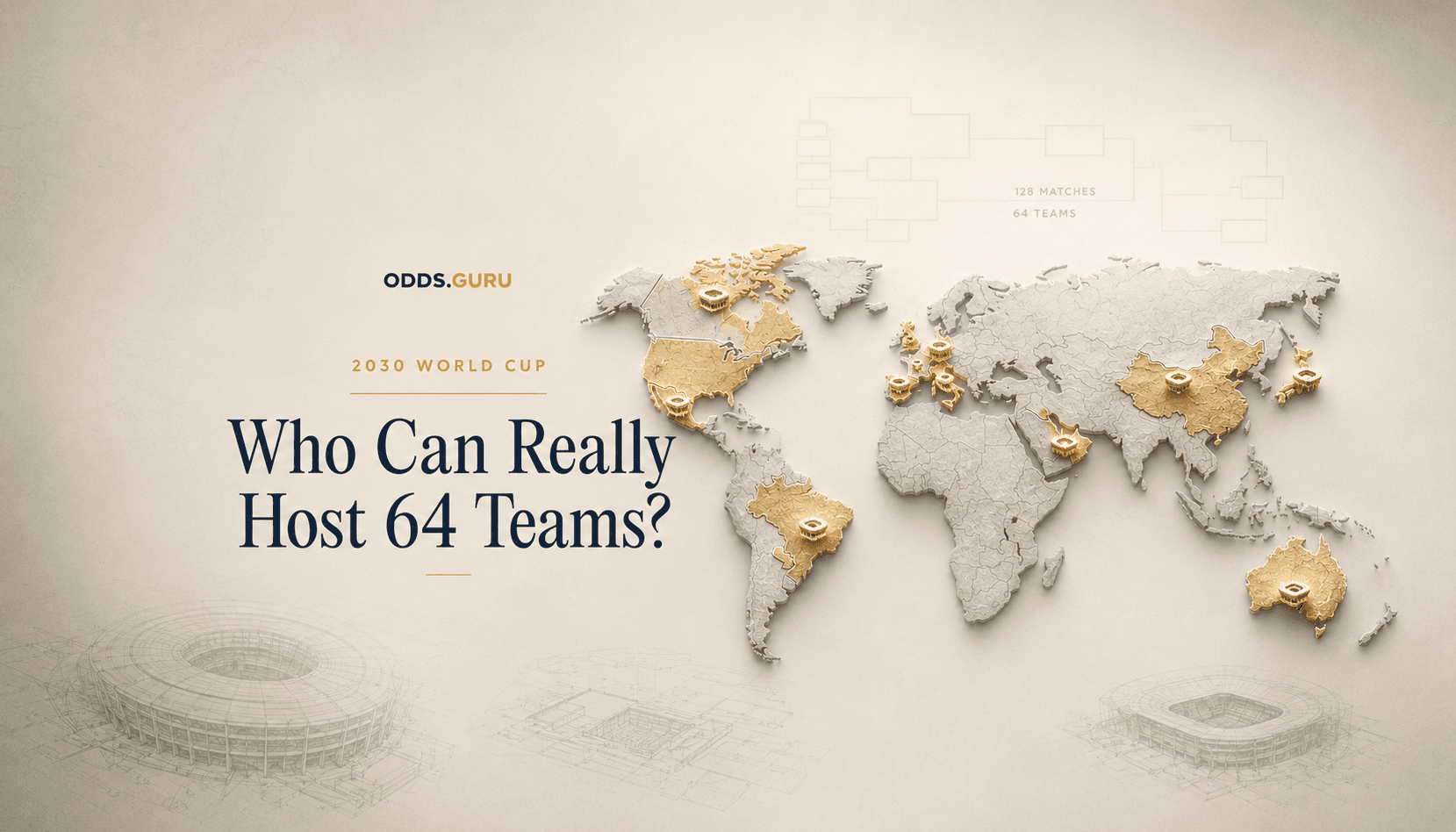
  1. 1.An original world map plotting only the stadiums that clear FIFA's minimum-seating standards lays out, country by country, who could realistically stage a 64-team World Cup — and the answer is very few.
  2. 2.It matters because CONMEBOL has formally pitched FIFA to expand the 2030 centenary tournament to 64 teams and roughly 128 matches, a jump that pushes venue demands past what most single nations own.
  3. 3.The open question is whether major tournaments become the standing preserve of a handful of mega-hosts and permanent multi-country blocs.

The pitch that started the arithmetic

The idea moved from corridor talk to formal proposal fast. It was first "spontaneously raised" by Uruguayan Football Federation president Ignacio Alonso during the "any other business" section of a FIFA council meeting in March 2025, then presented at FIFA congress in April by CONMEBOL, which frames it as a one-off way to mark the World Cup's 100th anniversary.

In September, senior South American figures — CONMEBOL president Alejandro Dominguez, the heads of the Argentine, Paraguayan and Uruguayan federations, plus two sitting heads of state — took the case directly to FIFA's New York headquarters.

The scale of the jump is the whole story. The World Cup ran on 16 teams for decades, moved to 24 in 1982, settled at 32 in 1998, and expands to 48 for 2026. Adding another 16 for 2030 would double the field in eight years and put more than 30% of FIFA's 211 members in the finals.

The format most observers expect is a scaled-up version of the classic template: 16 groups of four, top two through, a 32-team knockout starting at the Round of 32. Total match count lands near 128 — up from the 104 already scheduled for 2026 and double the 64-game era that ran through 2022.

Opinion inside FIFA is split. President Gianni Infantino said "every idea is a good idea." UEFA's Aleksander Ceferin called expansion a "bad idea" for both the tournament and qualifying. Concacaf's Victor Montagliani said it "doesn't feel right," and AFC president Sheikh Salman bin Ibrahim Al Khalifa warned it would bring "chaos." The FIFA council holds the final call, and there is no sign of an imminent vote.

The stadium bar a 64-team World Cup would set

The reason a capacity map is the right lens: FIFA's seating thresholds are fixed and public, and they scale with the stage of the match.

  • 40,000 minimum for group-stage and early-round matches.
  • 60,000 minimum for quarter-finals and semi-finals.
  • 80,000+ for the opening match and the final.
  • Every venue must be all-seater — no standing terraces.
Those numbers are the filter. A stadium that seats 38,000 or runs on bleacher seating does not clear the door, regardless of atmosphere or history. That is exactly the wall the mapped analysis runs into: plenty of large grounds worldwide fail on seating type or configuration rather than raw headcount, and the pool that meets all the capacity standards out of the box is thinner than the global stock of "big stadiums" suggests.

The 2026 field illustrates the top and bottom of the band. Its 16 venues stretch from AT&T Stadium in Dallas at roughly 94,000 down to BMO Field in Toronto at 45,000, with Estadio Azteca at about 87,500 carrying the opening match. Only a subset of any country's grounds sit in that range and satisfy the all-seater, sightline, media and security specifications at the same time.

Now apply the 128-match load. A 64-team event does not simply need bigger stadiums; it needs more of them, concurrently, plus the supporting web around each — training pitches that match the main surface, hotels close enough for team bases, and airports that can move squads, officials and supporters between host cities on a compressed schedule.

Why 2030 already reads as a blueprint for consolidation

The 2030 tournament was designed as a multi-continent event before the 64-team idea gained traction. Main hosts Spain, Morocco and Portugal carry the bulk of the schedule across a planned 20 stadiums (23 venues once three centenary matches in Uruguay, Argentina and Paraguay are counted), spanning six countries and three continents.

That spread is the tell. Even at 48 teams, the centenary edition needed a coalition to assemble the venue base. Push to 64 and 128 matches, and the pool of single nations that could shoulder it alone narrows to the largest, wealthiest football economies — the kind that already own multiple 60,000-plus all-seater grounds and the airport-and-hotel density to feed them.

FIFA's own framing runs the other way. Infantino has pitched expansion as growing the game — more teams, more representation, more investment worldwide. The venue math complicates that message. Broader qualification lets more nations reach a World Cup; it does not follow that more nations can host one. If anything, the capacity bar concentrates hosting in fewer hands even as the field widens.

There is a revenue logic pulling the same direction. FIFA expects to earn around $11bn across the four-year cycle to December 2026, and more matches point to larger broadcast and sponsorship inventory. Bigger commercial returns, though, are precisely what raise the infrastructure floor a host must clear.

What the map does — and doesn't — settle

The exercise is a discovery signal, not a rulebook, and it comes with real caveats. Stadium counts shift with temporary seating, which FIFA permits to top up capacity for specific matches, and with retrofits that convert bleacher or terrace sections to individual seats. A ground outside the qualifying set today can be inside it after a renovation cycle — the 2026 hosts spent heavily bringing existing venues up to standard, Azteca among them.

So the map is best read as a snapshot of ready-now capacity rather than a permanent ceiling. What it captures cleanly is the gap between the number of countries that can send a team and the number that can build a 128-match tournament without a coalition or a construction programme.

The consolidation question, unresolved

Strip the proposal to its logistics and a tension sits at the centre. A 64-team World Cup is sold as the most inclusive edition ever conceived, opening the finals to nearly a third of FIFA's membership. The venue requirements that come attached point the opposite way, toward a hosting model dominated by a small set of mega-hosts and standing multi-nation blocs.

FIFA's council has not committed to the expansion, and the loudest confederation presidents outside South America remain opposed. But the mapping exercise reframes the debate usefully. The sharpest objection to 64 teams may not be about diluted group-stage drama or watered-down qualifying. It may be about who is left able to host at all once the field doubles again — and whether the World Cup's next century belongs to the few countries that can physically hold it.

What people are saying

The point that stadiums are the easy part cuts to the real barrier: airports, transit, hospitality and healthcare surges are what actually decide a bid, and a bare seat-count map flatters countries that could never absorb the logistical load.

C
u/Corporate_BanksterReddit2026-07-26

Stadiums are the easiest bit. You need much more than that to host Things like international airports, transportation infrastructure between host cities, mass transit within host cities, telecom infrastructure, hospitality infrastructure, healthcare infrastructure, training facilities, public spaces and services able to withstand a surge in visitors, security and first responding capabilities, etc. Even stadiums are not created equal. Some sorry 40k seat stadium in Senegal or Lybia isn’t comparable to a 40k stadium in Europe The map massively understates the difficulty of the task. If anything it makes the matter look very manageable Then there is the most important bit of all: can you package that and sell it to the world as a dream experience? That’s the kind of things you can’t capture in scorecards and pivot tables and what have you - the reality is that with the exception of Qatar, every World Cup host has a global brand that makes it desirable for visitors the world over one way or another

The methodology question is the crux — whether you count only turnkey venues or those a retrofit away swings the US total wildly, and eight college stadiums over 100k could tip the map from tight to trivial depending on where FIFA draws the line.

L
u/LowEffortUsername789Reddit2026-07-26

How did you determine which stadiums count? Is it only the ones that meet all of FIFA’s requirements out of the box without any need for modifications? The US has way more stadiums that could be used for a World Cup than what’s on this list. There are 8 college football stadiums with over 100k capacity, but they’d need to switch from bleacher seating to individual seating.

The single-host era does look finished on the numbers, and the Hanoi crowd-crush worry sharpens why: multi-nation bids spread the venues but multiply the crowd-management and border-transit problems nobody has solved at this scale.

L
u/Longjumping_Excuse_1Reddit2026-07-26

I think its almost the end of single hosting countries. There are very few with the stadiums and money to overhaul infrastructure. I'd love an South East Asian joint world cup between 6-7 countries but just imaging hundreds of fans trying to cross a street in Hanoi, people going to end up dead.

The tension here is worth naming: FIFA sells expansion as growing the game, yet a capacity map that leaves most of Africa short exposes how few confederations can actually stage the event they are being told it is for.

R
u/RegionComplex7304Reddit2026-07-26

Map really shows how ridiculous the 64 team idea gets, most of the world just cant handle it. Like Africa has what one or two countries with enough big stadiums and even those are probably for other sports. FIFA keeps pretending its about growing the game but its really just USA, China and maybe a joint Europe bid every cycle now

Comments sourced from public Reddit threads. Individual experiences may vary.

Related Market

What do you think?

Will Claudia Sheinbaum leave President of Mexico before Jan 1, 2027?

Share:
M

Contributor

News & Analysis · odds.guru

View Marcus's profile

Marcus Chen covers news, industry developments, and timely analysis for odds.guru. His archive also includes earlier guides and platform explainers.

Industry newsSports bettingPrediction markets

About this byline: Marcus Chen is an editorial pen name used by odds.guru for news and analysis, with earlier guides and platform explainers retained under the same byline. Articles carrying this byline are approved by an accountable editor under our editorial standards. Read our editorial standards.

Related guide: How to Bet on Football: The Complete Guide

AI & editorial disclosure

OddsGuru may use AI tools to support research, drafting, editing, formatting, and production workflows. Every published article is reviewed and approved by an editor before publication. AI tools do not publish articles independently, and editorial responsibility remains with the OddsGuru team. Read our AI usage policy

Affiliate & risk disclosure

OddsGuru may earn a commission when readers visit partners through links on this page. Our news coverage is informational only and should not be treated as betting, financial, legal, or investment advice. Odds, prices, markets, availability, and eligibility can change. Always check the operator's terms and gamble responsibly. Affiliate disclosure · Responsible trading · Terms