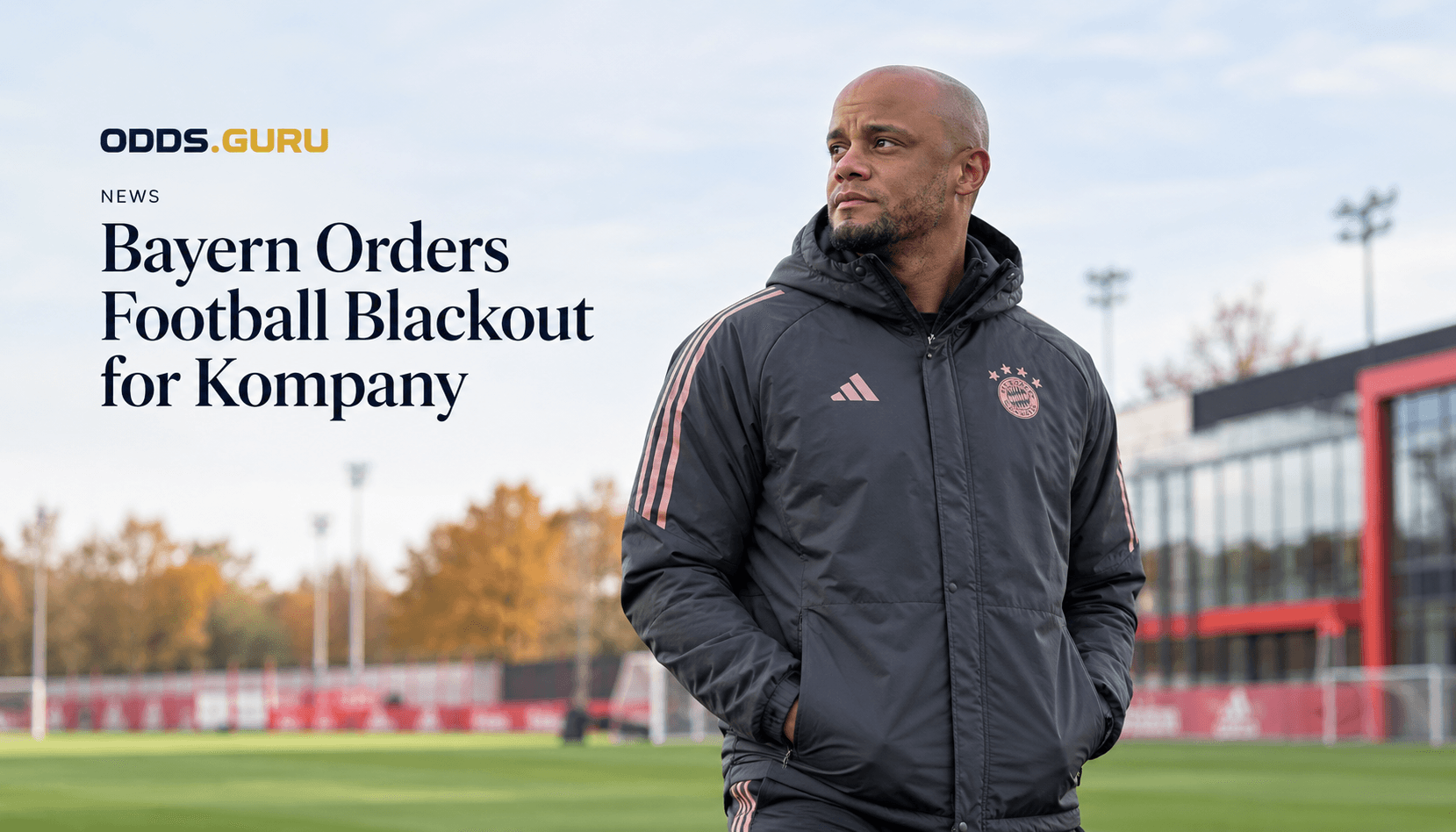
Bayern Munich has instructed its coaching staff not to discuss tactics, match analysis or team selection with Vincent Kompany while he recovers from meningeal irritation symptoms. The restriction covers phone calls and personal visits, and assistants must not engage even if the head coach introduces the subject himself.
Interim manager Aaron Danks confirmed the arrangement ahead of Bayern’s Bundesliga meeting with Borussia Dortmund. Kompany, 40, has been discharged from hospital following his collapse at the club’s training ground, but remains on medication and has been told to rest fully at home.
Vincent Kompany’s recovery extends beyond hospital discharge
Kompany’s release from hospital has not brought permission to resume work. Medical staff have advised him to suspend football duties, and Bayern’s leadership has extended that instruction to the conversations through which a manager could otherwise remain involved from home.
The distinction has practical consequences. Staying away from the training ground would still leave room for reviewing an opponent, discussing a starting lineup or advising an assistant over the phone. Bayern has closed those routes while Kompany continues his recovery.
He collapsed while observing an Under-23 training session at Säbener Straße, losing consciousness and requiring emergency treatment. He was taken by helicopter to a Munich hospital. Subsequent updates described treatment for meningeal irritation symptoms; a date for his return to coaching has not been set.
Kompany had experienced health problems before the collapse. He had been working after a viral infection without sufficient rest, including staying up late to analyse match footage. That history gives context to the club’s insistence on a complete break, although it does not establish the medical cause of the emergency.
Eberl declines to set a deadline
Max Eberl, Bayern’s board member for sport, made clear after the incident that the club was preparing for an absence measured in weeks rather than days.
“He will get all the time he needs. We aren't going to start setting any time windows,” Eberl said. “We won't be talking about days, we'll be talking about weeks, that must be clear to all of us.”
That statement described Bayern’s approach to the absence, rather than a fixed recovery schedule. Leaving hospital was a step forward, but the club has continued to separate that development from readiness to manage the first team.
Eberl also acknowledged the difficulty of persuading a coach accustomed to constant activity to stop.
“Vinnie just wants to do and act,” he said.
Bayern’s response places responsibility on the people around Kompany as well as on the manager himself. His assistants have been instructed to keep work out of their contact with him, removing the opportunity for a welfare call to become a discussion about the next match.
Eberl and Freund’s instruction reaches every football call
Asked whether tactical conversations with Kompany could resume, Danks left little room for interpretation.
“No, absolutely not. Not at all. We are taking the situation very seriously,” he said.
Danks identified Eberl and sporting director Christoph Freund as the executives behind the instruction. Their direction was to avoid those discussions from the outset and allow Kompany to concentrate on his health and time with his family.
The restriction covers the main areas in which a head coach would normally guide his assistants:
- Tactics: discussions about the team’s approach to matches.
- Match analysis: reviewing performances and preparations.
- Team selection: conversations about the starting lineup and player choices.
That detail makes the policy more demanding than a request not to disturb him. An assistant cannot treat a question from the manager as permission to bring him back into the working day. The instruction remains in place even when Kompany wants to contribute.
Contact itself continues. Danks described an earlier conversation in which he checked on the head coach while making clear that football was excluded.
“I spoke to him last night and told him that we will not be having any football conversations. I only wanted to know how he was doing. We're taking care of everything,” he said.
The arrangement preserves personal support while transferring the immediate workload to the staff still at the club. Eberl and Freund have given Danks explicit backing to maintain that separation.
Danks prepares Bayern without remote tactical input
The restriction remained in force during preparations for Borussia Dortmund. Bayern therefore approached a major Bundesliga fixture without seeking Kompany’s advice on tactics or selection, leaving Danks and the coaching staff to handle the work.
For Danks, that responsibility goes beyond representing the absent manager at a press conference or standing in the technical area. The ban removes the option of calling Kompany to resolve a selection question or discuss a change in approach.
The staff must prepare the team within the arrangements already in place, while taking responsibility for the decisions that arise during his absence. Kompany’s existing work remains part of Bayern’s preparation; fresh consultation with him is excluded.
There is an immediate sporting cost to that choice: Bayern cannot draw on its head coach’s judgement as preparations develop. The club has accepted that limitation, with Danks explaining that the purpose is to give Kompany the rest needed to return fully fit.
“We want him to rest and recover properly so that when he returns to us, he is fully fit and can help us in the best possible way,” Danks said.
“We are being very strict here and are completely keeping football out of it.”
A recovery policy backed by the executives who appointed him
Eberl and Freund were central to bringing Kompany to Bayern in summer 2024. Their involvement in enforcing his break adds context to the decision: the same executives who backed his appointment are now limiting his access to work.
Eberl recently recalled that an initial telephone conversation with Kompany during the recruitment process lasted four hours, ending only because he had another meeting. Freund subsequently came away convinced by the coach as well.
Kompany arrived after taking Burnley into the Premier League and then suffering relegation the following season. Bayern nevertheless backed his football philosophy. Since his appointment, the club has won two Bundesliga titles, two DFL Supercups and one DFB Cup.
Those results explain the importance of the manager Bayern is temporarily working without. They also put the current decision in perspective: the executives are protecting the recovery of a coach they recruited for a sustained role, while asking his assistants to manage the immediate demands.
The collapse also disrupted Bayern’s youth team
The consequences of the emergency extended beyond first-team preparations. Kompany collapsed in front of young players during the Under-23 session, and Bayern postponed the reserve team’s scheduled fixture after the incident.
Eberl described the effect on players aged 17 and 18, some of whom had little experience of witnessing a medical emergency.
“For 17 or 18-year-old boys, that was overwhelming and that is only human,” he said. “Many people haven't had negative experiences yet, so luckily we were able to postpone the game.”
The postponement addressed a different consequence of the same event. While Kompany needed treatment and the senior coaching staff took over his duties, the younger players were given space after witnessing his collapse.
Bayern has not announced when the restrictions on football discussions will be lifted. For now, Kompany remains at home receiving treatment and resting, with Danks handling preparations and personal contact kept focused on the head coach’s wellbeing.