

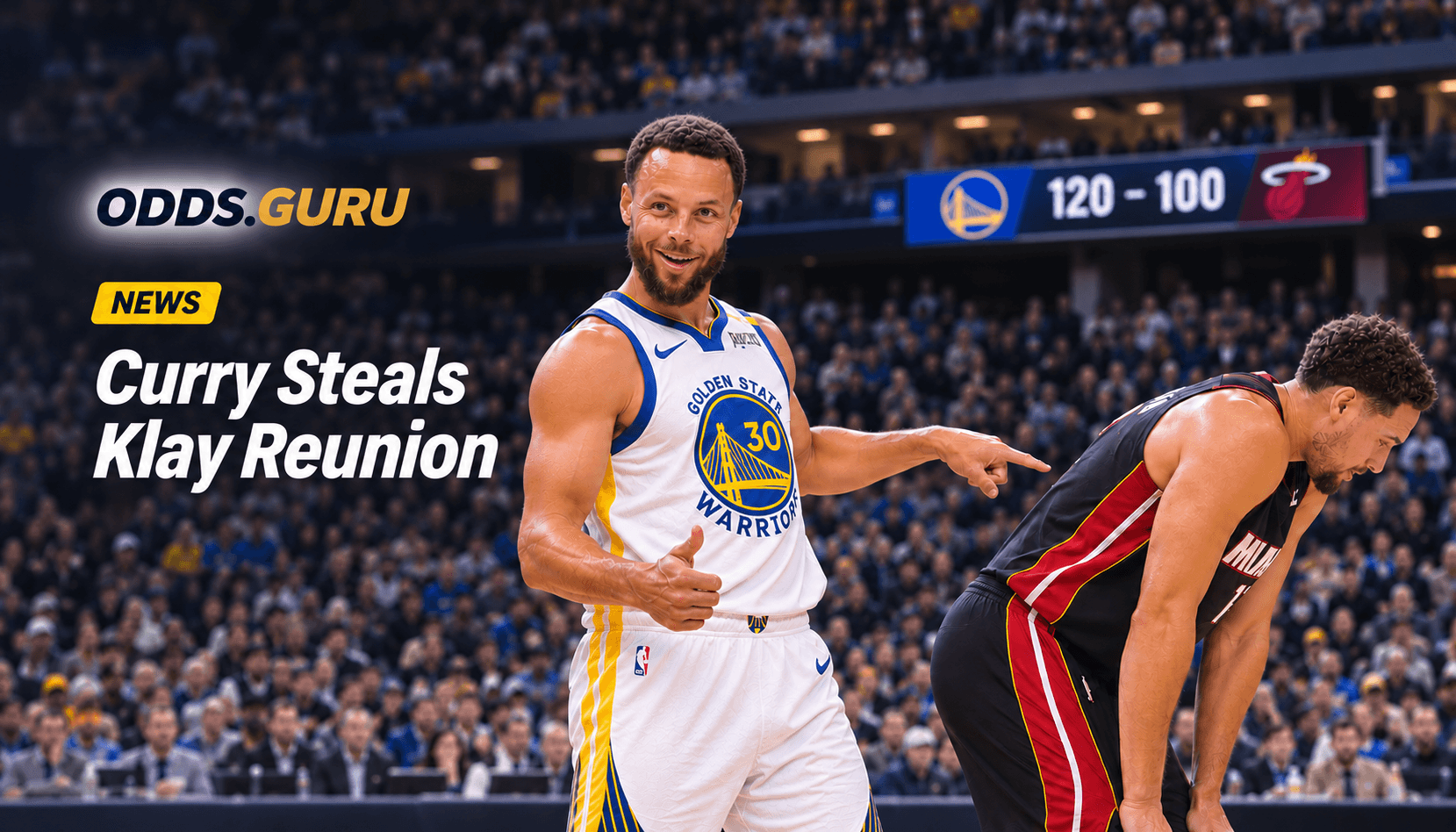
Steph Curry poses as Thompson looks elsewhere
Klay Thompson is nearby but looking away as Steph Curry poses for the camera and points towards him during Golden State’s home meeting with Miami. The brief exchange accompanied a more decisive basketball result: the Warriors beat the Heat 120-100 on November 5, with Curry making six three-pointers.
The moment is small and recognisable. Curry notices the camera and brings Thompson into the picture with a gesture; Thompson does not share the camera-facing pose. There is no confirmed explanation from either player for the exchange, and Thompson’s expression alone says little about his mood.
The reunion had a specific competitive setting. This was Thompson’s first game against Golden State as a member of the Heat, bringing him back to Chase Center with a different team and an immediate chance to follow a dramatic Miami victory with another win.
Curry’s gesture gave that return a lighter moment. It did not settle anything about the relationship between the players, nor did it need to. Their familiarity was already part of the fixture, with Thompson openly discussing the prospect of beating old friends before arriving.
The distinction matters because a few seconds of footage can make an ordinary interaction appear more pointed than it was. Curry’s pose is visible; a deliberate rejection by Thompson is not established. Neither player has a confirmed comment explaining what Thompson noticed or whether he knew Curry was posing.
The basketball provides the firmer account of the evening. Curry finished with 29 points in 28 minutes, and Golden State extended a winning run against a Miami team playing on consecutive nights. Thompson’s return became part of another Warriors victory rather than the second straight Heat win he had wanted.
For Golden State, the lasting numbers came from Curry’s shooting. For Miami, the reunion followed an encouraging Thompson performance against the Clippers but ended with a considerably less favourable team result.
Six Curry threes underpin a 20-point win
Curry made six of 12 three-point attempts against Miami, accounting for 18 of his 29 points. He shot nine of 19 overall and made all five of his free throws, adding four assists, one rebound and one steal.
That distribution shows how heavily his scoring depended on the outside shot. Twelve of his 19 field-goal attempts came from beyond the arc, and he converted half of them. Miami still had to account for his scoring inside the three-point line and at the foul line, but his long-range accuracy supplied most of the damage.
His two most recent performances offer a useful comparison:
| Curry’s performance | Against Phoenix, November 2 | Against Miami, November 5 |
|---|---|---|
| Points | 34 | 29 |
| Field goals | 9 of 21 | 9 of 19 |
| Three-pointers | 5 of 13 | 6 of 12 |
| Free throws | 11 of 12 | 5 of 5 |
| Assists | 7 | 4 |
| Minutes | 33 | 28 |
| Golden State result | Won 116-113 | Won 120-100 |
Against Phoenix, Curry needed more free throws to reach his total. Against Miami, he made an additional three-pointer on one fewer attempt and scored his 29 points in five fewer minutes.
Across those games, he produced 63 points and 11 made threes, with Golden State winning both. The different margins also matter: Phoenix finished three points behind the Warriors, while Miami finished 20 behind. Curry’s individual contribution was substantial in each, but the second result was much more comfortable on the scoreboard.
Those figures do not identify every reason Miami lost. They do establish that Curry’s camera moment occurred on an evening when his shooting was a central part of Golden State’s performance.
The Warriors had entered the Miami game with five straight wins. The result extended that sequence to six, giving the reunion significance beyond the two players in the frame. Golden State continued a run of team results while Curry followed a 34-point outing with another efficient scoring night.
Thompson arrived with 30 points and an overtime winner
Thompson travelled to Chase Center after scoring 30 points against the Clippers and making the overtime three-pointer that secured Miami’s 117-116 victory on Wednesday.
That finish gave his comments about the Warriors an immediate competitive basis. He was heading into the reunion after deciding a close game, with another opportunity to help Miami win the following night.
“It's fun to beat up on old friends,” Thompson said before the Golden State meeting.
His fuller ambition was straightforward: “Hopefully I can continue to stay afloat because I made a lot of buckets in that building. It's fun to beat up on old friends, so that would be awesome to come away with a back-to-back win.”
The 36-year-old had more than that single shot behind him. Over the three games preceding the Warriors meeting, Thompson averaged:
- 24.7 points per game.
- 2.3 assists and 2.0 rebounds per game.
- 57.4% shooting from the field.
- 52.8% shooting from three-point range.
Miami’s early results had nevertheless been closely associated with Thompson’s scoring. In the Heat’s three wins before the reunion, he averaged just under 20 points and made five threes per game. In their losses, his scoring average was 11.
That split does not make Thompson solely responsible for Miami’s outcomes. It does show the difference his scoring had accompanied: the Heat’s winning performances featured considerably more production from him.
Golden State presented a demanding next opponent. Thompson was returning to a familiar building, but he was doing so on the second night of consecutive games against a team already winning regularly. The intended back-to-back victory did not follow his Clippers winner.
Miami’s outside shooting meets Golden State’s defence
Before the reunion, Golden State ranked third in defensive rating at 103.5 and stood inside the league’s top 10 in three-point defence. Miami arrived with the league’s fastest pace and its second-ranked offence.
Those rankings gave the fixture a clear basketball tension. Miami had been generating a strong overall offensive return, while Golden State had been effective at limiting opponents. Thompson’s recent accuracy offered the Heat a way to challenge that defence from distance.
Miami’s broader shooting numbers were less convincing. Despite its offensive ranking, the team sat in the bottom half of the league for both three-pointers made and three-point percentage. A productive offence and inconsistent outside shooting can coexist; the Heat’s early profile contained both.
Adebayo’s screen gives Thompson a route to space
Bam Adebayo was central to the shot that beat the Clippers. Thompson credited Adebayo’s screen with freeing him for the overtime winner, identifying a specific action behind the result.
That partnership gives Miami something practical to develop. Screens and dribble handoffs can help Thompson receive the ball with room to shoot, reducing the need for him to create every opening himself. Against a team familiar with his tendencies, the timing of those actions becomes especially relevant.
The Golden State result does not establish which Miami actions failed or how often the Heat created clean attempts for Thompson. His individual shooting line from the reunion is not confirmed here, so the 20-point defeat should not be turned into an unsupported judgment about his performance.
What is clear is the difference between Miami’s two nights: a one-point overtime victory against the Clippers, followed by a 20-point defeat against the Warriors. Thompson’s successful combination with Adebayo supplied one encouraging detail from that sequence. Curry’s six threes and Golden State’s sixth consecutive win supplied the stronger finish.