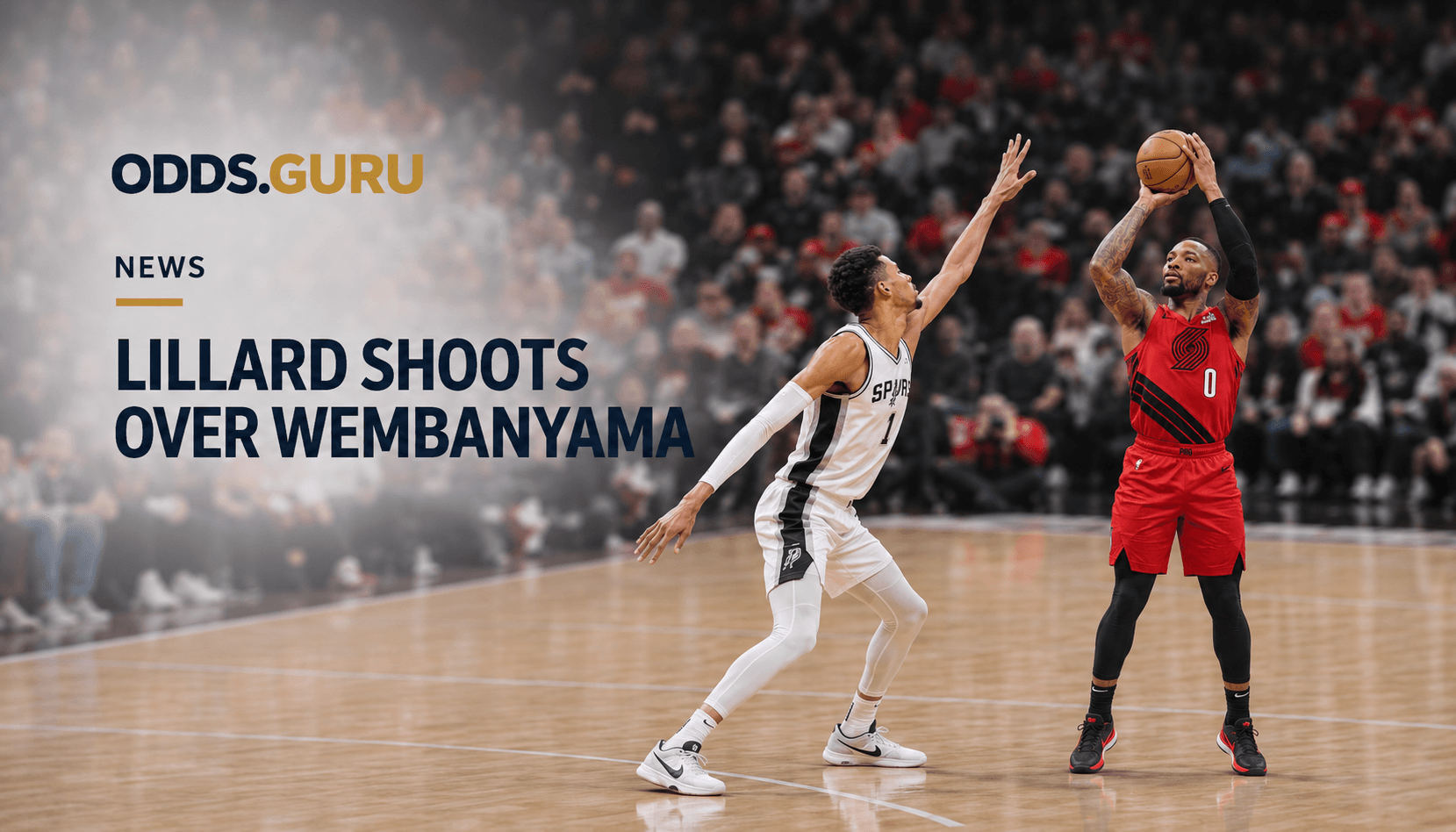
Damian Lillard asked for the one-on-one matchup against Victor Wembanyama and finished it with a three-pointer over the San Antonio centre as Portland won 116-111 on November 25. The shot supplied a striking individual moment in a game that required considerably more than one difficult basket to settle.
Lillard finished with 29 points, five made threes and seven assists. Wembanyama answered with 44 points and 16 rebounds, while Deni Avdija led Portland with 33 points and made the late three that gave the Trail Blazers room to close out the victory.
The result left Portland at 12-6 and San Antonio at 15-4. It also brought the teams level in the NBA Cup standings at 2-1, adding a tournament consequence to a contest that featured more than two dozen lead changes.
Damian Lillard’s five threes carried a difficult shooting night
Seven made field goals produced Lillard’s 29 points. Five came from beyond the arc, and he added a perfect 10-for-10 performance at the free-throw line.
That distribution explains a night in which his overall shooting percentage told only part of the story. Lillard went 7-for-20 from the field, or 35%, but made five of his 12 three-point attempts, a 41.7% return. His three-pointers and free throws accounted for 25 of his 29 points.
The isolation against Wembanyama was the clearest expression of his willingness to attempt a difficult perimeter shot. Rather than leave the confrontation to another possession, Lillard called for space and made the three over the defender in front of him.
There is a tactical distinction between accepting that matchup and treating it as an easy one. An isolation reduces the immediate action to the ball-handler and his defender, placing more responsibility on the shooter to create a usable release. The successful attempt showed Lillard could finish that particular possession; it did not make Wembanyama a favourable target on every trip.
Wembanyama entered the wider season picture with 3.8 blocks per game. That shot-blocking production helps explain the significance of challenging him directly, although an average cannot describe the quality of a single perimeter contest.
Production beyond the highlighted possession
Lillard’s full contribution extended across 34 minutes:
- 29 points, with five made threes and 10 made free throws.
- Seven assists against two turnovers.
- Three rebounds and two steals.
His night also contained missed opportunities. Both Lillard and Avdija missed wide-open threes in the closing minutes. The isolation make therefore belongs within a mixed shooting performance, one in which perimeter accuracy and free throws kept Lillard productive despite difficulty converting elsewhere.
Wembanyama’s 44 points kept San Antonio within reach
Victor Wembanyama finished with 44 points, 16 rebounds, three assists and two blocks. The Spurs lost, but Portland did not achieve the result by removing San Antonio’s leading scorer from the game.
That matters to the reading of the individual matchup. A made three over Wembanyama was a successful attacking possession for Lillard. Wembanyama’s response across the game was sustained scoring and rebounding that repeatedly gave San Antonio a route back.
The scoring totals underline the different demands on the two offences. Lillard and Avdija combined for 62 points, with Avdija outscoring his teammate by four. Wembanyama scored 15 more than Lillard and remained the central problem Portland had to absorb.
San Antonio also found ways to keep possessions alive. Offensive rebounds and trips to the free-throw line helped compensate for weaker three-point shooting, allowing the Spurs to remain competitive while Portland tried to move the ball quickly.
Those are distinct sources of pressure. An offensive rebound creates another chance after the defence has already forced a miss. Free throws can add points without requiring a made field goal. Together, they gave San Antonio ways to answer Portland’s perimeter scoring.
The balance began to change as Portland became more competitive in those areas later in the game. The Trail Blazers could then gain more from their shooting advantage instead of repeatedly surrendering extra opportunities at the other end.
Wembanyama still had chances to influence the closing possessions. He committed a turnover and missed a spinning attempt near the rim during the final minutes, costly moments in a game that remained available to either team.
His 44-point performance and those late errors belong in the same account. San Antonio needed his production to stay close, but could not turn it into the final baskets required to win.
A 10-point shooting gap in a game of repeated lead changes
Portland shot 38% from three-point range, compared with San Antonio’s 28%. That 10-percentage-point difference gave the Trail Blazers an important advantage against an opponent generating extra chances through rebounding and free throws.
The percentages alone do not establish the total points gained from long range without both teams’ attempt totals. They do show that Portland converted its perimeter opportunities more frequently, a meaningful distinction in a game decided by five points.
Portland also worked to attack before San Antonio’s defence could settle. Advancing the ball quickly and moving it from side to side forced the Spurs to defend while adjusting their positions, rather than allowing them to organise for every possession.
The isolation highlight represented a different demand within that broader approach. Portland’s pace sought opportunities before the defence was ready; Lillard’s three showed he could also make a difficult shot against an established individual defender.
Neither approach produced a comfortable lead. Through the first three quarters, Portland never led by more than six points, while San Antonio’s largest advantage was three. More than two dozen lead changes reflected repeated responses rather than a single sustained period of control.
Portland’s early fourth-quarter opening did not last
A 12-2 run at the start of the fourth quarter pushed Portland’s lead to seven. San Antonio closed the gap again, preventing the Trail Blazers from turning that stretch into a straightforward finish.
That sequence gives the final margin its proper context. Portland found separation, lost it, and then needed another successful possession late. The victory was built through repeated scoring contributions rather than one run that effectively ended the contest.
It also explains why the three over Wembanyama, however memorable, cannot stand in for the entire result. Portland had to maintain enough production around Lillard to survive San Antonio’s answers.
Avdija supplied the largest share of that support, and his contribution went well beyond the shot that eventually created the decisive cushion.
Avdija’s banked three settled the final possession battle
With 39 seconds remaining, Lillard found Avdija beyond the arc. Avdija’s attempt banked in, stretching Portland’s lead to five points and leaving San Antonio needing a rapid response.
The Spurs’ subsequent long-range attempts missed. Portland closed out the game, ending San Antonio’s unbeaten road start and securing a result with consequences for both the regular-season standings and NBA Cup play.
Avdija finished with 33 points, 12 rebounds, seven assists and two steals. He led Portland in scoring while matching Lillard’s assist total, giving the Trail Blazers another player capable of both finishing possessions and creating opportunities for teammates.
His late make followed an open miss earlier in the closing stretch. Portland returned to him when the opportunity appeared, and Lillard delivered the pass rather than forcing another individual attempt.
The banked finish introduced an element of fortune to the outcome of that shot. Avdija’s broader contribution was substantial regardless: his scoring, rebounding and passing helped keep Portland in position to benefit from it.
For San Antonio, the defeat left a narrow but consequential gap between individual production and team reward. Wembanyama’s 44 points kept the Spurs competitive, yet their final opportunities went unconverted while Portland obtained the basket it needed.
The teams are now 2-1 in NBA Cup play, with neither qualification outcome established by this result alone. Portland’s next scheduled game is at home against Golden State on Friday, November 27, at 6:30 p.m. Pacific time.
 Reddit