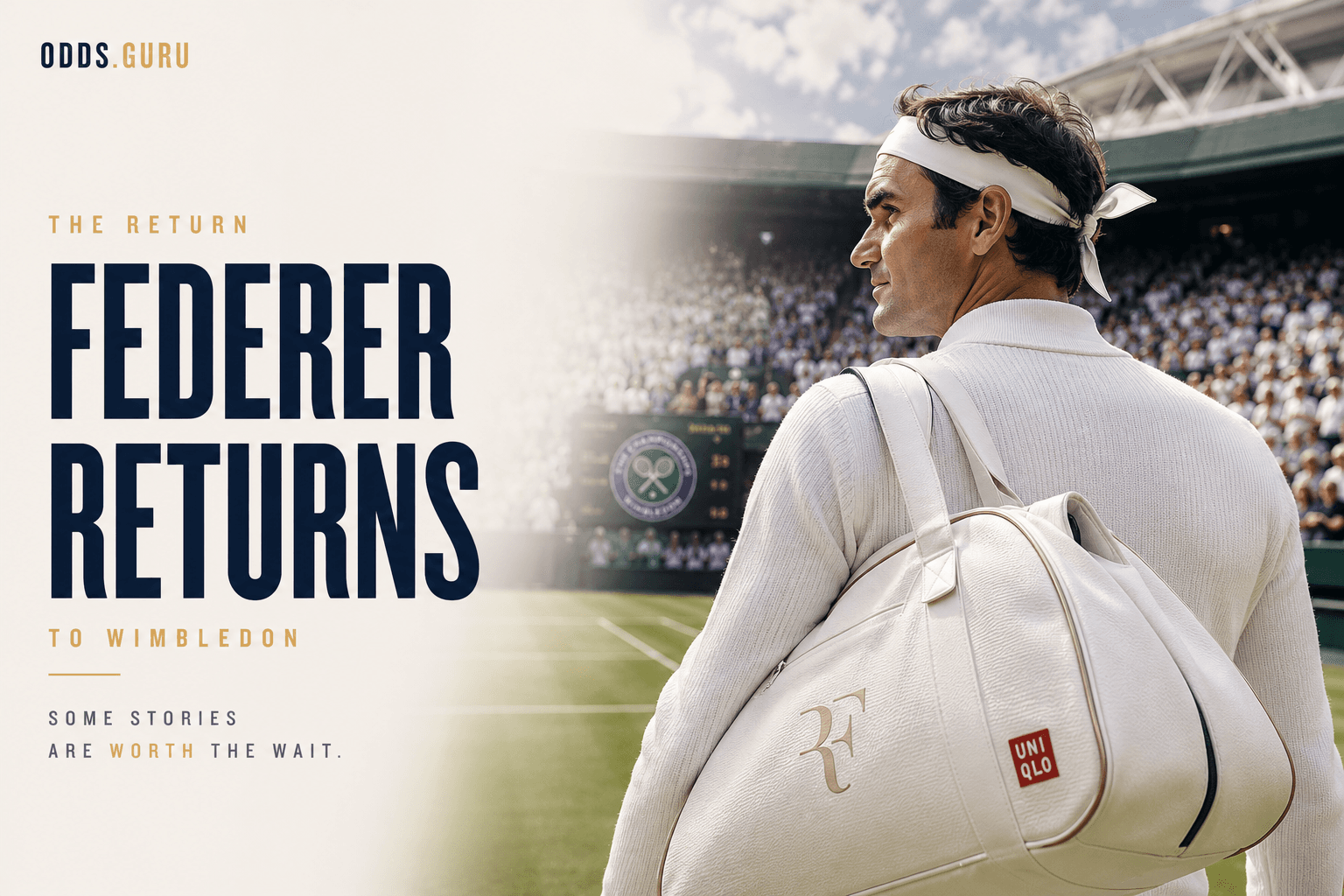
Roger Federer returns to Wimbledon, eight titles in tow
Roger Federer returns to Wimbledon: on Monday, July 6, the second Monday of the 2026 Championships, the 20-time Grand Slam champion strolled through the grounds of the All England Lawn Tennis Club before play began on day 8. It was his first appearance at the tournament since retirement — and Wimbledon's own media operation treated it as a headline event, cutting a dedicated video for its official channel within hours.
There was no racquet, no announcement, no ceremony on the schedule. Federer simply walked the grounds ahead of the day's second-week matches, and the tournament filmed it. That tells you something about the asymmetry at work here: a 58-second clip of a retired player walking through a club drew six figures of viewership before the day's actual tennis had finished circulating.
The players noticed too. Jasmine Paolini, speaking after her fourth-round win, closed her on-court interview with a thank-you directed at Federer — a small moment, but one the tournament clipped and published separately, where it pulled 74,000 views inside 11 hours.
For a man who won this event eight times, the setting needs no embellishment. The Championships were the centre of Federer's competitive identity, and the tournament clearly understands that his presence — even a non-playing one — is a product in itself.
105,626 views in 16 hours, for a man walking
The numbers around this appearance are worth lining up, because they explain why Wimbledon's cameras were waiting.
The official video — titled simply Roger Federer returns to Wimbledon — logged 105,626 views in its first 16 hours on the tournament's channel, which counts 2.57 million subscribers. It drew around 1,300 likes and just under 300 comments in that window. For context, that pace put a sub-minute clip of a retired player among the channel's fastest-moving content of the day, alongside the fourth-round match coverage itself.
None of this is accidental. Grand Slam tournaments have spent the past few years converting their archives and their alumni into year-round content engines, and Federer is the single most bankable asset in that inventory. A second-week visit from the most decorated champion in the event's modern memory is, from the tournament's side of the ledger, cheap to produce and near-guaranteed to travel.
The lesson for the other majors is not subtle. Which brings us to New York.
Next stop Arthur Ashe: the August 25 exhibition
Wimbledon is not a one-off. It slots into a 2026 calendar that Federer's camp and the sport's governing institutions have been assembling all year.
On June 8, the US Open confirmed that Federer will return to Arthur Ashe Stadium on the night of Tuesday, August 25 for a purpose-built exhibition — 'Roger Federer: An Icon Returns to New York' — starting at 7 p.m. He'll share the court with Andy Roddick, the 2003 US Open champion and his longtime rival, plus fellow US Open champions Andre Agassi and John McEnroe, with the USTA promising further celebrity appearances through the evening. Public ticket sales opened on June 11 at 9 a.m.
The New York numbers underpinning the event are their own argument. Federer won the US Open five times, and remains the only player — man or woman — to win five consecutive singles titles there, from 2004 to 2008. He last competed at Flushing Meadows in 2019, which means the August exhibition ends a seven-year absence from the stadium he once owned outright.
Here is Federer's 2026, as it currently stands:
| Date | Event |
|---|---|
| 2026 | International Tennis Hall of Fame induction |
| June 8 | US Open exhibition announced |
| June 11 | Public tickets on sale for the New York event |
| July 6 | Appears at Wimbledon, day 8 of The Championships |
| August 25 | 'An Icon Returns to New York', Arthur Ashe Stadium, 7 p.m. |
Federer's own framing of the exhibition was warm but precise. "So many unforgettable moments of my career happened in New York, and Arthur Ashe Stadium is a place that means a great deal to me," he said in the USTA's announcement. "To return to Arthur Ashe and share the evening with Andy, Andre and John makes it even more meaningful."
The institutional framing was warmer still. Brian Vahaly, the USTA's chairman of the board, president and interim co-CEO, called Federer "one of the greatest champions to ever step onto a tennis court" and said his US Open legacy "will carry on for generations."
Read the two appearances together — an unannounced walk through SW19 in July, a ticketed stadium event in New York in August — and the shape of the year is clear. This is a coordinated legacy tour, anchored by the 2026 International Tennis Hall of Fame induction, with each Slam getting its own flavour of Federer: Wimbledon the reverent cameo, the US Open the full production.
An appearance, not a comeback
We should be direct about what this is not. Federer did not hit a ball at the All England Club, and nothing in either the Wimbledon or US Open material suggests competitive tennis is on the table. The New York event is an exhibition alongside three fellow retired champions — a celebration, explicitly billed as such, not a ranking event and not a trial balloon for anything more.
That matters for how you should read the inevitable speculation. If you're looking for a betting angle here, there isn't one: no market prices a ceremonial walk through a members' club, and an exhibition against Roddick, Agassi and McEnroe carries no competitive consequence. The value of the story sits elsewhere — in what it signals about how tennis intends to monetise and memorialise its greatest era now that the men who built it have left the draw.
The genuine open questions are structural. Does the Wimbledon visit become an annual fixture, the way the club has historically folded its champions back into the fabric of the fortnight? Does the USTA's exhibition model — a named, ticketed, prime-time evening built around one retired player — become a template the other majors copy? And does Federer himself, now a Hall of Famer with a demonstrated willingness to show up, take on a formal role at either institution rather than the freelance-icon arrangement 2026 currently resembles?
None of those have answers yet. What the second Monday of these Championships established is narrower but real: four years on from his last competitive match, Federer walking through a gate still moves audiences at a scale most active players would take for a final. Wimbledon knows it, New York is banking on it, and the sport's calendar is quietly being redrawn around it.
 Reddit