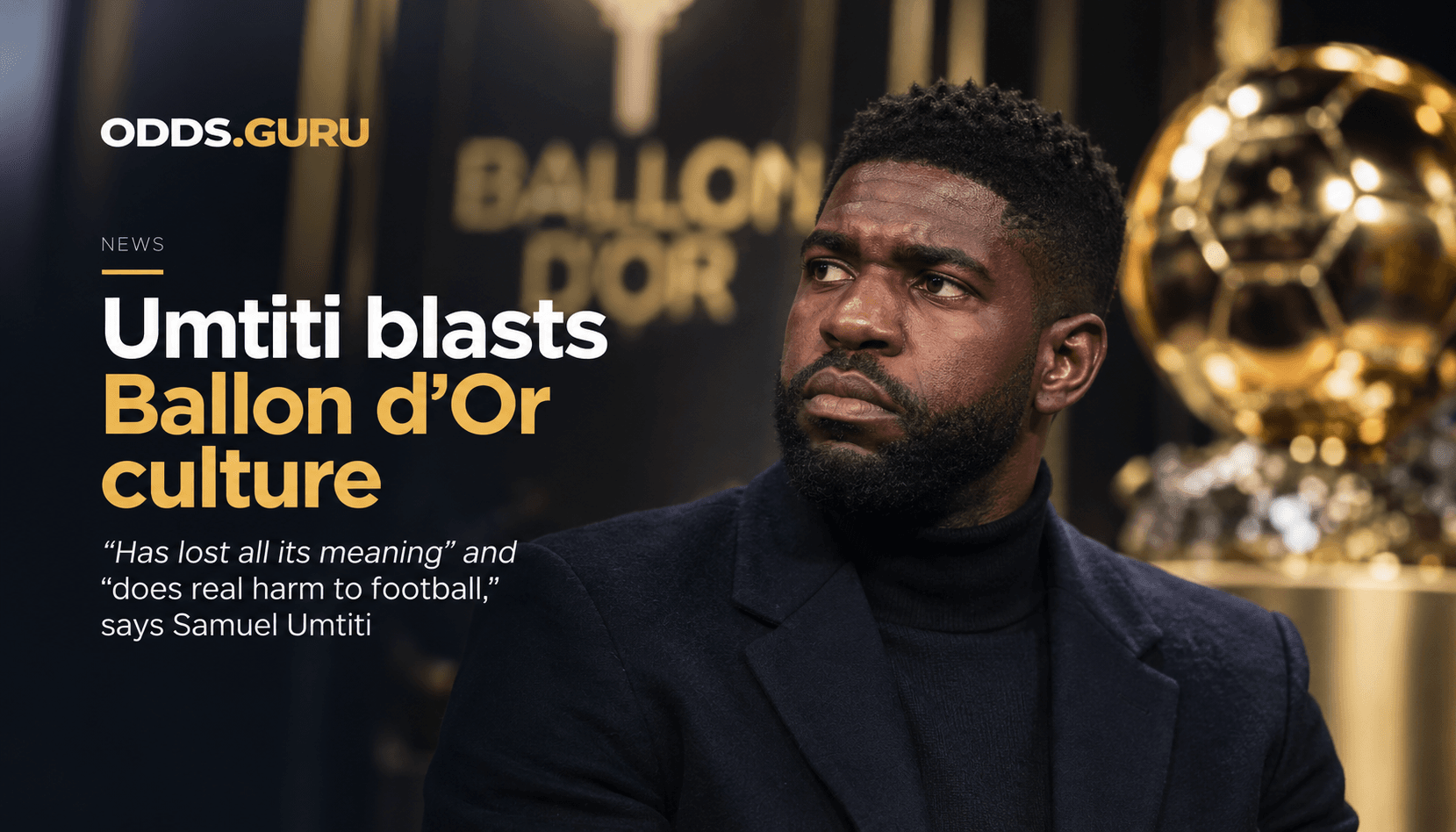
Samuel Umtiti's Ballon d'Or criticism arrived in the noisiest week of the 2026 award cycle. The Champions League had just restarted. The 30-name shortlist had just been published. And Mbappé had already told an audience on Monday that his numbers and records made him a credible winner, despite the absence of club or international silverware to hang the case on.
Umtiti, speaking in French on the RMC Sport show he now appears on as a pundit, did not soften it. The 2018 World Cup winner, formerly of Lyon and Barcelona, said he does not watch the ceremony, does not follow the trophy, and thinks the campaign season around it is corroding the sport's basic logic.
"People think much more about winning the Ballon d'Or than team awards," he said. "You can win a Champions League with your team, and you're only thinking about yourself." His summary line was shorter still: "Football isn't just about stats."
Nine PSG names, a Quiñones nomination and a first for goalkeepers
The shortlist published on Tuesday is weighted heavily towards Paris Saint-Germain, who won the Champions League: nine of the 30 nominees come from that squad alone. RMC also reported that the 2026 list marks a historic first for goalkeepers, a position that had never previously broken into the final 30.
The name that stopped Umtiti was Quiñones. Asked about the Mexico forward's inclusion, he pointed to a World Cup that ended for Mexico in the round of 16 and asked what, exactly, had earned the nomination. Four goals, one last-16 exit. "When I saw that, I wondered whether it was a joke," he said.
That is a narrower complaint than his headline one, and a more testable one. A 30-man list is a wide net by design, and wide nets catch tournament scorers from eliminated teams. But it sits underneath the broader point Umtiti is making: if the shortlist can be assembled largely from goal counts, the award's stated purpose becomes hard to describe in a sentence.
The ceremony itself has moved. The 2026 edition takes place in London rather than Paris, on 26 October — roughly six weeks after the shortlist dropped, with a full block of Champions League fixtures in between.
Ballon d'Or criticism aimed at Mbappé's own vote
The sharpest passage was reserved for the Real Madrid forward. Umtiti acknowledged the confidence, then drew a line around it.
"Mbappé is a self-assured person," he said. "You could say it's not really his place to talk about who deserves the award. He should focus on what happens on the pitch."
He went further: "Everyone has seen that he's scored lots of goals and performed well at certain times, but if you ask him, 'Who do you think will win the Ballon d'Or?', in the end he will tell you that he deserves it. And it's not up to him to decide the winner."
What makes the week instructive is that three of the leading names are arguing three incompatible cases at once:
- Mbappé leans on volume and records, without the club or national-team titles that historically settle these votes.
- Ousmane Dembélé, the reigning 2025 winner, has said the trophy cannot leave the PSG dressing room after a European title.
- Lamine Yamal has pointed to the World Cup he won with Spain.
Since Messi and Ronaldo, nobody clears the field
Umtiti's most useful observation was almost an aside. "Since the Messi-Ronaldo era, I don't even look at that trophy anymore," he said. "They had incredible statistics, and if they didn't win a major title, it didn't really matter, because their season was incredible. Now, there isn't necessarily one great player who stands out above the rest."
That is the mechanism. For most of a decade, the winner was effectively pre-agreed by output, and no lobbying was required because no lobbying could move it. Remove the duopoly and the vote becomes genuinely open — which is precisely when public argument starts paying. The campaigning Umtiti dislikes is a symptom of parity, not of vanity.
RMC's own preview of the race, published a month and a half out, lists Harry Kane, Yamal, Mbappé and Khvicha Kvaratskhelia among the contenders. Four names, no consensus, and a shortlist stacked with players from the same European champions who will split each other's votes. A field that flat rewards whoever tells the clearest story about their own season.
A defender's complaint about a forward's trophy
The obvious counter to Umtiti is that the Ballon d'Or is an individual award and always has been. Leagues and tournaments hand out their own player-of-the-season and player-of-the-tournament prizes; a player who scores heavily for a team that falls short is being punished for other people's limitations. That argument has been made forcefully by supporters online since the clip circulated, alongside plenty of agreement with him.
Both positions can be right at once, and mostly are. The award is individual; the sport is not. Every voting system that tries to hold those two facts together produces some version of this argument every autumn.
Where Umtiti's case is strongest is positional. Attackers dominate the shortlist and the ceremony, and a centre-back who won a World Cup is unusually well placed to notice it. Where it is weakest is in the implied fix — he does not offer one, and "value team awards more" is a sentiment rather than a criterion.
The line most likely to survive the news cycle is the narrow one, not the sweeping one: that a nominated player publicly nominating himself is a different thing from a player being confident. Umtiti's phrasing — that it is not up to Mbappé to decide the winner — is a procedural objection, and procedural objections tend to age better than complaints about the culture at large.
Between now and 26 October there is a Champions League block to be played. Six weeks of evidence, then a vote in London, with four credible names and no obvious one. That is the environment that produced this week's noise, and nothing about it resolves before the ceremony.
 Reddit