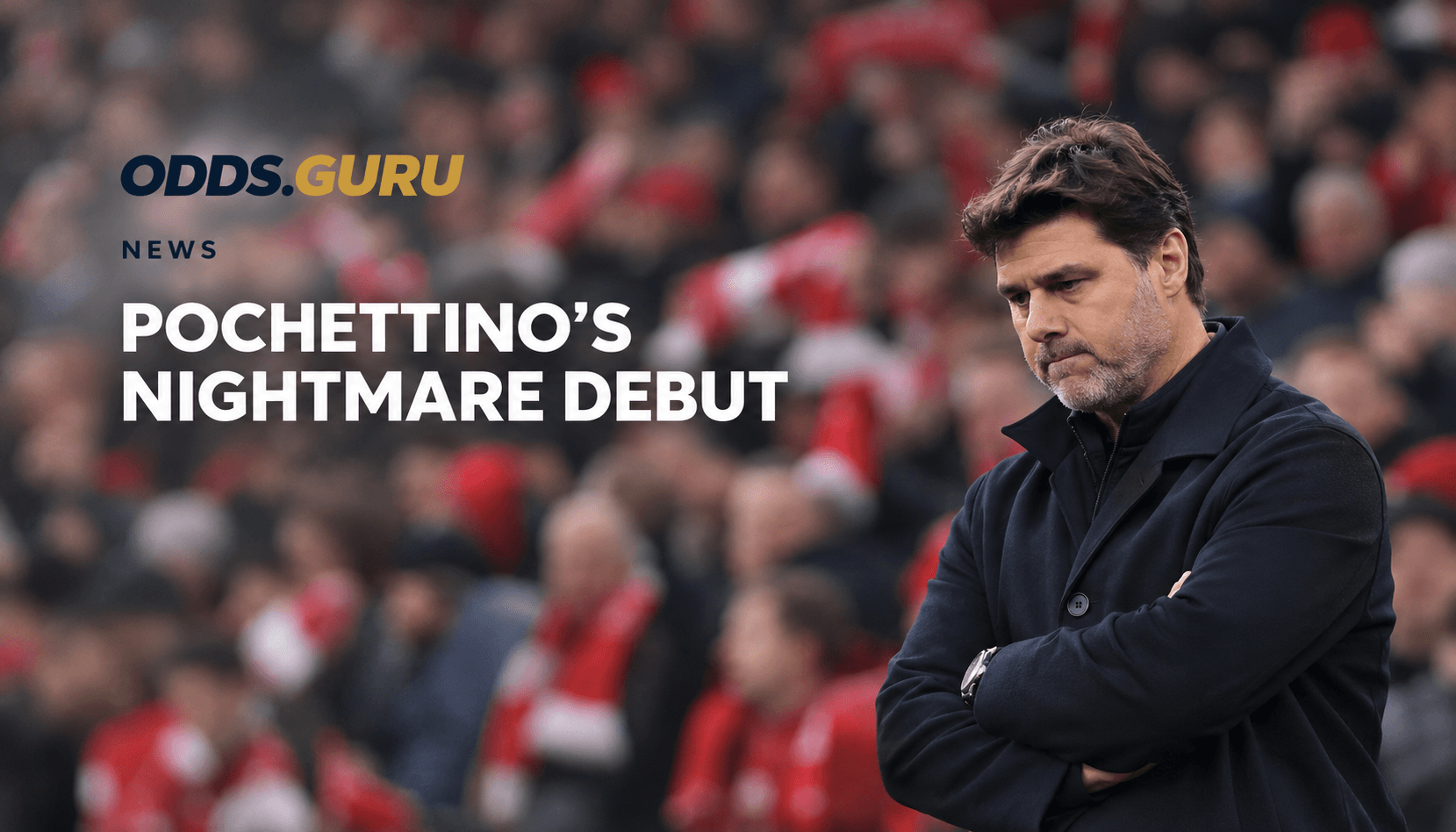
Mauricio Pochettino accepted responsibility after Manchester United lost 4-0 at Anfield on 22 November, equalling the heaviest defeat suffered by a manager in his first match in charge of the club. Lal Hilditch’s debut against Bolton in October 1926 ended by the same score.
The result left United second from bottom in the Premier League, two points from safety and 20 behind leaders Arsenal. Pochettino inherited that struggle after replacing Michael Carrick, but his first opportunity to address it was disrupted almost immediately.
Leny Yoro was sent off in the eighth minute, and Liverpool scored from the resulting free-kick. By the 14th minute, United were two goals behind, leaving their new head coach facing damage limitation before his opening match had properly settled.
Eight minutes before Mauricio Pochettino’s plans unravelled
The decisive sequence began with a mistake by Matthijs de Ligt, whom Pochettino had selected for his first Premier League start in a year. Yoro then fouled Alexander Isak and was dismissed for denying a goalscoring opportunity.
Dominik Szoboszlai converted the resulting free-kick. United had lost a defender and conceded the opening goal in the same passage of play, giving Liverpool both a numerical advantage and a lead to protect.
Florian Wirtz doubled that advantage with a twisting volley. Rio Ngumoha and Victor Munoz added second-half goals as Liverpool completed a victory that could have been heavier.
For Pochettino, the red card was central to understanding the defeat. It left United playing more than 80 minutes with 10 men, sharply reducing their ability to establish the attacking football associated with his previous teams.
“It is painful because it is 4-0 but we play more than 80 minutes with 10 men. I take responsibility for that, no worries,” he said.
“We have a lot of work to do and we take responsibility. We feel the pain but the thing is to keep working.”
De Ligt’s selection brings an immediate test
The decision to start De Ligt drew scrutiny because of his long absence from a Premier League starting line-up and his part in the incident preceding the dismissal. It was an early selection decision by the new manager with an immediate consequence.
That does not establish that another selection would have prevented defeat. It does, however, place defensive decision-making at the centre of Pochettino’s first assessment of the squad.
The dismissal substantially changed the match, but it did not happen independently of United’s performance. An error put the defence under pressure; Yoro’s response then left the team short-handed. Pochettino must address both the mistake that exposed his side and its ability to cope once the situation deteriorated.
The 1926 comparison concerns one match
The historical distinction is precise: Pochettino’s opening result matched Hilditch’s 4-0 defeat by Bolton a century earlier. It is a joint-worst managerial debut, rather than a record established across a sequence of matches under the new coach.
That difference matters because United’s league position reflects 11 games, only one of which Pochettino managed. The defeat belongs to his record; the season’s accumulated problems cannot all be assigned to him.
The figures describe different parts of the situation:
- 4-0: the score at Liverpool, matching Hilditch’s managerial debut in October 1926.
- 19th: United’s position in the 20-team Premier League after 11 matches.
- 23 goals: United’s total conceded across those league games.
- Two points: the gap separating United from a place outside the bottom three.
The 23 goals conceded make defensive improvement an urgent requirement. An attacking overhaul may be part of the longer-term plan, but United’s immediate position leaves little room for repeated errors that hand opponents early control.
Asked whether he had inherited a relegation battle, Pochettino did not dismiss the circumstances.
“Still a lot of games to play. We need to accept the reality and we need to be united and all together.”
Both parts of that answer apply. There is substantial time remaining, and a two-point gap is recoverable. United are nevertheless in the bottom three after 11 matches, making the need for points immediate rather than theoretical.
From Cincinnati to Anfield in five days
Pochettino’s appointment was confirmed on 13 November, but he remained with the United States for their international fixtures before travelling to Manchester. His final match in charge was a 2-0 victory over Haiti in Cincinnati on Tuesday.
He flew directly to Manchester afterwards, arriving at about 11:30 GMT on Wednesday before heading to Carrington. By Sunday, he was taking charge of United at Anfield.
The gap between the announcement and his debut therefore overstates the time he had available to work with his new players. Much of that period was spent completing his previous job.
A short preparation period does not explain every mistake, but it limits the changes a coach can reasonably establish. Pochettino had only a few days in Manchester before facing Liverpool, and fewer than eight minutes of competitive football with a full side before Yoro’s dismissal.
A longer contract meets an immediate problem
Pochettino agreed a two-and-a-half-year contract, taking him through to the summer of 2029. He became United’s eighth permanent manager since Alex Ferguson’s retirement in 2013.
His previous Premier League experience with Southampton, Tottenham and Chelsea gives him familiarity with the competition. His Tottenham side also reached the 2019 Champions League final, where they lost to Liverpool.
United appointed a coach with experience of developing players and building an attacking team. Those ambitions now sit alongside a more immediate requirement: making the side difficult enough to beat to move away from the relegation places.
The disagreement over the squad’s quality makes that task more pointed. Before the match, chief executive Omar Berrada described this season’s group as “fundamentally better” than the one that finished third last season.
United’s current position places that assessment under pressure. It also raises expectations of what Pochettino should eventually achieve with the players available, even though this debut offered little opportunity to judge a settled team under his direction.
Wirtz’s 10 chances expose United’s defensive workload
Liverpool’s performance deserves its own weight in the result. Florian Wirtz created 10 chances, scored his fifth goal in four matches for club and country, and supplied the assist for Munoz.
His contribution extended well beyond the volley that made it 2-0. United repeatedly had to defend situations he created, and Liverpool continued to turn their advantage into opportunities after establishing an early lead.
The numerical imbalance is essential context for those figures. Even so, restricting a player who was creating chances so frequently became part of United’s task once they were reduced to 10 men. The second-half goals showed Liverpool could still break through.
Liverpool head coach Andoni Iraola described Wirtz’s performance as a continuation of his recent form.
“I think he has been playing very well for a long, sustained period of time, he finished before the break with a goal and assist against Palace,” Iraola said.
“He has been playing well for a while but still he is giving us a lot.”
Victory moved Liverpool into fourth place, although it was only their second home league win of the season. United faced an opponent capable of exploiting the early dismissal decisively, but one that had not been collecting home victories consistently.
For Pochettino, the practical work begins with the defensive sequence that preceded Liverpool’s dominance. De Ligt’s mistake and Yoro’s foul left United trying to contain a side with an extra player for almost the entire match. Reducing those avoidable moments is an immediate task as he begins his first full week preparing the squad after taking charge.
 Reddit