

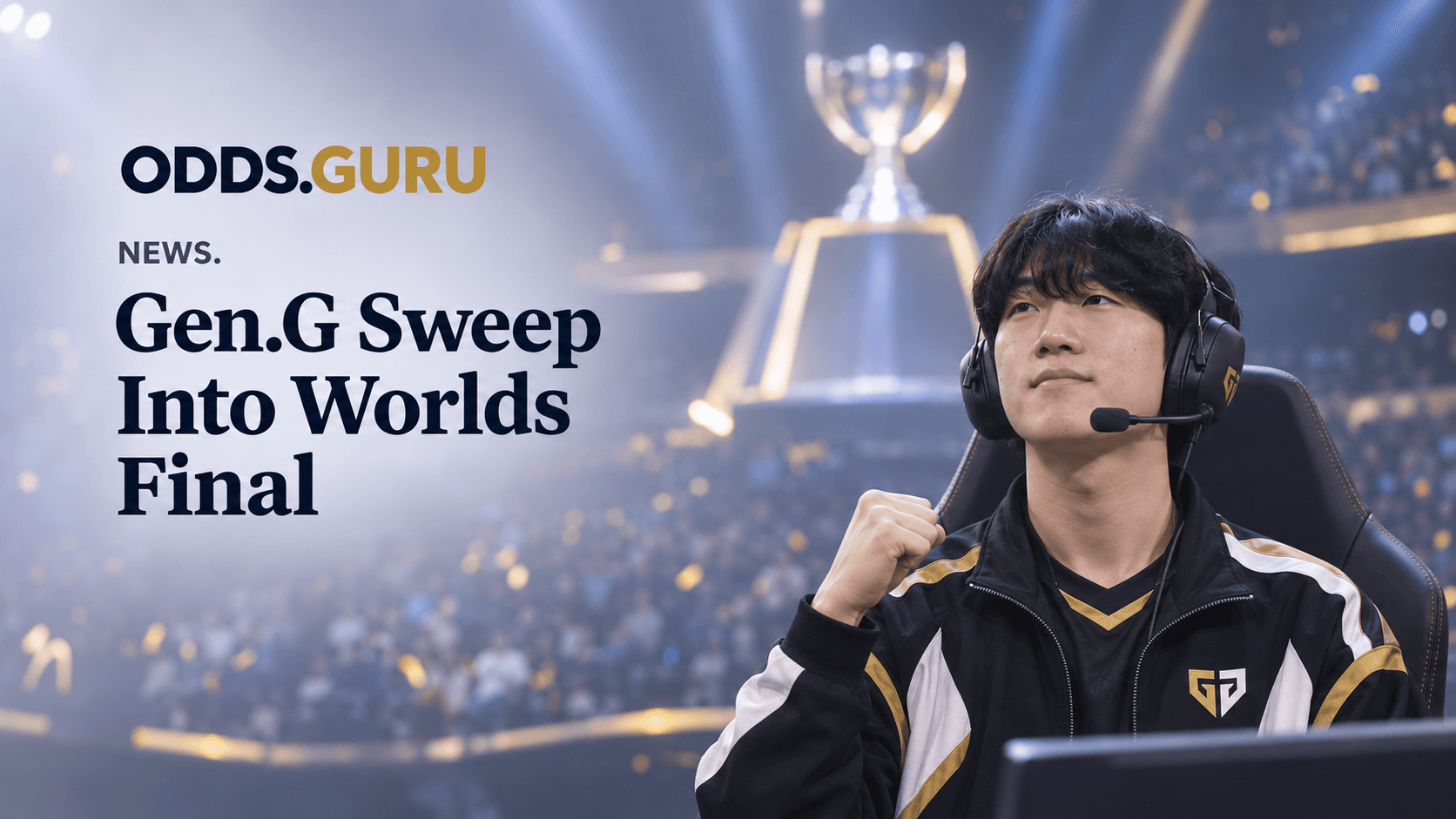
Gen.G vs Invictus Gaming finished with a 3-0 semifinal victory for Gen.G at the 2026 League of Legends World Championship on November 8, HKT. Canyon received the series MVP award as Gen.G secured their place in the final, where they will face the winner of Bilibili Gaming against T1.
The first two games ended with Gen.G holding gold advantages above 14,000. The third took 40 minutes and eight seconds, with IG finishing ahead in kills and dragons but still unable to prevent elimination. That distinction gives the sweep its shape: two decisive wins followed by a closer contest in which Gen.G’s damage output and structure-taking remained enough.
Gen.G vs Invictus Gaming: 27 towers to nine
Nine towers in each game gave Gen.G a consistent route through a series that became less comfortable as it progressed. IG managed three towers in the opener, one in the second game and five in the third. They did not take an inhibitor across the semifinal.
Gen.G also claimed all three Barons, one per game, and finished with four inhibitors destroyed. Those advantages put the kill scores in context. IG could make the final game competitive through fights and dragon control, but they never matched Gen.G’s progress through the opposing base.
The contrast between the opening two games and the closer is clear in the finishing numbers:
| Game | Duration | Gen.G gold | IG gold | Towers, Gen.G–IG | Dragons, Gen.G–IG |
|---|---|---|---|---|---|
| 1 | 33:38 | 73,300 | 58,600 | 9–3 | 4–1 |
| 2 | 29:16 | 63,800 | 49,300 | 9–1 | 4–1 |
| 3 | 40:08 | 78,200 | 71,700 | 9–5 | 2–4 |
The opener ended with a 14,700 gold gap. Gen.G took four dragons to one and won the kill count 29-9, giving IG little compensation elsewhere on the map. TheShy’s Kled finished without a kill at 0/6/5, while Ruler’s Jhin recorded nine kills and just two deaths.
Game two was shorter and left IG with even less structural progress. At 29:16, Gen.G had a 14,500 gold advantage and eight more towers. IG secured three Void Grubs to Gen.G’s none, but that early objective return did not produce a competitive tower count by the finish.
The distinction matters because objective totals do not all tell the same story. IG obtained some resources in both defeats. Gen.G finished with substantially more gold, greater access to the base and the major neutral objectives needed to support their attack.
Across the first two games, IG took only four towers and two dragons. By the time they produced a more balanced game, they had no further defeat available in the best-of-five series.
Canyon’s MVP, Ruler’s damage
Canyon finished 14/4/37 across the semifinal, participating in 71.8% of Gen.G’s kills. His strongest statistical performance came in game two, when his Lee Sin went 5/0/15: 20 kill involvements without a death.
The opener had already established his influence. On Qiyana, Canyon recorded 7/1/12, accumulated 18,500 gold and dealt 32,203 damage. His gold total was the highest on either team, and his damage was only slightly below Ruler’s 32,905.
Those were substantial contributions from the jungle position in two games that Gen.G won with large economic advantages. Canyon’s first two performances combined aggressive output with very few deaths, leaving IG unable to make his own scoreline expensive.
The series MVP award nevertheless sat alongside another major contribution. Ruler led Gen.G with 23 kills, participated in 78.9% of their kills and averaged 994.88 damage per minute across the series.
His three performances provided a different form of continuity:
- Jhin, game one: 9/2/11, with 32,905 damage.
- Ashe, game two: 7/3/15, with 23,677 damage.
- Yunara, game three: 7/3/7, with 45,924 damage.
Gen.G’s supporting contributions also changed across the series. Duro’s Leona finished the opener 5/2/17, participating in 75.9% of the team’s kills. Kiin’s Gwen and Chovy’s Ahri each collected six kills in game two.
In the closer, Chovy’s Taliyah contributed 33,471 damage and participated in 87.5% of Gen.G’s kills, matching Ruler’s involvement rate. Canyon’s Wukong finished 2/3/10, a quieter individual score than his opening performances but still involvement in three-quarters of the team’s kills.
The knockout stage uses Fearless Draft, and Gen.G’s players won these games on different champions. The changing selections produced a similar outcome in the first two games, then enough damage from the carries to finish the more difficult third.
Rookie’s 11 kills could not extend the series
Rookie finished game three 11/2/5 on Locke, participating in 88.9% of IG’s kills. After recording two kills in each of the first two games, he supplied 11 of his team’s 18 in the closer.
IG also took four dragons to Gen.G’s two and finished ahead 18-16 in kills. Wei’s Naafiri recorded 1/2/13, while TheShy’s Gnar contributed 3/4/8. There was considerably more resistance than the final series score alone suggests.
The game lasted 40:08, almost 11 minutes longer than game two. IG took five towers, more than their total across the opening two games, and finished with 71,700 gold. They had given themselves a much more substantial contest.
Yet Gen.G still ended 6,500 gold ahead, with nine towers destroyed, an inhibitor and the game’s only Baron. IG’s advantage in kills did not become an advantage in the resources or structures that decided the finish.
Ruler’s 23,900 gold in the closer
The largest individual economic gap was in the bottom-lane carry position. Ruler’s Yunara finished with 23,900 gold against JiaQi’s 16,800 on Ezreal, a difference of 7,100.
Ruler also recorded 437 creep score to JiaQi’s 380 and dealt 45,924 damage against 27,351. Both players died three times, but Ruler finished with seven kills and seven assists; JiaQi had three kills and five assists.
That comparison does not reduce the defeat to a single position. Rookie’s exceptional kill total kept IG competitive, and IG’s dragon advantage was real. It does show the scale of the damage and resources available to Gen.G when the series reached its longest game.
Rookie’s 11 kills were accompanied by 21,938 damage. Chovy, with three kills, dealt 33,471. Kill totals captured Rookie’s finishing contribution, but they did not capture the full distribution of damage across the two teams.
IG therefore leave with a third-game performance that was materially stronger than the first two, rather than evidence that the whole semifinal was closely contested. Gen.G had to absorb more opposition to complete the sweep; IG still could not force a fourth draft.
Six knockout wins before the final
Gen.G have now won six consecutive knockout games, following their 3-0 quarterfinal victory over LYON with the same result against IG. Their earlier Swiss-stage meeting with LYON had finished 2-1, but the quarterfinal rematch ended without Gen.G dropping a game.
IG entered this semifinal after defeating Top Esports 3-1 in the quarterfinals. Their elimination came against a team that conceded no Barons or inhibitors across the three-game meeting.
The remaining semifinal pairs Bilibili Gaming and T1, scheduled for November 9 at 06:00 HKT. Bilibili Gaming reached that match by sweeping Dplus 3-0; T1 advanced with a 3-1 victory over Karmine Corp.
Either opponent will face a Gen.G side that has demonstrated two different winning performances in this semifinal: large advantages in the first two games, then a victory despite losing the kill and dragon counts in the third. The latter adds substance to the sweep without erasing the pressure Rookie and IG created.
For the eventual challenger, Ruler’s sustained damage and Canyon’s opening-game influence are central problems. For Gen.G, the third game leaves evidence of greater resistance than they encountered earlier in the series, particularly around IG’s mid-lane kill production and dragon return.
The World Championship final is scheduled for November 15 at 03:00 HKT, with Gen.G’s opponent to be decided by Bilibili Gaming against T1.