

A McDonald’s deal after a two-day-notice debut
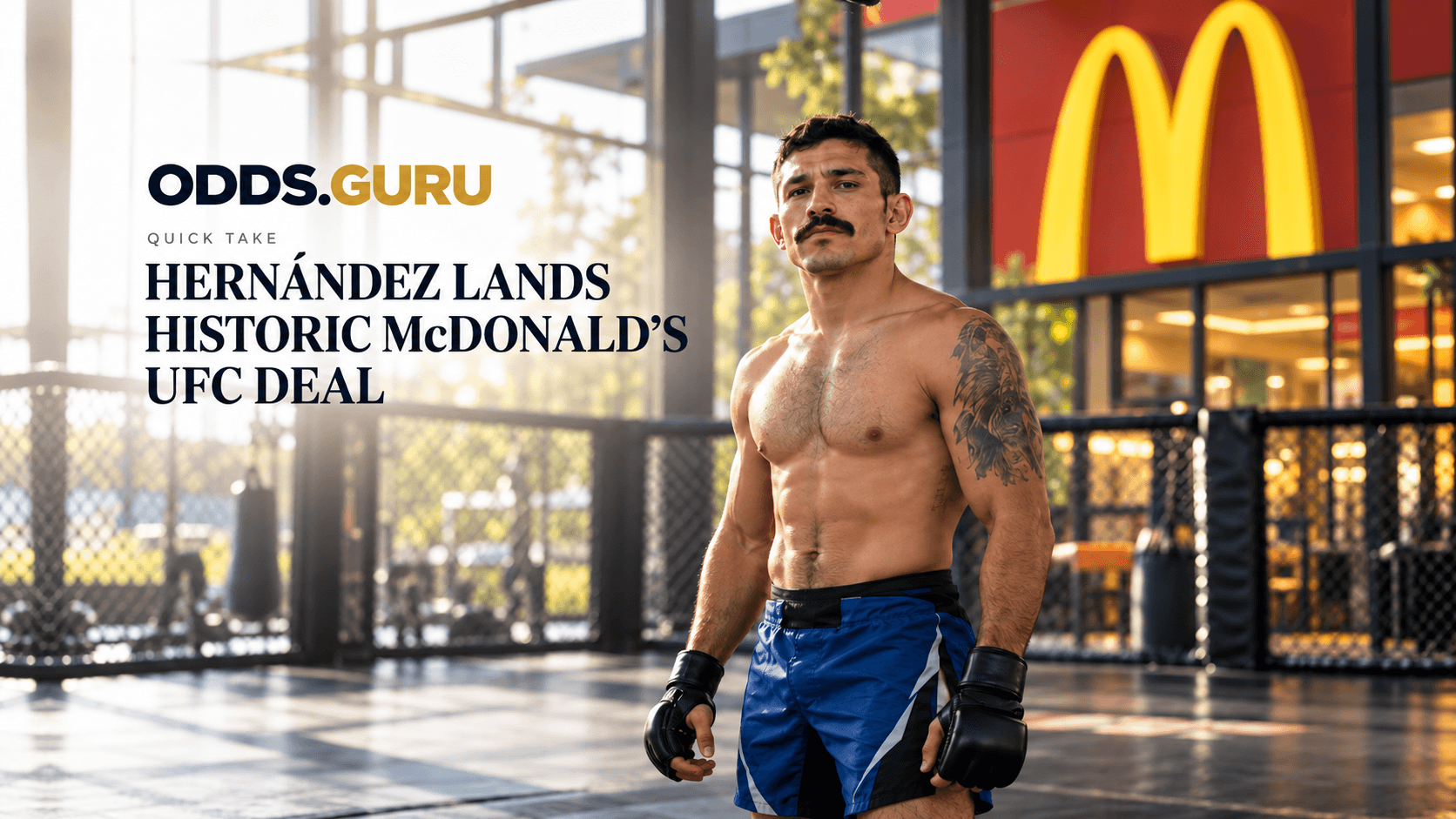
Two days’ notice was enough for Luis Hernández to accept his UFC debut against Sedriques Dumas and win; his newly announced McDonald’s deal now gives that opening chapter a commercial milestone.
Hernández announced the sponsorship on 21 October, less than a month after defeating Dumas on 26 September in Las Vegas. The Miami-Dade County sheriff’s deputy had earned his UFC contract through Dana White’s Contender Series before making the successful move into the promotion.
The agreement is being billed as the first between McDonald’s and a UFC fighter. Malki Kawa celebrated the signing publicly and credited First Round Management and Malki Kawa with completing it.
“Happy meal happy deal!!!” Kawa wrote in the announcement, congratulating Hernández on his progress in a short period.
The historic description gives the signing its immediate significance. Its financial weight is harder to judge: the announcement did not disclose the agreement’s value, duration or geographical reach. Whether Hernández will feature in a broad advertising campaign or a more limited promotion is also yet to be confirmed.
Those details matter because a recognisable sponsor and a large sponsorship contract are different achievements. Hernández has secured the former. There is no disclosed figure with which to assess the latter.
Even with those limits, the timing is striking. The agreement arrives near the beginning of his UFC career, following a successful debut rather than a long run of victories inside the promotion. His move from a Contender Series contract to a short-notice win has already been followed by an opportunity outside competition.
The sequence puts his sporting progress and his working life at the centre of the story. He is a new UFC fighter with a victory to build on, but he is also still a serving deputy organising training around a full-time job.
Hernández’s first UFC win gives the sponsorship a sporting foundation
Hernández defeated Sedriques Dumas in a light heavyweight contest at Meta APEX on 26 September. A guillotine choke secured the submission victory, giving him a successful debut after accepting the fight with little notice.
That result is the strongest sporting context for the sponsorship. Hernández did not simply arrive in the UFC and announce an endorsement: he followed his contract-winning appearance on Contender Series with a victory against an opponent already competing in the promotion.
The short turnaround adds to the significance of the debut. Accepting a fight on two days’ notice leaves little time for preparation specific to that opponent. Hernández nevertheless converted the opportunity into a win.
It would be premature to turn that performance into a forecast of his place in the division. A debut victory establishes a starting point; it does not settle how a fighter will fare across a longer UFC schedule. The McDonald’s agreement similarly says more about his early commercial appeal than his competitive standing.
A sponsor arrives before a long UFC résumé
The combination is unusual enough to make the signing newsworthy without overstating what it promises. Hernández has a recent submission win, a rapid introduction to the UFC and an occupation that distinguishes his story from a straightforward move into full-time professional fighting.
Those elements give a sponsor several ways to introduce him to an audience. His sporting achievement can stand alongside the practical story of a deputy training between shifts. That is a plausible appeal of the partnership, although McDonald’s reasons for selecting him have not been disclosed.
There is also a limit to what the “first” designation tells readers. It describes the claimed novelty of the agreement, not its size, reach or likely effect on Hernández’s career.
The sponsorship does not itself answer the next sporting questions: whom he will face, how often he will compete or whether he can repeat the success of his debut. Those answers will come through his fight schedule and performances.
One hour on duty, more training around shifts
For Hernández, the immediate constraint is time. Despite joining the UFC and winning his debut, he has continued working full-time in law enforcement.
His account of that arrangement is specific. He can train for an hour while on duty, then uses leave and adjustments to his working hours to make additional sessions possible.
“We get to actually train on duty,” Hernández said. “We get an hour every day to train.”
Beyond that hour, he described using paid time off, vacation and compensatory time. He also works extra hours on shifts to build time he can use later, allowing him to train multiple times a day.
His current routine therefore draws on several sources of flexibility:
- On-duty training: an hour each day within his working schedule.
- Accumulated leave: vacation and other paid time used for additional training.
- Extra shift hours: time worked now to create flexibility later.
Hernández invoked Stipe Miocic, the fighter and firefighter, as a precedent for maintaining both careers.
“If Stipe Miocic did it, right, a firefighter, it’s time for an officer to do it, a deputy now.”
That comparison expresses his ambition rather than guaranteeing the arrangement will remain workable. Hernández himself has left room to adapt as his UFC career develops.
“I’m starting my career and, I’m gonna take it one day at a time,” he said, explaining that he has vacation time available and will work out how to use it as the demands increase.
His final qualification was practical: “But let’s see how many fights I get a year.”
Fight frequency will influence how often he needs extended preparation and time away from shifts. A sponsorship could provide additional financial flexibility, depending on its terms, but there is no disclosed payment that would justify assuming it changes his employment plans.
The campaign’s scope remains undisclosed
The McDonald’s announcement introduces another potential demand on Hernández’s calendar. Any filming, appearances or promotional work would have to fit around training and policing, although no such obligations have been made public.
For now, there is no basis to say the agreement requires a substantial amount of his time. Equally, there is no basis to treat it as a payment with no accompanying work. Its practical effect depends on the contract.
Visibility and income remain separate questions
A campaign featuring Hernández prominently could extend his recognition beyond people who watched his UFC debut. A narrower promotion would have a different reach. Without details of where and how McDonald’s plans to use him, that distinction remains unresolved.
The same applies to income. No payment figure has been disclosed, so comparisons with other fighters’ endorsement earnings would be speculative. The brand’s familiarity cannot substitute for contract terms.
The next substantive details would be the campaign’s launch, the territories involved and Hernández’s promotional commitments. Those would show what the sponsorship entails beyond the announcement.
Meanwhile, Hernández’s stated plan remains to manage his fighting career alongside his job, using the leave he has accumulated and adjusting as his schedule develops. His own account leaves that decision tied to the number of fights he receives, rather than to the arrival of a sponsor.
 Reddit