The Michigan Hail Mary sequence, throw by throw
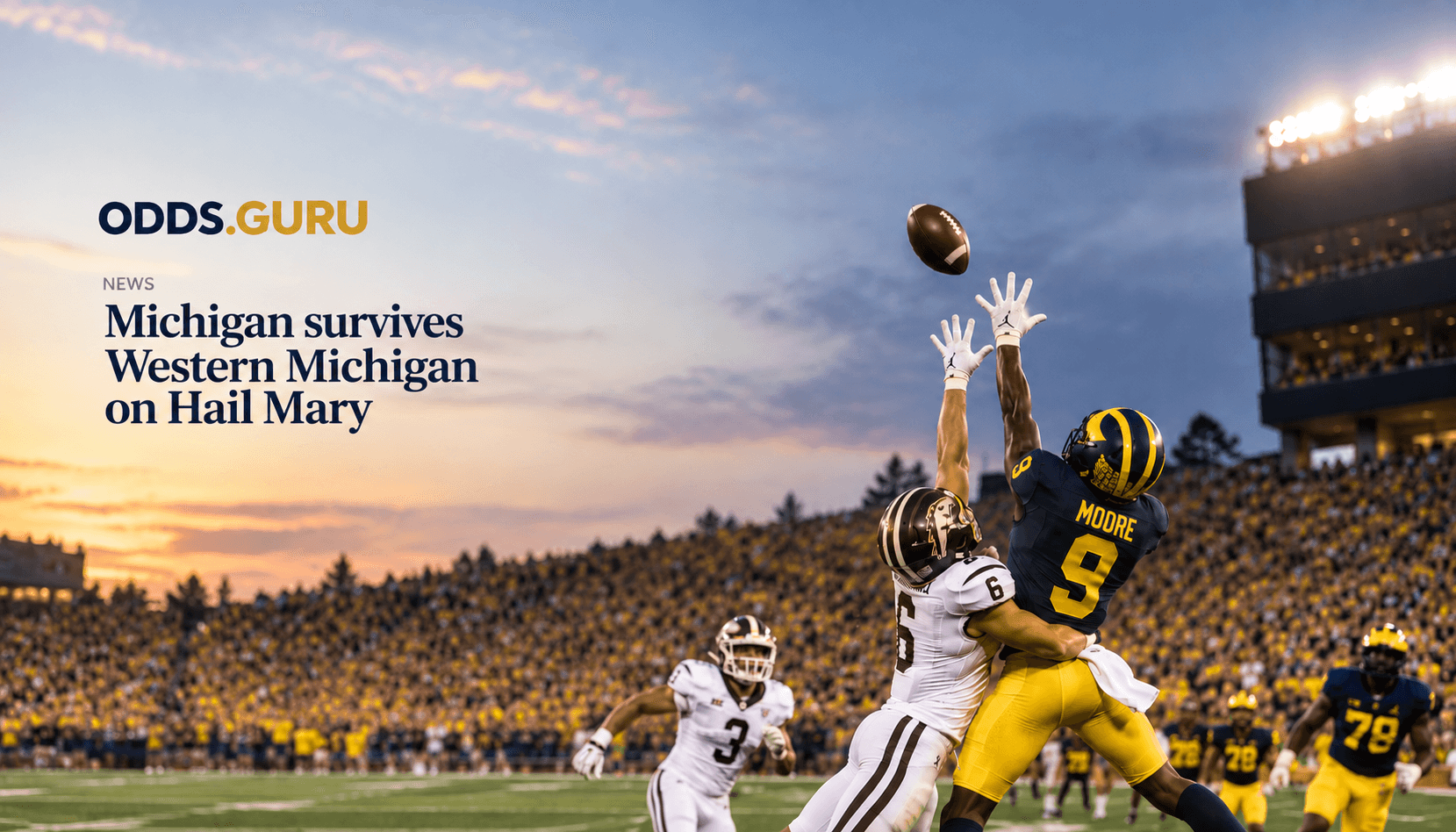
Michigan trailed by five with the ball outside scoring range and no timeouts left in hand at Michigan Stadium on Saturday, 5 September. Underwood's first heave sailed through the back of the end zone. The stadium clock read 0:00.
Western Michigan's sideline emptied. Players and coaches ran onto the field believing they had just recorded the first win in program history over their in-state neighbour, a series they entered 0-8 all time.
Officials waved them back and went to review whether time had in fact expired. It had not, the crew determined. One second went back on the clock.
| Play | Clock after | Outcome |
|---|---|---|
| Underwood heave No. 1 | 0:00 on the stadium clock, then reset to 0:01 after review | Incomplete, out of the back of the end zone |
| Underwood heave No. 2 | 0:00 | 47-yard completion to Buchanan in a crowd for the winning score |
Sequence as described by USA TODAY and NBC's broadcast of the game.
Buchanan, a 6-foot-4 transfer who arrived from Utah and works primarily out of the slot, came down with the ball among a cluster of bodies. Final: Michigan 13, Western Michigan 12.
The out-of-bounds jump the Big Ten says stopped the clock
The conference did not leave the decision unexplained. Late on Saturday night the Big Ten released a statement backing the review and, unusually, published the recording that officials examined before restoring the second.
Its reading of the first Hail Mary attempt hinges on a Western Michigan defender rather than on the ball hitting the turf.
"It was determined Western Michigan No. 18 started his jump from an established out-of-bounds position (left foot) and made contact with the ball with one second remaining on the clock," the conference said, citing the rule that stops the clock when a player in that position touches the ball.
The player in question is Micah Davis. On the conference's video, the clock reads 0:01 at the moment of contact.
That is the whole argument, and it is narrower than the objection most viewers had. The Big Ten is not claiming the ball was live longer than it looked. It is claiming the clock should have stopped a beat earlier than the stadium operator stopped it, because of a touch nobody watching in real time was tracking.
Terry McAulay's objection, and the feed problem behind it
NBC's rules analyst Terry McAulay was not persuaded on air, and he said so plainly while the review was still the story of the night.
"The ball is clearly still in the air when the clock goes to zero on our screen," McAulay said. "The Big Ten's going to have to tell a lot of us how they got to one second on this play."
He added an important qualifier: the officials may have been working from a different video review system than the one available in the NBC booth. That caveat matters more than it might sound, because it points at the actual dispute.
Two things can both be true here:
- The broadcast feed McAulay watched showed the clock reaching 0:00 with the ball still airborne and untouched.
- The replay feed the crew used showed 0:01 at the moment Davis made contact.
What the Big Ten has not published is a frame-synced comparison against the broadcast feed. Until that exists, the disagreement is not really about the rule — it is about which clock the public gets to trust.
Rule 1-1-3-b makes the scoreline permanent
Even a subsequent admission of error changes nothing about the standings. The NCAA football rulebook is explicit at Rule 1, Section 1, Article 3, paragraph b: "When the referee declares that the game is ended, the score is final."
There is no mechanism for replaying a finish, restoring a result, or splitting the difference. Western Michigan's record shows a loss, Michigan's shows a win, and any conference review of the crew's process runs on a separate track from the box score.
The Mid-American Conference has accepted the Big Ten's account that one second remained. That removes the most escalatory path available — a formal inter-conference dispute — and reduces the matter to officiating evaluation behind closed doors.
Broncos head coach Lance Taylor declined the obvious opening afterwards, and pointedly credited the crew rather than attacking it.
"I thought that this crew tonight did a really nice job handling multiple close calls and review situations," Taylor said. "We had several where the spot was questioned and reviewed, and those calls went our way, the review went our way. I'll let the commissioner and those guys handle it."
That is a deliberate piece of positioning. Taylor points at earlier reviews that broke in Western Michigan's favour, then hands the file upward. It is also, in practice, the only useful move available to a coach whose result cannot be restored.
Thirteen points against a MAC defence is the other story
The officiating argument has swallowed the game itself, which does Michigan few favours on inspection.
Western Michigan, a heavy underdog on the road at a stadium where they had never won, held the No. 16 team in the country to 13 points and led with the clock inside a second. Michigan needed a 47-yard throw into traffic to avoid the upset.
Underwood is the axis of this Michigan offence — the quarterback the roster has been rebuilt around, taking effectively all the meaningful snaps. His night ended with the throw of the weekend and, before it, an afternoon that produced almost nothing else on the scoreboard.
Buchanan's catch will carry the highlight package. The more durable data point for Michigan is that a MAC opponent controlled the game for close to sixty minutes in Ann Arbor, and that the margin of survival came down to a second that required a video review and a conference statement to defend.
Whether the Big Ten releases the frame-by-frame comparison that would settle the timing question is now the only part of this still open. The scoreline is not.
 Reddit