

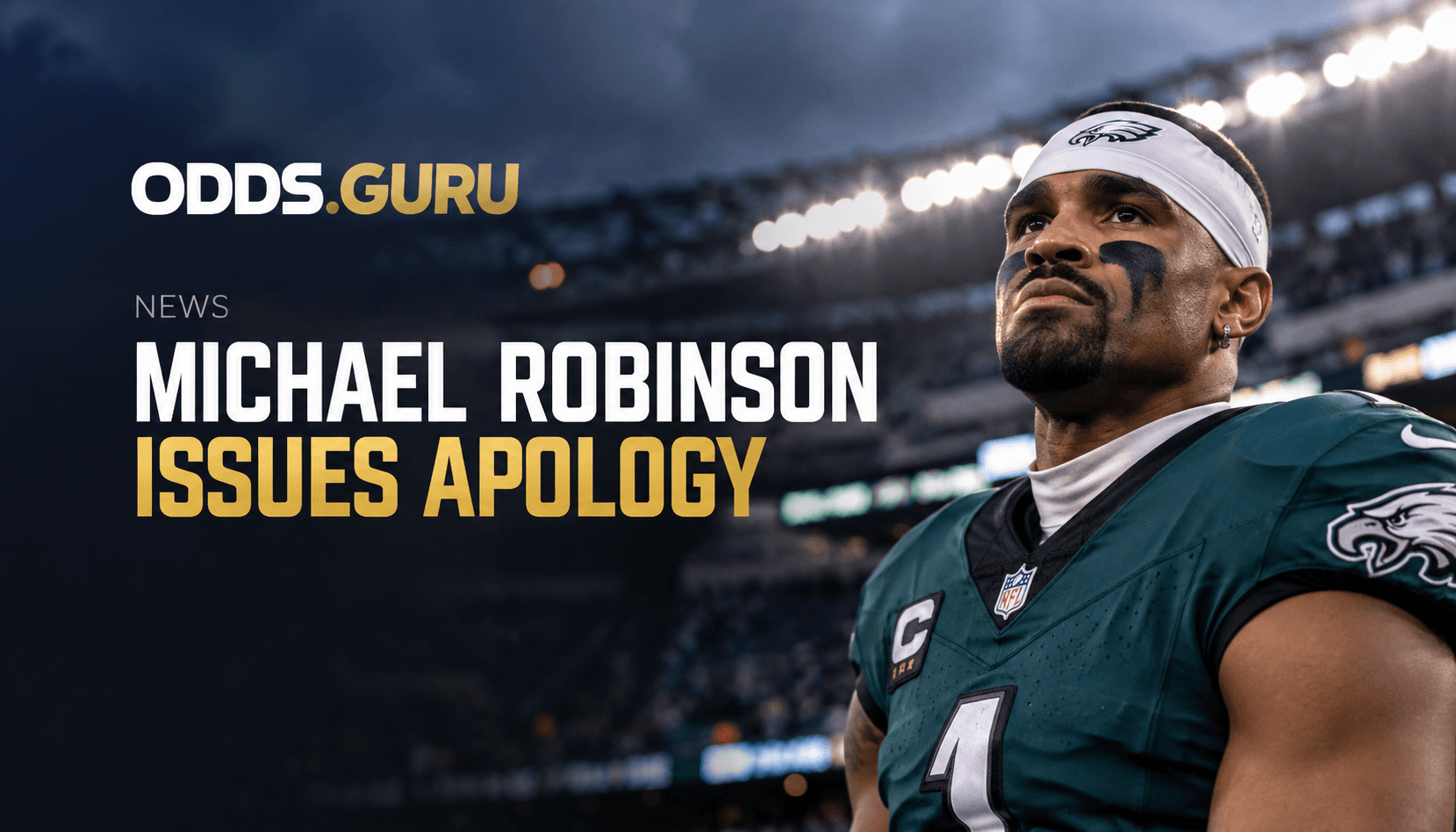
The Michael Robinson apology came on October 19, four days after the former NFL fullback suggested Jalen Hurts was distancing himself from Philadelphia’s struggling season. Robinson called his remarks “unfounded” as the Eagles and Hurts’ agent, Nicole Lynn, disclosed a diagnosis involving blood clots in the quarterback’s lungs.
Hurts is on injured reserve and is expected to miss the remainder of the 2026 season. His recovery is expected to take three months, although he has not officially been ruled out for the year. The Eagles and Lynn said his prognosis is very good and a full recovery is expected.
Michael Robinson apology withdraws doubts over Hurts’ commitment
“They were unfounded and I never should’ve speculated on a health issue of a player nor his commitment to his team,” Robinson said in his apology.
That admission addressed the central problem with his October 15 remarks: he had attached a personal motive to Hurts’ absence, suggesting the quarterback might be trying to avoid responsibility for Philadelphia’s difficulties.
Robinson had made the comments on “NFL Gameday Kickoff” after news of Hurts’ blood clot emerged. He first suggested the Eagles were “incentivized to go into the draft and maybe look for a quarterback,” then extended that argument to Hurts himself.
“To me, it looked like Jalen is kind of getting himself out of the fray so that this lost season … he’s pulling himself out so that this doesn’t look like it’s on me,” Robinson said during the broadcast.
His subsequent statement withdrew that interpretation. It did not merely acknowledge that the wording had caused offence; it described the comments themselves as unfounded.
“I want to sincerely apologize to Jalen Hurts, his family, the Philadelphia Eagles organization and fan base for my comments last Thursday,” Robinson wrote. The accompanying message was equally direct: “My comments were wrong. No excuse.”
Robinson’s experience gives his football commentary a particular authority. He played for San Francisco and Seattle, earned a 2011 Pro Bowl selection and won Super Bowl XLVIII with the Seahawks. He also played quarterback at Penn State before becoming an NFL fullback.
That background provides experience of dressing rooms, injuries and the pressure surrounding a struggling team. It does not establish why a particular player requires medical treatment. In this case, Robinson’s own apology acknowledged that his assessment had gone beyond football performance and into unsupported claims about a player’s health and intentions.
Blood thinners rule out contact football
The medical update released on Monday described a more serious condition than the initial diagnosis in London.
Hurts was first diagnosed with a left calf superficial vein thrombosis. Further testing and monitoring produced a diagnosis of deep vein thrombosis and bilateral pulmonary emboli: blood clots in both lungs.
The Eagles and Lynn said Hurts was clinically stable and had no significant functional limitations. His treatment is expected to involve anticoagulation, commonly described as blood thinners.
“During this time, he will not be allowed to participate in any contact activities, including football,” their statement said.
That restriction governs his availability. Remaining active around the team or continuing to condition does not mean he is cleared to take contact. The statement specifically anticipated both activities while he undergoes treatment.
Recovery expectations and a return date
The medical outlook was encouraging without setting a firm comeback date.
“Jalen’s prognosis is very good, and we expect a full recovery,” the statement said. It added that he was expected to have the opportunity to resume contact football once off blood thinners, with no long-term effects anticipated.
The expected three-month recovery makes a return during the current season doubtful. But “expected to miss the season” and “officially ruled out for the season” remain different descriptions of his status.
The distinction matters because his treatment, rather than Philadelphia’s results or draft position, determines whether he can return to contact activities. There is no confirmed date for that clearance.
It also explains why the prospect of Hurts remaining involved with the Eagles is consistent with a lengthy playing absence. He can contribute around the team while still being unavailable for the physical demands of an NFL game. The announced plan expressly allows for continued conditioning while contact football remains prohibited.
October 8–19: the diagnosis changed after London
The sequence began before Robinson’s broadcast and before Philadelphia placed Hurts on injured reserve.
Hurts reported calf issues on October 8, after being cleated during the Eagles’ October 4 loss to the Los Angeles Rams. He received treatment and appeared on the October 9 injury report as a full practice participant ahead of the trip to London.
The subsequent medical and playing-status updates followed this timeline:
- October 10: An evaluation in London revealed a superficial blood clot; medical staff and doctors determined Hurts could safely play against Jacksonville.
- October 14: A follow-up examination revealed movement in the small blood clot.
- October 15: Philadelphia ruled Hurts out of its Week 6 game against Carolina.
- October 17: The Eagles placed him on injured reserve.
- October 19: The Eagles and Lynn announced the diagnosis of deep vein thrombosis and bilateral pulmonary emboli.
The later findings do not, by themselves, establish that the earlier decision was negligent. Equally, the fact that Hurts received clearance to play in London does not diminish the seriousness of the condition subsequently disclosed.
Nick Sirianni was asked on Monday whether the Eagles could have handled Hurts’ status differently. He said he relied on the team’s medical experts and retained confidence in them.
“I’m not a medical expert,” Sirianni said. “I lean on our guys in all those situations. I’m a football coach.”
Those questions concern medical assessment and the decisions surrounding a player’s availability. Robinson’s remarks had introduced a different allegation: that Hurts might be using the situation to escape blame. His apology withdrew that speculation without resolving the separate questions surrounding the earlier medical timeline.
Philadelphia’s 2-4 start continues with Tanner McKee
The Eagles’ football problems remain substantial. They are 2-4, sit second in the NFC East and lost 25-14 to Carolina with Tanner McKee starting in Week 6.
McKee struggled to move the offense until late in the defeat. The result extended the difficulties surrounding Philadelphia’s attack while the team was adjusting to the loss of its starting quarterback.
Those struggles help explain the setting for Robinson’s comments. Injuries were already affecting the offense: offensive coordinator Sean Mannion had discussed operating without Saquon Barkley and DeVonta Smith before the Carolina game, while Smith subsequently discussed his return.
But a depleted lineup and a poor start do not establish that a medically enforced absence reflects a player’s commitment. Robinson’s suggestion connected Philadelphia’s competitive position to Hurts’ personal motives without a factual basis, as his apology acknowledged.
McKee’s preparation becomes the immediate football issue
McKee discussed stepping into the starting role on October 15, the day Hurts was ruled out against Carolina. Sirianni addressed his preparation the following day, then discussed changes to the game plan with McKee on October 19.
The Eagles therefore have an immediate task independent of the apology: preparing their offense around the quarterback available to play. The Carolina defeat provided the first result of that adjustment, but it did not settle how the offense will perform over the remainder of Hurts’ absence.
Sirianni also addressed the offensive struggles and his trust in Mannion on Monday. Those are football decisions that can be judged through Philadelphia’s preparation and performances.
Hurts’ next playing-status decision belongs to his recovery. For now, the announced plan is for him to undergo treatment, continue conditioning and remain around the team, with contact activities dependent on coming off blood thinners.